
Views: 0 Author: Site Editor Publish Time: 2025-06-23 Origin: Site
Pharmaceutical rigid PVC blister film is a thermoformable forming web widely used to create transparent cavities for tablets, capsules, vitamins, nutraceuticals, veterinary products, and other suitable solid-dose packaging applications. It provides a practical combination of optical clarity, forming performance, dimensional stability, mechanical protection, and cost efficiency.
For pharmaceutical manufacturers and blister packaging converters, material selection should not be based on transparency or thickness alone. Buyers should also evaluate thermoforming behavior, thickness uniformity, roll flatness, web tension, cavity geometry, moisture and oxygen barrier requirements, heat-seal compatibility, surface quality, regulatory documentation, and finished-package stability.
Wallis supplies customized transparent rigid PVC film in different thicknesses, widths, roll formats, colors, and surface configurations according to pharmaceutical blister machine requirements and customer specifications. Higher-barrier structures such as PVC/PVDC should be evaluated separately when the packaged product requires greater protection from moisture or oxygen.
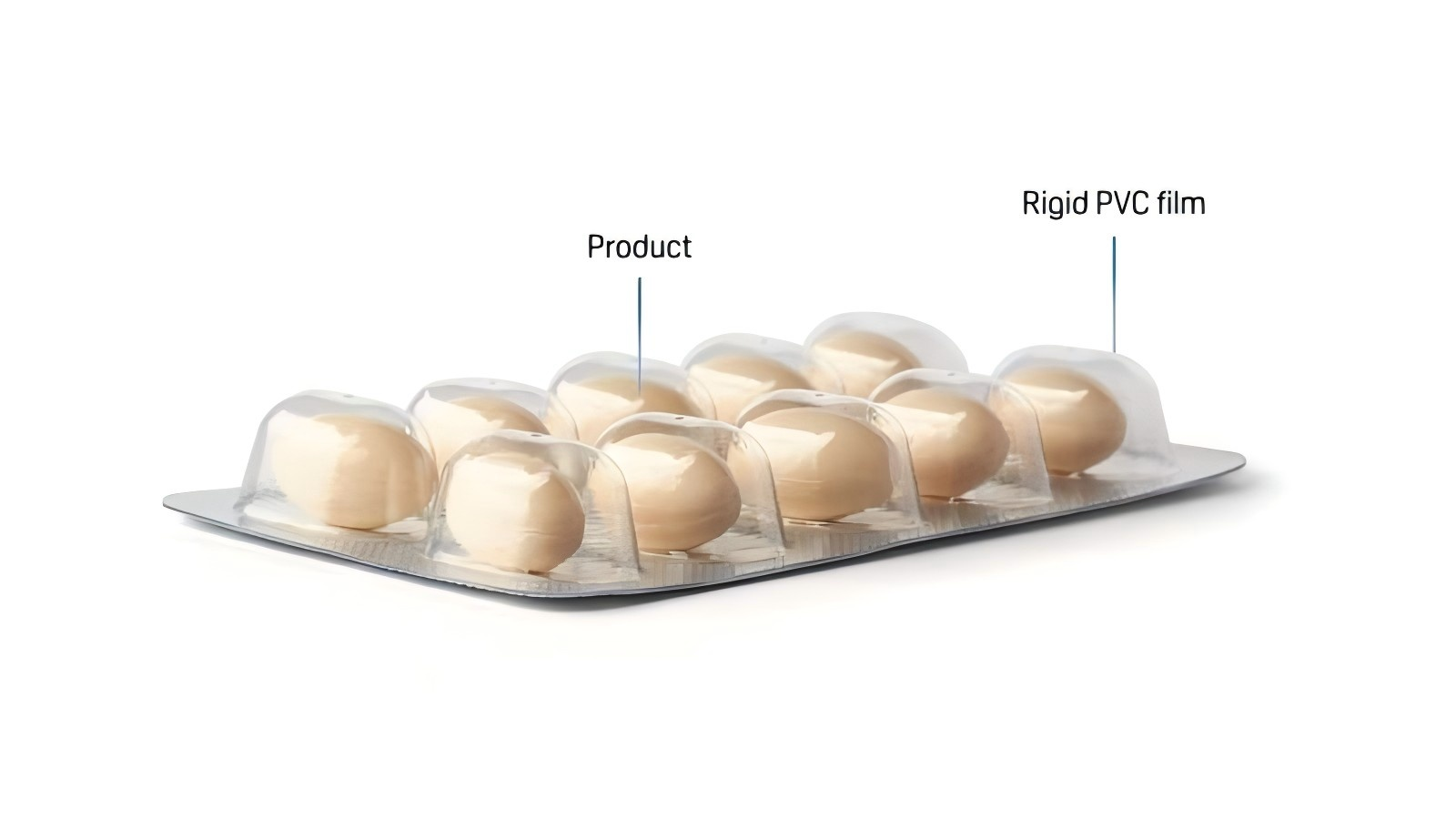
Rigid PVC, or polyvinyl chloride, is a thermoplastic material that can be formulated and calendared or extruded into clear rigid film suitable for thermoforming. In pharmaceutical blister packaging, the PVC film acts as the forming web that is heated and shaped into cavities before tablets or capsules are inserted.
After filling, the formed PVC web is sealed to a compatible lidding material, commonly aluminum foil with a heat-seal lacquer designed for the selected forming web. The finished blister is then cooled, perforated or cut, inspected, and packed according to the pharmaceutical manufacturer's process.
Plain rigid PVC is commonly selected when a formulation has moderate barrier requirements and the packaging project prioritizes transparency, reliable thermoforming, production efficiency, dimensional consistency, and competitive material cost.
The final suitability of any pharmaceutical packaging material should be confirmed through product stability studies and packaging qualification rather than material name alone.
Transparent PVC allows the packaged tablet or capsule to remain visible through the finished blister. This supports product identification, visual inspection, packaging-line quality checks, and consumer visibility.
Professional buyers should inspect clear film for haze, gels, black spots, scratches, contamination, flow marks, uneven surfaces, and other optical defects that can become highly visible in formed blisters.
The PVC forming web must soften uniformly within the intended forming temperature range so that cavities can be produced consistently without excessive thinning, web distortion, whitening, tearing, or incomplete forming.
Actual forming performance depends on film formulation, gauge, heating profile, mold design, cavity depth, forming pressure or vacuum, machine speed, and cooling conditions.
Stable gauge is critical for predictable heating and forming. Excessive thickness variation can create uneven cavity walls, inconsistent stiffness, variable sealing pressure, web tracking problems, or difficulties maintaining stable high-speed blister production.
A stable forming web should unwind smoothly and remain sufficiently flat during heating, forming, filling, sealing, perforating, and cutting. Excessive curl, waviness, or shrinkage can reduce line efficiency and registration accuracy.
Plain rigid PVC provides useful physical protection and moderate moisture-barrier performance for many conventional blister applications, but it should not automatically be classified as a high-barrier pharmaceutical film.
For moisture-sensitive, oxygen-sensitive, aroma-sensitive, or highly stability-sensitive formulations, pharmaceutical packaging engineers may need to evaluate higher-barrier structures such as PVC/PVDC, multilayer PVC/PE/PVDC, PCTFE-based laminates, other specialty barrier films, or cold-form aluminum.
Water Vapor Transmission Rate, or WVTR, is one of the important measurements used when comparing moisture-barrier packaging. The meaningful value depends on film thickness, structure, forming conditions, temperature, relative humidity, test method, and finished cavity geometry.
Oxygen Transmission Rate, or OTR, may also be important for formulations sensitive to oxidation. Plain PVC should not be assumed to provide the same oxygen protection as dedicated high-barrier coated or multilayer structures.
| Material Structure | Primary Advantage | Typical Selection Logic |
|---|---|---|
| Plain Rigid PVC | Clarity, thermoforming and cost efficiency | Products with relatively moderate barrier requirements |
| PVC/PVDC | Improved moisture and oxygen barrier while retaining transparency | More moisture- or oxygen-sensitive formulations |
| PVC/PE/PVDC | Multilayer barrier and processing flexibility | Applications requiring additional forming or barrier functionality |
| PCTFE-Based Laminate | Very high moisture barrier with transparent blister appearance | Highly moisture-sensitive products |
| Cold-Form Aluminum | Very high protection from moisture, gases and light | Highly sensitive formulations where transparency is not required |
The highest-barrier material is not automatically the best solution. Packaging engineers should select the lowest-complexity structure that still satisfies the validated stability requirement while balancing blister size, material cost, line speed, forming performance, secondary packaging, and supply-chain requirements.
The current Wallis product information provides the following customization range. Final specifications, tolerances, test methods, and grade suitability should be confirmed against the approved technical specification for each pharmaceutical packaging project.
| Parameter | Current Customization Reference |
|---|---|
| Thickness | Approximately 0.15 mm to 0.40 mm or customized by project |
| Width | Up to approximately 800 mm according to current page specification |
| Supply Form | Roll or converted sheet format according to machinery requirements |
| Color | Transparent standard grade; tinted or colored structures subject to confirmation |
| Surface / Functional Options | Anti-static or other project-specific surface treatments subject to qualification |
| Higher-Barrier Option | PVDC-coated structures can be evaluated as a separate high-barrier product grade |
Request Pharmaceutical PVC Film Samples
A conventional pharmaceutical blister usually combines a thermoformed PVC cavity with an aluminum lidding foil containing a heat-seal lacquer formulated for compatibility with the forming web.
The sealing temperature must be high enough to activate the lidding lacquer but remain within a process window that does not excessively distort the formed blister or damage the packaged product.
Seal quality depends on the interaction between temperature, pressure, dwell time, foil lacquer, forming-web surface, tooling, and line speed. These settings should be established through actual machine trials.
Finished blister integrity should be validated according to the pharmaceutical manufacturer's packaging specification. Plain PVC and aluminum foil do not automatically guarantee product sterility or shelf life; performance depends on the complete packaging system and packaged drug product.
The term pharmaceutical grade should be supported by documentation applicable to the exact material grade, production site, destination market, and intended pharmaceutical application. A generic statement such as “FDA certified” is not sufficient to establish suitability for every pharmaceutical packaging project.
The TDS should define relevant product characteristics such as material construction, thickness range, dimensional tolerance, appearance, surface requirements, mechanical properties, forming recommendations, storage requirements, and applicable test methods.
A COA should correspond to the actual grade or batch supplied and list the agreed release specifications. Buyers should verify that documentation refers to the purchased PVC product rather than a related but different PVDC or multilayer grade.
Pharmaceutical buyers may need documentation relating to the polymer formulation, additives, residual monomers, extractables, migration, or other safety characteristics depending on the intended market and drug application.
Customers should define the applicable pharmacopoeial, regulatory, restricted-substance, packaging-system, and destination-market requirements before supplier qualification. Compliance should be evaluated against the exact product and current documentation.
Rigid transparent PVC is commonly used to form individual cavities for tablets where product visibility and conventional thermoforming performance are required.
Capsule packaging often requires deeper blister cavities than small tablets, making forming consistency and wall-thickness distribution important during material selection.
Selected vitamins, supplements, and nutraceutical solid-dose products may use PVC blister structures according to product stability, destination-market requirements, and packaging design.
Veterinary tablets and capsules can also use rigid blister forming webs where the selected packaging system satisfies the specific product and regulatory requirements.
Rigid PVC may also be evaluated for selected diagnostic, healthcare, or non-sterile device blister applications. Medical-device projects requiring sterilization or sterile-barrier performance should separately verify sterilization compatibility, package integrity, and applicable regulatory requirements.
The correct PVC gauge depends on the cavity size, cavity depth, tablet or capsule dimensions, desired blister rigidity, forming method, machine speed, web width, and final package design.
Relatively shallow cavities may allow the use of thinner forming webs where sufficient rigidity and wall thickness remain after forming.
Deeper cavities create greater material draw and wall thinning. A thicker gauge or a more formable grade may be required depending on pocket geometry and production conditions.
The final thickness should be validated on the actual blister packaging machine using the production mold, heating profile, forming pressure, sealing foil, line speed, and cutting system.
Run sample material using the production blister mold. Inspect cavity depth, corner definition, wall thinning, whitening, web distortion, tearing, and overall pocket consistency.
Test unwinding, tension control, heating, forming, filling, sealing, coding, perforating, cutting, and web tracking at a representative production speed.
Use the intended lidding foil and production sealing conditions to determine an acceptable temperature, pressure, and dwell-time window.
Evaluate the completed blister system rather than the raw PVC film alone. Finished packaging qualification may include package integrity, dimensional stability, barrier performance, visual inspection, transport testing, and drug-product stability according to the customer's validation program.
Discuss Your Pharmaceutical Blister Project
Consistent raw materials and controlled formulation help maintain stable color, clarity, thermoforming behavior, mechanical performance, and batch-to-batch consistency.
Gauge should be measured across the web and along the roll according to the agreed test method and tolerance.
Transparent pharmaceutical PVC should be inspected for contamination, black spots, gels, scratches, bubbles, haze variation, surface marks, and other visible defects.
Rolls should be checked for telescoping, loose winding, edge damage, wrinkles, blocking, contamination, and other conditions that can interfere with high-speed blister machinery.
Where tensile, impact, shrinkage, forming, or other mechanical parameters are important, the buyer should define the test direction, conditioning, standard, method, and acceptance criteria.
Possible causes include insufficient film temperature, insufficient forming pressure or vacuum, excessive machine speed, unsuitable PVC formulation, or an overly demanding cavity geometry.
Deep cavities can draw material away from corners and sidewalls. Adjusting gauge, heating profile, cavity geometry, forming conditions, or PVC grade may improve thickness distribution.
Curl can be influenced by material stress, storage temperature, roll winding, heating conditions, web tension, or asymmetric processing.
Possible causes include incompatible lidding lacquer, contaminated surfaces, insufficient temperature, pressure or dwell time, uneven sealing plates, excessive line speed, or incorrect film and foil combination.
Supply format: rolls or converted sheets according to project requirements.
Width: customized according to blister layout and machine configuration within available production limits.
Core: selected according to roll dimensions and unwinding equipment.
Protection: protective film, moisture-resistant wrapping, cartons, pallets, or customized export packaging as required.
Labeling: product grade, dimensions, batch information and other agreed traceability details.
Samples: trial material can be discussed for machine and blister qualification.
End product: tablet, capsule, nutraceutical, veterinary product or other application.
Required plain PVC, PVC/PVDC or other blister structure.
PVC thickness and tolerance.
Roll width and maximum roll diameter.
Core size.
Transparent, tinted, colored or opaque requirement.
Blister packaging machine brand and model.
Forming method and approximate cavity depth.
Production line speed.
Aluminum lidding foil specification.
Required barrier or stability target.
Applicable pharmacopoeial or regulatory documentation.
Required TDS, COA or additional test documentation.
Sample quantity and annual purchase forecast.
Packaging, labeling and destination port requirements.
Request Pharmaceutical PVC Specification & Quote
Wallis supplies rigid PVC film and related pharmaceutical packaging materials for blister converters, pharmaceutical manufacturers, packaging distributors, healthcare suppliers, and OEM customers.
Thickness, width, roll length, core size, film color, surface requirements, and packaging can be discussed according to the customer's blister machine and production layout.
Plain PVC can be evaluated for conventional blister applications, while PVDC-coated or other higher-barrier structures can be discussed when product stability requires additional protection.
For new projects or supplier replacement, sample testing allows customers to evaluate forming behavior, machine compatibility, cavity quality, sealing, roll running performance, and finished blister appearance before commercial approval.
Export packaging, palletization, roll labeling, order documentation, shipment coordination, and project-specific logistics requirements can be discussed for international pharmaceutical packaging customers.
| Buyer Requirement | Wallis Project Support |
|---|---|
| Material Selection | Plain rigid PVC and related higher-barrier structures according to application |
| Dimension Customization | Customized thickness, width, roll dimensions and converted formats |
| Color and Appearance | Transparent and project-specific tinted or colored structures subject to approval |
| Machine Qualification | Sample material for thermoforming and sealing trials |
| Documentation | Project-specific TDS, COA and available technical documentation for qualification |
| International Supply | Customized export packing, labeling and logistics support |
Pharmaceutical rigid PVC is a thermoformable plastic forming web used to create blister cavities for suitable tablets, capsules, nutraceuticals, veterinary products, and other solid-dose packaging applications.
The correct thickness depends on cavity dimensions, forming depth, required rigidity, machine design, line speed, and package specification. The current Wallis page references approximately 0.15–0.40 mm for this product range, with final dimensions subject to project confirmation.
No. Plain rigid PVC is generally used where clarity, thermoformability, and cost efficiency are more important and the product has moderate barrier requirements. Moisture- or oxygen-sensitive formulations may require PVC/PVDC, PCTFE-based films, multilayer structures, cold-form foil, or another high-barrier solution.
PVC is the thermoformable base film. PVC/PVDC adds a PVDC barrier coating to improve moisture and oxygen protection while maintaining a transparent blister structure. Barrier performance depends on coating weight, structure, forming conditions, and test method.
Yes, suitable PVC grades can be thermoformed into different cavity geometries, but deeper pockets create greater material draw and wall thinning. The correct thickness, formulation, heating profile and forming conditions should be validated using the actual mold.
Standard clear PVC provides product visibility rather than strong light protection. Tinted, opaque or UV-absorbing structures may be evaluated where light protection is required, but actual wavelength-specific transmission and finished-package stability should be validated.
The aluminum lidding foil normally contains a heat-seal lacquer compatible with the forming web. Heat, pressure and dwell time activate the sealing system and create the finished blister seal.
No generic PVC product should automatically be described as “FDA certified.” Pharmaceutical packaging suitability depends on the exact material composition, available supplier documentation, intended drug product, packaging system, destination market, safety assessment, compatibility, quality control, and stability requirements.
Depending on the project, buyers may request a technical data sheet, certificate of analysis, composition or regulatory declarations, restricted-substance information, relevant pharmacopoeial information, migration or extractables data, and other documentation required by their internal qualification procedure.
Thermoforming and sealing performance depend on the machine, mold, heating profile, forming pressure, web tension, line speed, lidding foil, sealing conditions, and finished cavity geometry. Production-line validation provides more useful information than raw material data alone.
Yes. Thickness, width, roll dimensions, core size, color, surface requirements and packaging can be discussed according to manufacturing capability and the customer's blister packaging equipment.
Provide the pharmaceutical application, film structure, thickness, width, roll size, machine model, cavity dimensions, forming conditions, lidding foil, barrier requirement, applicable documentation requirements, sample quantity, annual volume and destination market.
Pharmaceutical transparent rigid PVC film remains a practical forming material for conventional tablet and capsule blister packaging where clarity, reliable thermoforming, dimensional stability and cost efficiency are important.
For professional pharmaceutical packaging, however, plain PVC should be selected based on the actual drug-product stability requirement rather than assuming it provides high moisture or oxygen barrier performance. More sensitive formulations may require PVC/PVDC, PCTFE-based or other advanced barrier structures.
By evaluating thickness, forming performance, barrier requirements, lidding compatibility, seal integrity, regulatory documentation, machine performance and finished-package stability before commercial approval, pharmaceutical manufacturers and blister converters can reduce packaging risk and build a more reliable supply chain.


