
Views: 0 Author: Site Editor Publish Time: 2025-06-16 Origin: Site


Holographic PVC rainbow overlay film is a thin transparent or semi-transparent card-lamination material that combines printed-image protection with an angle-dependent optical effect. When incorporated into a properly designed card structure, the overlay can help protect printed information from normal handling while adding a visible rainbow, diffractive, logo, geometric, or customized holographic feature.
These films are used in ID cards, access cards, membership cards, bank-related cards, hotel key cards, student cards, transport cards, VIP cards, loyalty cards, gift cards, RFID cards, NFC cards, and other laminated plastic cards where manufacturers require a combination of visual differentiation, surface protection, and optional authentication features.
For professional card manufacturers, however, holographic overlay should not be selected only by visual appearance. The correct film must also match the card substrate, overlay thickness, coating type, holographic pattern, pattern registration, printing process, lamination temperature, pressure, finished-card thickness, RFID structure, and expected service life.
Request Holographic Overlay Samples
A holographic PVC card overlay is normally a thin transparent PVC layer positioned over a printed card core during heat lamination. The film contains a diffractive or holographic pattern that changes appearance as the card is tilted or viewed under different lighting conditions.
Unlike a printed rainbow graphic, a genuine holographic or diffractive structure interacts physically with incident light. This creates changing colors, movement, depth, switching images, line effects, or other optical behavior that cannot be reproduced accurately using ordinary CMYK printing alone.
Because the film remains transparent or semi-transparent, the underlying card artwork, photographs, names, serial numbers, QR codes, barcodes, and other printed information can remain visible through the overlay when the optical pattern density is correctly selected.
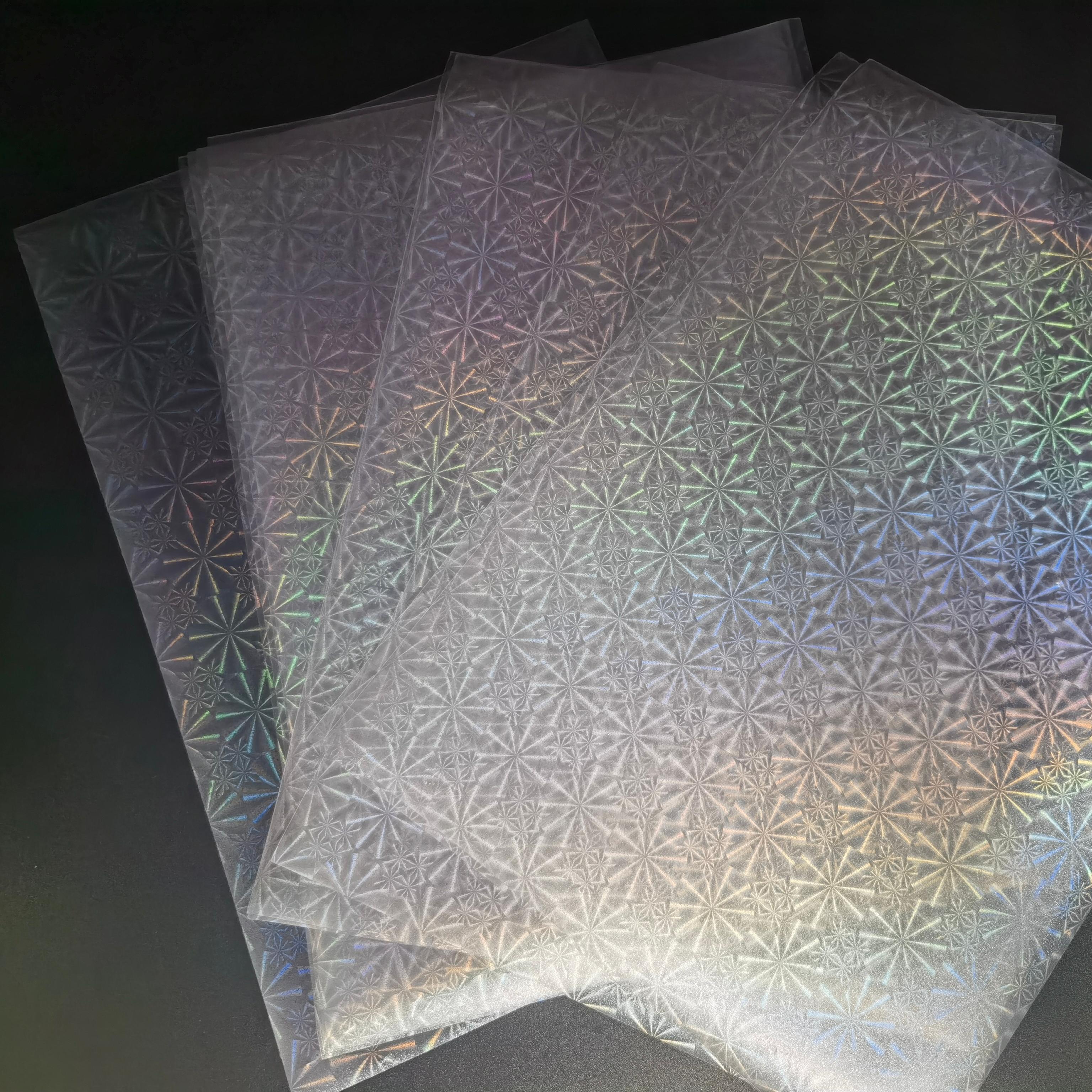

Buyers often use the terms overlay, laminate, holographic film, overlaminate, and hot-stamping foil interchangeably. In professional card manufacturing, these products can have very different structures and processing requirements.
| Product Type | Typical Structure | Application Method | Main Function |
|---|---|---|---|
| Holographic PVC Sheet Overlay | Thin transparent PVC sheet with holographic or rainbow optical pattern | Placed in card stack and laminated with heat and pressure | Card surface formation, print protection and decorative or verification effect |
| Printer Overlaminate | Thin clear or holographic roll-format laminate for compatible card printers | Applied after personalization using a card-printer lamination module | Protects printed/personalized data and can add visible security features |
| Self-Adhesive Holographic Overlay | Transparent PET or similar film with pressure-sensitive adhesive | Manual or automatic peel-and-stick application | Retrofit surface protection and visual authentication |
| Hot-Stamping Holographic Foil | Carrier film, release layer, holographic layer and heat-activated transfer system | Transferred locally using heated dies, rollers or stamping equipment | Localized logo, patch, stripe or decorative/security hologram |
| Holographic PVC Core Sheet | Thicker decorative or printable sheet used inside the card body | Printed and laminated as a structural card layer | Card-body decoration rather than transparent outer protection |
These formats are not interchangeable. A card factory purchasing sheet-form PVC overlay should not use specifications intended for a printer ribbon or pressure-sensitive holographic sticker, and a hot-stamping foil should not be treated as a laminated PVC card layer.
Holographic films contain very fine structures that diffract incoming light into different wavelengths and directions. As the viewing angle changes, different portions of the visible spectrum are reflected toward the observer, creating the familiar rainbow appearance.
More advanced holographic designs can create apparent movement when the card is tilted. Circles, lines, logos, waves, or geometric elements can appear to move inward, outward, rotate, switch, or change brightness.
A switch effect allows two or more images to appear at different viewing angles. For example, an institutional logo may appear from one angle and a word such as AUTHENTIC or VALID from another.
Depending on the mastering and production process, high-detail holographic structures can include fine lines, microtext-like features, guilloche-style patterns, latent images, or other controlled optical elements intended to make visual verification more difficult to imitate with conventional printing.
Transparent rainbow overlay provides a general iridescent or diffractive effect across the card while allowing printed artwork to remain visible underneath. It is suitable for membership cards, gift cards, VIP cards, access cards, hotel key cards, promotional cards, and other applications where visual appearance is a major consideration.
Stock patterns may include stars, dots, waves, geometric structures, grids, circles, globes, security-style wording, or repeating decorative motifs. These are economical for large-volume commercial card programs because no customized hologram master needs to be developed.
A widely available stock pattern should primarily be treated as a decorative and visual differentiation feature rather than a complete high-security anti-counterfeit solution.
Custom overlays can incorporate a company logo, government emblem, institution name, brand symbol, project name, text, or proprietary optical design. A controlled custom design is generally more useful for visual authentication than a widely available generic holographic pattern.
Development normally requires approved vector artwork and holographic origination or master development. Feature size, repeat pattern, viewing direction, registration accuracy, card orientation, and ownership of the artwork should be confirmed before manufacturing.
A registered overlay places holographic elements in defined positions relative to the card artwork. This is important when the holographic feature must avoid a portrait, chip, signature panel, QR code, barcode, transparent window, or other functional area.
Registered designs require tighter control of sheet registration, card pitch, X/Y tolerance, pattern repeat, printing alignment, lamination alignment, and punching position.
Higher-security applications can use custom optical structures incorporating fine-line effects, microtext concepts, kinetic elements, switching graphics, hidden features, proprietary symbols, or multiple optical effects within one design.
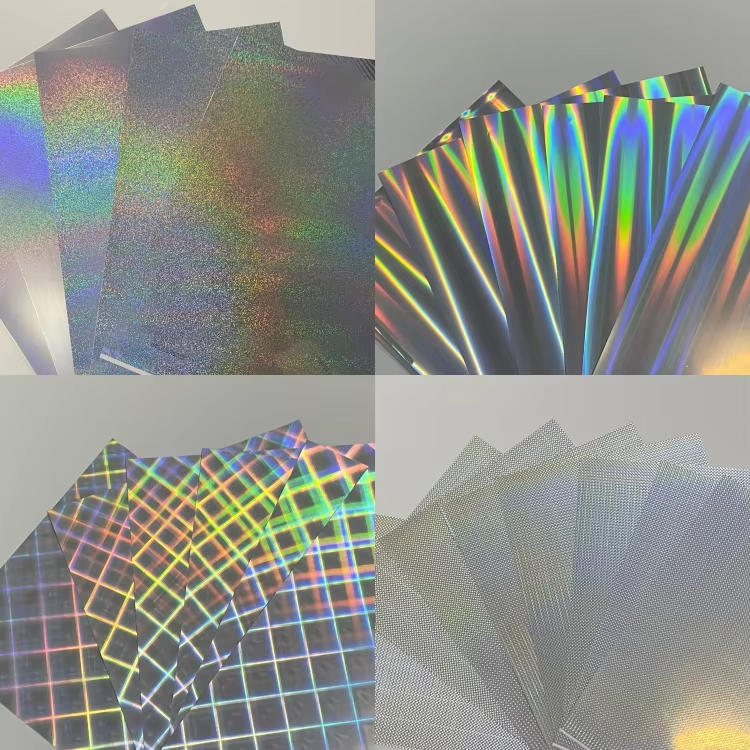
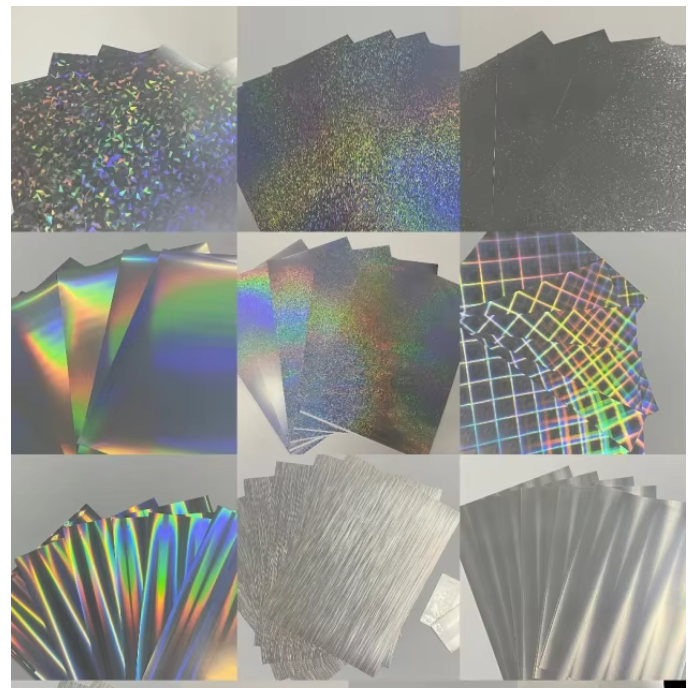
Holographic PVC overlay is normally only one layer within a multilayer card structure. The exact construction depends on card type, printing system, smart-card components, required thickness, and final service environment.
| Layer | Typical Function | Critical Check |
|---|---|---|
| Front Holographic Overlay | Optical effect, surface protection and finished-card appearance | Pattern direction, transparency, coating side and registration |
| Printed Front Core | Logo, artwork, portrait background, text and other printed content | Ink cure, total ink coverage and bonding compatibility |
| Internal Core / RFID Inlay | Builds thickness or provides chip and antenna functionality | Thickness balance, antenna position and lamination protection |
| Printed Rear Core | Rear artwork, instructions, serial information or branding | Registration and ink compatibility |
| Rear Overlay | Protects rear printing and balances the card structure | Thickness, coating and layer symmetry |
Overlay thickness must be calculated as part of the complete finished-card stack. Common card-overlay thicknesses can vary by product and application, and buyers should confirm the actual available range rather than assuming one universal specification.
For professional sheet-form PVC overlay, thicknesses around 0.04–0.10 mm are commonly discussed, although the exact range depends on the product grade and customized requirements.
Sheet dimensions should match the printing layout, card pitch, lamination plate, registration marks, punching tool, and production equipment. Customized sizes may be required for industrial card factories using proprietary layouts.
A holographic effect that is too dense can reduce the visibility of photographs, small text, QR codes, barcodes, signatures, or fine graphics underneath the overlay. Sample evaluation should therefore include the actual printed card design rather than viewing the holographic sheet by itself.
PVC overlay may be supplied with different coating or bonding characteristics. The selected grade should match the printed core, ink system, lamination conditions, card substrate, and required peel strength.
Directional patterns should have clearly defined machine direction, top/bottom orientation, card orientation, repeat distance, and registration reference. Rotating sheets during production can make cards from the same order appear visually inconsistent.
Not every holographic film provides the same security value. B2B buyers should separate decorative rainbow effects from controlled security holograms.
| Security Level | Typical Feature | Typical Application |
|---|---|---|
| Decorative | Stock rainbow, stars, dots, waves, light-beam or geometric effects | Gift, membership, VIP, promotional and entertainment cards |
| Visual Verification | Custom logo, institution name, proprietary pattern or registered graphic | Access cards, employee IDs, campus cards and controlled membership programs |
| Higher Security | Custom hologram combined with fine-line, micro-optical, kinetic or controlled authentication features | Government, financial, transportation and other controlled-issue credentials |
| Layered Security System | Hologram plus UV, microtext, chip, serialization, secure personalization or backend verification | High-value identity and authentication programs |
A holographic overlay can make casual copying more difficult and give inspectors a visible authenticity indicator, but it should not be treated as the only security layer for a high-risk identity credential.
Very small text can be incorporated into the card artwork or specialized holographic design. At normal viewing distance it may resemble a fine line, while magnification reveals readable characters.
Fine interlaced line structures can provide another visual copy-resistant layer and may be integrated into printing, holographic design, or both.
UV-visible text, logos, or graphics provide a covert or semi-covert inspection feature that becomes visible under ultraviolet illumination.
Card numbers, unique identifiers, serialized laminate references, QR codes, or database-linked verification can help connect a physical credential to controlled issuance records.
Electronic credential security depends on chip functionality, cryptographic design, encoding, key management, reader infrastructure, and backend systems. It can complement visible holographic authentication but should be engineered independently.
Angle-dependent optical changes give staff and users a quick visible feature that can help distinguish an approved card design from a basic printed imitation.
When the overlay forms the outer card layer, it can protect underlying printing from direct rubbing, fingerprints, routine handling, and other everyday surface contact.
Rainbow and kinetic effects can increase the perceived value of membership, gift, VIP, entertainment, hospitality, or brand cards without covering the complete printed design.
Logos, institution names, branded symbols, and proprietary visual elements can be incorporated into the holographic pattern to strengthen brand recognition and provide a more distinctive card appearance.
Properly selected sheet-form holographic PVC overlay can be incorporated into the same multilayer lamination workflow used for conventional PVC card manufacturing.
Calculate the front overlay, printed layers, core, RFID inlay if applicable, rear printed layer, and rear overlay so that the finished card reaches the required total thickness.
Some card overlays have a designated bonding or coated side. Incorrect orientation can result in weak adhesion, poor surface appearance, or complete delamination.
Mark top, bottom, machine direction, and pattern direction before sheet stacking. This is particularly important for custom logos, directional holograms, and registered security features.
Printed ink should be fully dried or cured before lamination. Residual solvent, uncured UV ink, excessive ink coverage, or surface contamination can reduce interlayer adhesion.
Use registration holes, printed marks, pins, jigs, or other production controls to maintain alignment between the holographic feature, printed card artwork, chip, antenna, and punching position.
Temperature, pressure, heating time, plate finish, cooling time, and stack structure should be optimized for the actual PVC overlay and card core combination. A universal lamination recipe should not be applied to every film grade.
Controlled cooling helps stabilize card flatness, thickness, layer bonding, and surface quality before the laminated sheet is removed for punching.
Finished cards should be checked for hologram position, surface quality, bubbles, scratches, bonding, flatness, thickness, image visibility, chip function, RFID performance, and punching registration where applicable.
A dense holographic pattern placed directly over a photograph can reduce facial detail or visual clarity. Identity cards should therefore test hologram density and feature placement over real personalized portraits.
Strong reflective patterns placed over machine-readable codes can reduce scanning reliability under some lighting conditions. Registered overlays can reserve a clear or low-density area around critical QR and barcode zones.
Fine printed information should remain legible under the overlay from normal viewing angles. Dense rainbow structures should be tested against low-contrast text before approval.
Holographic effects can look dramatically different over white, dark, metallic, or strongly colored artwork. The final appearance should therefore be evaluated using the real card design rather than a plain white test card.
Transparent PVC overlay itself is generally only one component of an RFID or NFC card, but the exact holographic construction should still be checked when used close to an antenna.
If the holographic effect uses metallic or electrically conductive layers, the material can potentially influence antenna tuning or communication performance depending on coverage, location, frequency, and card construction.
For contactless card projects, manufacturers should test the complete laminated card with the intended chip, antenna, reader, holographic film, printing, and finished-card thickness before bulk production.
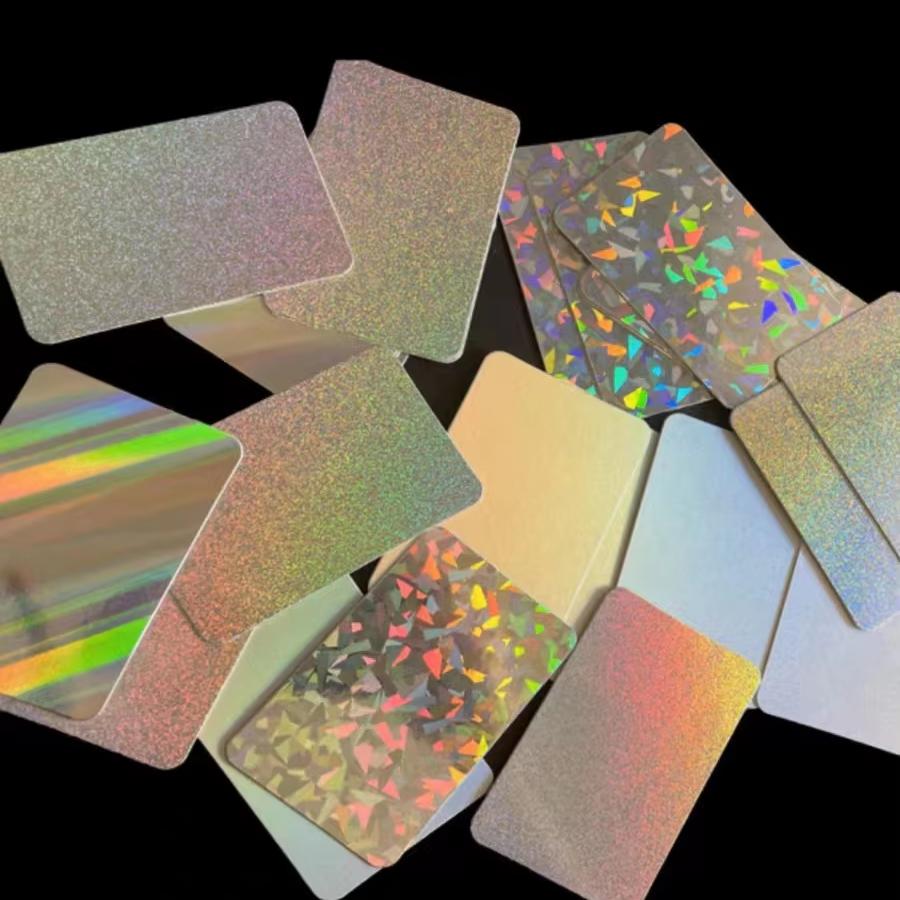
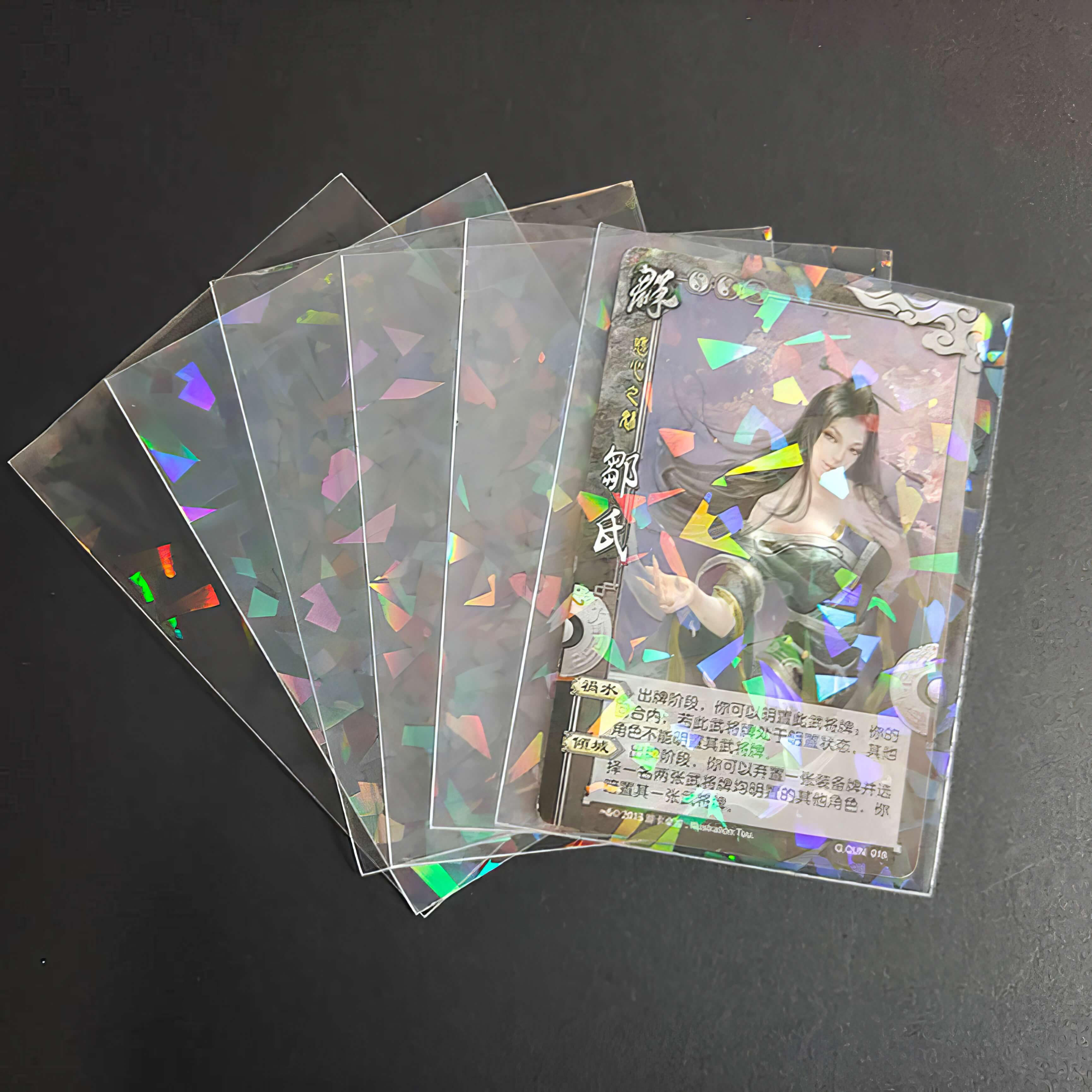
Controlled holographic overlays can provide visible authentication and surface protection for identity credentials. High-security projects typically combine the hologram with additional physical, personalized, and electronic security features.
Corporate access cards can use branded holographic elements to make approved credentials easier for security personnel to recognize visually.
Holographic elements may be incorporated into financial card designs as visual brand or security features, subject to the card program's technical, security, and network requirements.
Rainbow and custom holographic finishes can increase the premium appearance of membership, loyalty, luxury retail, hospitality, and brand cards.
Campus credentials can combine visual holographic authentication with photographs, barcodes, QR codes, magnetic stripes, contactless chips, or other campus-service functionality.
Hotels and resorts can use holographic films to create distinctive branded key cards and VIP credentials while retaining compatibility with suitable RFID or magnetic stripe systems.
Decorative rainbow films are especially effective for limited-edition cards, entertainment cards, gift cards, premium promotional pieces, and products where visual impact is more important than high-security authentication.
Overlay thickness should remain within the approved specification so that the complete card stack reaches the required finished thickness consistently.
Production lots should be checked for pattern continuity, brightness, visual consistency, direction, repeat distance, and obvious defects such as missing or distorted holographic areas.
Registered holographic features should be measured against the approved X/Y tolerances and final card punching position.
Sample cards should be inspected for bonding, bubbles, whitening, delamination, layer separation, surface distortion, and hologram degradation after lamination.
Where long card life is required, test the finished card against representative handling, abrasion, wallet use, chemical exposure, moisture, and environmental conditions rather than assuming all overlay grades provide the same durability.
Decide whether the hologram is primarily decorative, intended for visual authentication, used to protect personalization, or part of a wider security architecture.
PVC, composite PVC, PETG, PC, ABS, and other card structures can have different heat, bonding, and dimensional characteristics. The overlay should be validated with the actual substrate.
Stock patterns reduce origination cost and lead time. Custom logo or registered holograms provide stronger brand differentiation and can support more controlled visual authentication.
Decide whether portraits, QR codes, signatures, chips, barcodes, magnetic stripes, or contactless antenna zones need reduced hologram density or completely clear areas.
Use the supplier's starting recommendations and then validate them on the actual press, card stack, ink system, and lamination plates.
The approved sample should represent the final card as closely as possible, including printing, holographic overlay, inlay, thickness, punching, personalization, and any required electronic or mechanical tests.
Card application: ID, bank-related, access, membership, hotel, transport, gift or promotional card.
Required material: sheet-form PVC overlay, printer overlaminate, self-adhesive overlay or hot-stamping foil.
Card substrate: PVC, composite PVC, PETG, PC, ABS or other material.
Required overlay thickness.
Sheet dimensions and card layout.
Transparent, rainbow, silver, gold or other optical appearance.
Stock hologram or customized logo design.
Repeating pattern or registered hologram.
Required pattern direction and repeat distance.
Clear zones for QR code, portrait, chip, barcode or signature.
Printing process and ink type used on the core sheet.
Lamination temperature, pressure, cycle and plate type.
RFID or NFC chip and antenna requirement.
Finished card thickness.
Required durability, abrasion or environmental testing.
Sample quantity and expected production volume.
OEM packaging, labeling and batch-documentation requirements.
Discuss Your Holographic Card Project
Holographic overlay performance cannot be evaluated accurately from a digital photograph alone. Lighting, background color, ink coverage, card thickness, lamination pressure, surface finish, and viewing angle all influence the final visual result.
A representative sample should therefore be laminated using the intended card stack and inspected under multiple lighting conditions before approving a production order.
Verify the holographic pattern and color-shift effect.
Check portrait, text, QR and barcode readability.
Confirm pattern orientation and registration.
Test lamination bonding and card flatness.
Measure finished-card thickness.
Inspect for bubbles, scratches, haze or pattern distortion.
Test RFID or NFC performance if applicable.
Approve a golden sample for bulk-production reference.
Holographic PVC rainbow overlay film can provide three important benefits in card manufacturing: protection of printed information, distinctive visual appearance, and an additional visible authentication feature when the holographic design is properly controlled.
Standard rainbow patterns are well suited to decorative and premium commercial cards, while customized logo, registered, kinetic, or higher-detail holographic designs can support more controlled credential programs.
For higher-security applications, however, holographic overlay should be combined with additional physical, personalized, electronic, or database-linked verification measures rather than being treated as a standalone anti-counterfeit system.
The most reliable B2B sourcing process is to define the card structure, choose the required holographic effect, confirm thickness and registration, validate lamination conditions, test the finished card, and approve a physical sample before mass production.
Request Custom Holographic Overlay Pricing
Holographic PVC card overlay is a thin transparent PVC layer containing a diffractive optical pattern. It is normally laminated over a printed card core to form part of the finished card surface while adding a rainbow or customized holographic effect.
No. Holographic overlay is normally a thin transparent outer card layer. Holographic PVC core sheet is a thicker structural or printable layer used inside the card body. Their thickness, printing role, optical behavior, and lamination function are different.
Not necessarily. Sheet-form PVC overlay is incorporated into the card body during industrial lamination. Printer overlaminate is usually supplied in roll format and applied to an already personalized card by a compatible card-printer lamination module.
Holographic overlay is a complete film layer incorporated into the card structure. Hot-stamping foil transfers only selected optical or metallic layers from a carrier film onto a defined part of the card using heat and pressure.
No. A holographic overlay can make visual reproduction more difficult and provide a useful authentication feature, but a high-security credential should use multiple complementary security measures rather than relying on a hologram alone.
A controlled custom hologram containing proprietary logos, text, symbols, or optical features generally provides stronger visual authentication than a generic pattern that is available to many buyers. Actual security still depends on artwork control, issuance, verification procedures, and other credential features.
Sheet-form PVC card overlay can be supplied in different thicknesses depending on the product and card structure. Around 0.04–0.10 mm is a common range for some professional card-overlay applications, but buyers should confirm the exact available specification before ordering.
Yes. Custom holographic designs can incorporate logos, institution names, text, symbols, geometric patterns, kinetic effects, or project-specific visual elements. Custom origination normally requires approved artwork and technical review.
A registered holographic overlay positions specific holographic features at controlled coordinates on the finished card. It is useful when a hologram must align with a portrait, logo, card border, window, chip, or other defined area.
It can physically cover the printed code, but dense reflective holographic effects may interfere with scanning under some conditions. For machine-readable areas, a lower-density or clear holographic zone is often preferable.
Yes, provided the complete card structure is technically compatible. If the holographic construction contains metallic or conductive layers, finished-card RF performance should be tested with the actual chip, antenna, reader, and overlay.
When the overlay forms the outer card surface, it can protect the underlying printing from routine rubbing and handling. Actual durability depends on film thickness, bonding, card construction, surface treatment, usage conditions, and environmental exposure.
No plastic overlay should automatically be described as scratch-proof. Different film grades provide different levels of abrasion resistance, and the finished card should be tested according to the expected service environment.
Compatibility depends on the exact overlay construction and bonding system. PVC, PETG, PC, composite PVC, and other substrates have different heat and adhesion behavior, so interlayer bonding and finished-card performance should be tested before production.
Provide the card application, overlay type, substrate material, thickness, sheet size, card layout, stock or custom hologram requirement, logo artwork, registration requirement, clear zones, lamination process, RFID requirement, sample quantity, and expected order volume.
Yes. Sample testing should confirm optical appearance, artwork visibility, pattern registration, lamination, bonding, thickness, flatness, punching, abrasion performance, QR or barcode readability, and RFID functionality where applicable.


