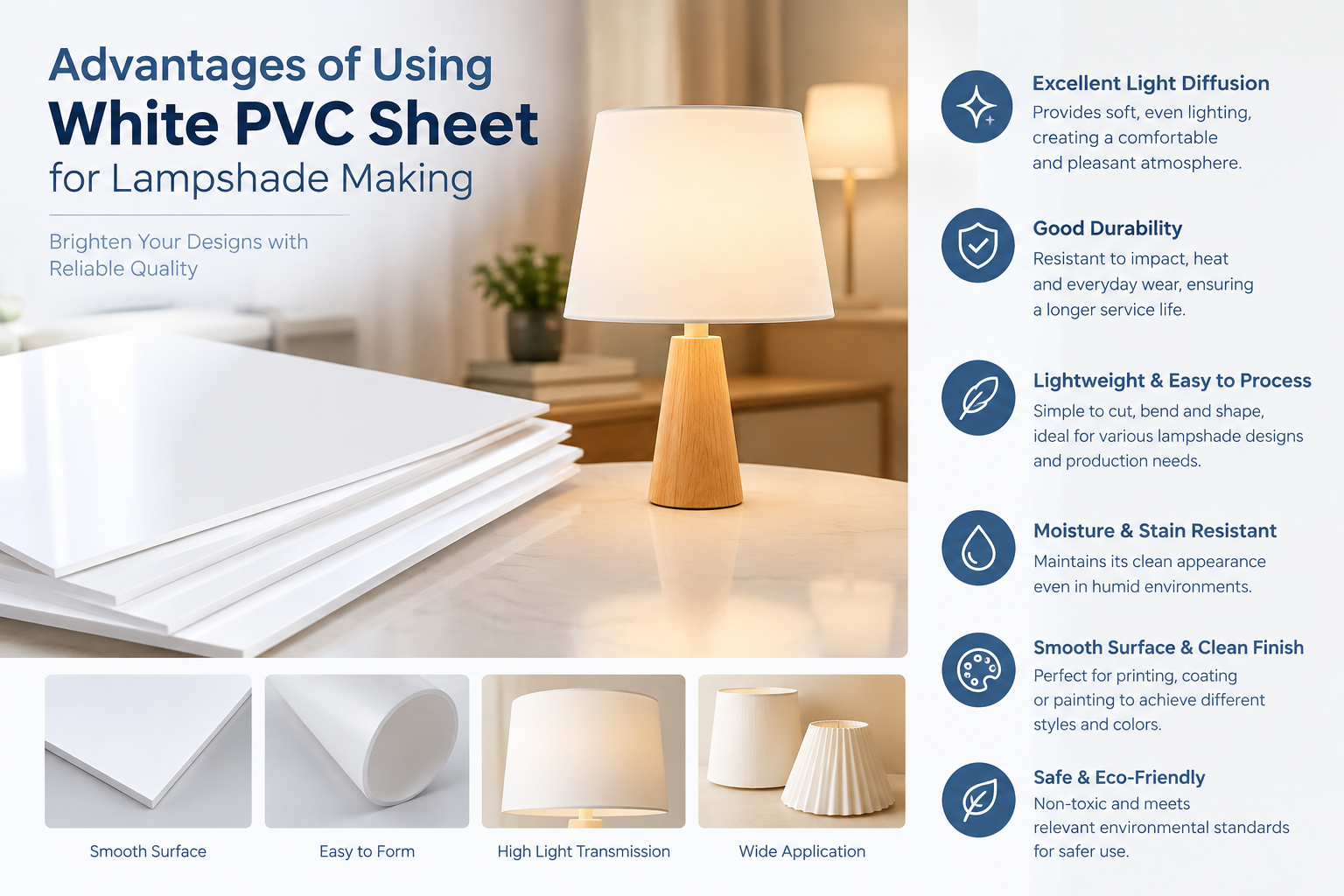
White PVC Lampshade Sheet for Custom Lighting Manufacturing
Wallis supplies white PVC lampshade sheets for lighting manufacturers, lampshade converters, decorative shade makers and OEM material distributors. The sheet can be specified by thickness, sheet or roll size, white tone, surface finish, opacity and forming requirements, with final availability confirmed against the selected material grade.
Choosing lampshade material is not simply a matter of selecting a white plastic sheet. Buyers need to balance the desired illuminated appearance, glare control, stiffness, bending behavior, fabrication method and the operating temperature of the completed luminaire. White opaque PVC and white translucent PVC are not interchangeable: one primarily conceals the light source, while the other may transmit and scatter light.
For a practical material recommendation, share the lampshade design, covering fabric if used, light-source type, bulb clearance, expected assembly temperature and target-market compliance requirements. Wallis can discuss sample evaluation and customized bulk orders without assuming that every available PVC grade meets every lighting application.
Request White PVC Lampshade Sheet Samples
White PVC Lampshade Sheet Specifications
The following specification categories describe the white PVC lampshade sheet offering. Thickness, dimensions, optical performance and surface finish are selected and confirmed for each project; they should not be read as universal fixed values for every grade.
| Parameter | Specification |
| Product Name | White PVC Sheet for Lampshade Manufacturing |
| Brand | WALLIS |
| Material | Polyvinyl Chloride (PVC) |
| Color | White; confirm available white shades |
| Thickness | Customized according to product requirements |
| Sheet Size | Customized; confirm available dimensions |
| Surface Finish | To be confirmed: matte, glossy, or other available finishes |
| Opacity | To be confirmed according to the selected grade |
| Light Transmission | Available performance to be confirmed |
| Supply Format | Sheet or roll, subject to production capability |
| Processing Options | Cutting and other processing options subject to confirmation |
| Application | Lampshade manufacturing and related lighting components |
| Customization | Thickness, dimensions, color, and selected material properties |
| Packaging | To be confirmed according to order requirements |
| Minimum Order Quantity | Confirm with the Wallis sales team |
| Sample Availability | Subject to sample specifications and availability |
White PVC Lampshade Sheet: Opaque, Translucent or Diffusing?
The intended lighting effect determines which white PVC grade to evaluate. Opacity controls how much of the source is concealed; light transmittance controls how much light passes through; and diffusion controls how evenly that transmitted light is spread. A matte appearance alone does not prove a specific light-diffusion percentage.
| White PVC appearance | Typical lighting effect | Best-fit consideration |
| High-opacity white | Blocks more direct light and provides a neat white inner surface | Useful when source concealment or reflected light is more important than transmitted illumination |
| Milky or translucent white | Allows some light through while softening visible source detail | Consider for drum shades, pendant shades and decorative illuminated panels |
| Matte or frosted white | May reduce surface glare and change the apparent spread of light | Request illuminated samples; finish does not replace measured optical data |
| White satin backing | Can form the structural inner layer beneath decorative fabric or paper | Check rigidity, adhesive compatibility and shade assembly, if lamination is required |
For projects requiring measurable optical performance, buyers may specify luminous transmittance, haze or an agreed diffusion test where the selected material and test method are applicable. Tests should be made on the final color, finish and thickness, ideally with the intended LED module or lamp.

White PVC Lampshade Sheet Surface

PVC Sheet Appearance and Format
Advantages of White PVC Sheet for Lampshade Production
Sheet Formability and Consistent Fabrication
A suitably chosen rigid or semi-rigid PVC grade can be cut into repeatable patterns and used in selected curved or formed shade structures. Production yield depends on the sheet stiffness, thickness tolerance, cutting quality and whether the selected grade can retain the required shape.
Lightweight Sheet Construction
PVC sheet may provide a lightweight backing or decorative component compared with certain heavier shade constructions. Weight should be calculated from the actual thickness, cut size and sheet density rather than relying on a generic claim that every design will be lighter.
Choice of White Tones and Surface Finishes
White, off-white and other available shades may produce different visual effects under warm-white and cool-white LEDs. Matte, glossy, satin or textured surfaces should be evaluated by samples for visible hotspots, color uniformity, finish consistency and cleanability.
Cost and Bulk-Order Planning
Sheet utilization, scrap rate, tooling, roll width and shipment format can materially affect finished shade cost. For OEM programs, compare the cost per usable cut panel and reject rate rather than sheet price alone.

Lampshade Applications and Design Selection
| Application | What the sheet does | Important checks |
| Drum and cylindrical lampshades | Acts as a curved backing, support or diffusing inner layer | Bending radius, seam overlap, rings, fabric lamination and temperature |
| Table and floor lamps | Supports a clean white shade interior and chosen lighting effect | LED position, heat rise, visual comfort, shape retention and yellowing |
| Pendant and decorative shades | Provides a formed decorative surface or lining | Light-source clearance, drop/impact, mounting and compliance of complete assembly |
| Hotel and commercial decorative lighting | Enables repeatable finishes and OEM shade geometry | Batch color consistency, wipe-clean testing and approved fire performance |
| Fabric-covered lampshades | Serves as a backing under fabric, wallpaper or decorative coverings | Adhesive, delamination, printed substrate compatibility and light show-through |
Special installations, high-output lamps and outdoor fixtures require application-specific validation. Outdoor UV durability, moisture exposure and lamp operating temperature should not be inferred from the general properties of white PVC.

PVC Sheet for Custom Lamp Shapes

White PVC Material for Lighting Design
How to Select Thickness, Stiffness and Sheet Size
Thin backing materials and thicker rigid panels can behave very differently during cutting, rolling and assembly. Published market examples include approximately 0.3–0.5 mm materials for certain lampshade constructions; those figures are selection references, not confirmed specifications or stock ranges for Wallis. The final grade should be matched to the shade diameter, height and support method.
| Design factor | Why it matters | Recommended buyer input |
| Sheet thickness | Affects bending, shape retention, panel weight and cutting | Required nominal thickness and tolerance |
| Flexural stiffness | Controls drum roundness, sagging and fit to frame | Shade diameter, height and any free-standing unsupported spans |
| Sheet or roll width | Influences yield, seams and tooling layout | Panel layout drawing, finished cut size and annual volume |
| White tone and color variation | Changes appearance between batches and under different LEDs | Approved master sample, viewing light and acceptance tolerance |
| Finish and opacity | Influence direct glare, reflective appearance and light distribution | Opaque versus translucent target, matte/satin/gloss preference |
| Surface treatment | May affect printing, fabric bonding and scratch behavior | Ink, fabric, pressure-sensitive adhesive or lamination requirement |
Cutting, Rolling, Forming and Fabric Lamination
The manufacturing method should be selected for the exact PVC grade rather than for PVC as a broad polymer family. Confirm tool settings in small-scale trials, as unsuitable heat or forming pressure can damage the surface, distort the white finish or affect dimensional stability.
Cutting: Check die-cutting, knife-cutting or other approved conversion methods for burrs, white edge marks, cracking and repeatable dimensions.
Rolling or curved assembly: Confirm a practical bend radius and evaluate seam overlap, spring-back and long-term shade roundness.
Fabric or paper lamination: For laminated designs, test adhesive choice, bond strength, surface preparation, edge release and illuminated appearance.
Printing or decoration: Check ink adhesion, color match, abrasion resistance, gloss uniformity and any impact on light output.
Thermal processing: Use appropriately controlled equipment and ventilation; confirm that the selected grade and process are suitable for heating.
Finished assembly: Check fit to the lamp frame, adhesive joints, electrical clearance and performance after continuous operation.
Self-adhesive lampshade backing is a separate construction that combines a PVC layer, adhesive and release liner. Wallis buyers requiring this construction should specify it explicitly, rather than assuming a plain PVC sheet is supplied with adhesive.
Lighting Heat Resistance and Fire Safety
A white PVC sheet is not automatically suitable for every lamp. The surface temperature experienced by the shade depends on light-source technology, power, ventilation, bulb clearance, geometry, ambient temperature and operating duration. Use the measured worst-case operating conditions of the finished lighting assembly to approve the material.
| Safety consideration | What to verify |
| Operating temperature | Maximum measured shade temperature, heat aging, deformation and discoloration |
| Source and clearance | LED module or bulb type, power, distance from the shade, ventilation and enclosure design |
| Material flammability | Actual grade-specific report, specimen thickness and relevant test designation, if required |
| Complete luminaire | Safety evaluation to applicable lighting rules, such as IEC 60598-1 where relevant |
| Adhesives and fabric | Heat aging, flame behavior, bond integrity and the full composite construction |
| Hot tooling or processing | Appropriate processing temperature control, fume management and trained operating procedures |
For specification purposes, a UL 94 material classification is not the same as approval of the complete lamp or lampshade assembly. Request applicable material reports and confirm the assembled lighting product against the destination market’s requirements.
White PVC versus Other Lampshade Materials
| Material | Typical advantage | Potential limitation / selection check |
| White PVC sheet | Can provide a cost-conscious, convertible backing or selected white lighting surface | Grade-specific diffusion, heat behavior, yellowing and flame performance |
| Polycarbonate diffuser | Engineering-grade impact and temperature performance may suit selected higher-demand parts | Different price, surface requirements and validated optical grade |
| Acrylic / PMMA sheet | Can offer high optical clarity and attractive diffusion-grade options | Impact and heat limitations depend on selected grade |
| PET / PET-based film | Useful in selected thin-film and decorative backing constructions | Thermal behavior, coating compatibility and forming need approval |
| Fabric over backing | Offers texture, color and patterned decorative appearance | Requires compatible backing, adhesive, assembly and fire-safety testing |
The best selection depends on whether the part is an exposed diffuser, a decorative surface, a fabric backing or a structural element. Those functions can require different material properties even within the same lamp design.
Quality Control for Bulk White PVC Sheet Orders
| Inspection item | Recommended acceptance check |
| Material identification | Approved resin/grade, lot code and declaration matched to samples |
| Thickness and width | Nominal gauge, across-web variation, sheet dimensions and cutting tolerance |
| White appearance | Approved shade, batch color difference, yellow tint, spots, streaks and contamination |
| Surface finish | Matte/gloss consistency, scratches, defects, blocking and handling marks |
| Light performance | Transmittance, diffusion, hotspots or source visibility as agreed |
| Mechanical performance | Bend radius, stiffness, crease or crack behavior, flatness and warp |
| Fabrication | Die-cut fit, seam bonding, print or laminate adhesion where required |
| Lighting safety | Agreed operating-temperature and flammability documents for actual grade |
| Export packing | Protective interleaves, packaging cleanliness, moisture, edge protection and pallet identification |

White PVC Sheet Finishes

PVC Lampshade Sheet for Bulk Fabrication
Common Lampshade Production Problems and Solutions
| Observed problem | Possible cause | What to test or adjust |
| Visible LED hotspots | Insufficient diffusion or unsuitable source spacing | Compare white grades, optical properties, diffuser spacing and LED layout |
| Shade looks too dark | PVC is too opaque or fabric blocks additional light | Approve assembled-shade transmission with the intended lamp |
| Visible yellowing | Heat aging, UV exposure or grade-related discoloration | Heat/UV trial at application conditions; compare approved color standard |
| Sheet cracks when rolled | Grade too rigid, bend radius too tight or cold processing | Change grade/gauge and validate radius and temperature |
| Shade goes out of round | Insufficient stiffness or seam/assembly stress | Reassess sheet thickness, frame support, overlap and forming procedure |
| Fabric starts peeling | Incompatible adhesive or surface contamination | Test adhesive and full laminate heat-aging behavior |
| White finish appears uneven | Batch variation, surface damage or thickness change | Strengthen incoming optical and appearance inspection |
| Sheets stick or scratch in shipping | Packing pressure, surface friction or inadequate protection | Review interleaves, roll tension, cartons and protective film |
OEM Customization, Samples and Export Packing
Wallis supports specification discussions for white PVC lampshade sheet wholesale projects. Material selection and quotation depend on the confirmed availability of the relevant white grade, thickness, dimensions, finish and the order quantity.
Specifications: sheet thickness, tolerance, width, cut-panel size, opaque or translucent white, and surface appearance.
Fabrication: die cutting, curved shade forming, printing or fabric lamination, where appropriate for the grade.
Supply format: sheet or roll, core and roll diameter, interleaves, edge protection and pallet configuration where available.
Sample approval: color master, illuminated appearance, lamp operating temperature and conversion results.
Documents: grade-specific technical sheet, material declarations and any available flame/lighting test data.
Commercial terms: MOQ, sample cost, production lead time, shipping destination and projected annual demand.
Discuss White PVC Sheet OEM Requirements
Frequently Asked Questions
What is a white PVC lampshade sheet?
It is a white rigid or semi-rigid polyvinyl chloride sheet used as a lampshade backing, formed shade component or selected lighting surface. The required grade depends on stiffness, shade design and optical behavior.
Is white PVC lampshade sheet transparent or opaque?
Both opaque and translucent white options exist in the market. White does not specify a single light-transmission value. Request a sample and, where needed, measured optical data for the exact grade and thickness.
Can white PVC sheets diffuse LED light?
A suitable translucent or diffusing grade can soften light and reduce source visibility. Performance depends on formulation, thickness, surface finish, LED spacing and the complete fixture design.
What PVC thickness is suitable for lampshade making?
The required thickness depends on shade diameter, height, bend radius and frame support. Thin lampshade backing materials are often around 0.3–0.5 mm in the market, but Wallis stock and availability must be confirmed for the requested project.
Can I order white PVC lampshade sheet in custom widths or lengths?
Customization can be discussed according to available production capability, order quantity, sheet or roll format and cutting requirements. Provide your panel drawing and target annual volume.
Is the sheet supplied with self-adhesive backing?
Plain PVC sheet and self-adhesive lampshade backing are different products. If a pressure-sensitive adhesive and release liner are required, state the adhesive type, covering material and lamination process so availability can be assessed.
Can PVC lampshade backing be laminated to fabric?
A suitable sheet and adhesive combination can be evaluated for cotton, linen, decorative paper or other coverings. Verify initial adhesion, heat aging, show-through and edge retention in the final construction.
Can white PVC lampshade material be curved or rolled?
Selected rigid or semi-rigid grades can be formed into curved designs, subject to sheet gauge, minimum bend radius, temperature and seam construction. Test with your intended shade diameter before bulk conversion.
Does white PVC sheet offer a flame-retardant rating?
Some PVC materials have tested flame-performance classifications, but the rating is grade- and thickness-specific. Request documentation for the exact product rather than assuming all white PVC sheets carry the same rating.
Is white PVC sheet safe next to an LED bulb?
Compatibility depends on the LED module, heat generation, clearance, ventilation and tested sheet grade. The complete luminaire must be evaluated under its intended operating conditions.
Can white PVC sheet be used with incandescent or high-heat lamps?
Do not assume suitability. High-heat sources may expose a shade to temperatures beyond a given grade’s safe service range. Approve only with measured heat data and the required luminaire safety assessment.
Is white PVC lampshade sheet suitable for outdoor lighting?
Outdoor use requires separate evaluation for UV exposure, heat, water, weathering and the complete luminaire enclosure. Indoor white PVC grade performance cannot establish outdoor durability.
Can Wallis supply matte, glossy or embossed PVC sheet?
Surface options can be reviewed according to grade and manufacturing availability. Use actual samples to approve texture, glare, surface appearance and fabric adhesion where relevant.
How is light transmission or haze measured?
Testing may use an appropriate optical method for the selected material, such as ASTM D1003 where applicable. For highly diffusing or opaque white grades, agree on the test method with the laboratory and assess the illuminated assembly as well.
How should white PVC lampshade sheets be stored and packed?
Keep sheets clean, flat or properly supported on rolls, away from high heat and direct sunlight. Use appropriate interleaves, edge protection, lot identification and packing to prevent scratches, warping and contamination.
What are the most common production defects?
Common issues include sheet cracking when bent, uneven white color, adhesive delamination, surface scratches, visible light hotspots and shade distortion. Incoming inspection and finished-shade trials help identify the cause.
Can I request samples before placing a bulk order?
Contact Wallis with the intended lighting application, sheet thickness, white tone, finish and size. Sample supply depends on the required grade and availability; test samples with the actual light source and fabrication process.
What information is required for a wholesale quotation?
Provide the sheet or roll dimensions, nominal thickness and tolerance, opacity or light-diffusion target, surface finish, fabrication process, annual volume, safety documents needed and shipping destination.
Request a Quote for White PVC Lampshade Sheet
Looking for a white PVC lampshade sheet supplier for lighting manufacturing? Send Wallis Plastic your target thickness, dimensions, white shade, surface finish, optical requirements and manufacturing method. Include the light source, expected operating conditions, sample needs, order quantity and destination market so the most appropriate supply option can be reviewed.
Request Samples and Factory Quotation