PVC & PETG Edge Banding Guide for Furniture Manufacturing
PVC and PETG edge banding are decorative and protective edging materials used to cover the exposed edges of MDF, particleboard, plywood, melamine panels, laminated boards, PET/PETG-faced panels, acrylic panels, and other furniture substrates. The correct edge banding improves appearance while helping protect exposed panel edges from chipping, impact, dirt, and direct moisture exposure.
For furniture factories, cabinet manufacturers, panel processors, interior contractors, distributors, and OEM buyers, choosing edge banding involves much more than selecting a color. Material, thickness, width, flexibility, surface texture, gloss level, color consistency, primer, adhesive compatibility, trimming behavior, machine settings, and finished edge appearance all influence production quality.
This guide explains the differences between PVC and PETG edge banding, common surface finishes, processing considerations, adhesive selection, furniture applications, quality-control requirements, and the information B2B buyers should provide when requesting customized edging.

PVC & PETG Edge Banding

Custom Furniture Edge Banding
1. What Is PVC Edge Banding?
PVC edge banding is a thermoplastic edging strip widely used in panel furniture manufacturing. It is commonly selected because of its flexible processing characteristics, broad decorative range, practical impact resistance, availability in different thicknesses, and suitability for large-volume furniture production.
PVC edging can be manufactured in solid colors, wood grains, stone patterns, metallic effects, matte surfaces, super-matte finishes, high gloss, textured surfaces, and customized decorative designs. This allows furniture manufacturers to coordinate exposed edges with decorative films, melamine boards, laminates, painted panels, and other surfaces.
Why PVC Is Widely Used in Furniture Production
PVC provides a practical combination of flexibility, machinability, decorative versatility, and cost efficiency. It can be processed on many automatic, semi-automatic, and selected manual edge banding systems when the material, primer, adhesive, machine temperature, pressure, feed speed, and trimming tools are correctly matched.
2. Main Types of PVC Edge Banding
High Gloss PVC Edge Banding
High gloss PVC edge banding is designed for furniture fronts that require a bright, reflective appearance. It can be coordinated with high-gloss decorative boards, PVC films, acrylic-look panels, and other glossy furniture surfaces.
For a visually consistent result, buyers should compare not only the base color but also gloss level, surface smoothness, reflection, undertone, and viewing angle.
Matte and Super-Matte PVC Edge Banding
Matte PVC edging provides a low-reflection appearance suitable for contemporary kitchens, wardrobes, office furniture, storage systems, wall panels, and minimalist interior projects.
For ultra-matte furniture, matching the edge to the panel requires close control of color and surface gloss. A color that looks correct under one lighting condition may still show a visible edge if the gloss or texture differs from the furniture surface.
Wood Grain PVC Edge Banding
Wood grain PVC edge banding uses printed decorative patterns and optional embossing to coordinate MDF, particleboard, plywood, melamine-faced boards, and laminated panels with oak, walnut, ash, maple, teak, and other wood-look designs.
Professional matching should consider the background color, grain color, pattern scale, print repeat, embossing, pore structure, and gloss. A physical board sample is normally more useful than a photograph when developing a custom match.
Flexible PVC Edge Banding
More flexible PVC edge banding can be selected for curved furniture components, shaped boards, display fixtures, rounded panels, and other applications requiring a smaller bending radius. The achievable radius depends on material formulation, thickness, temperature, machine setup, and panel geometry.
3. What Is PETG Edge Banding?
PETG edge banding is a polyester-based edging solution used for selected decorative furniture applications, particularly where manufacturers want close coordination with PET or PETG decorative surfaces, deep gloss effects, transparent designs, super-matte surfaces, or specialized coated finishes.
Its actual properties depend on the formulation, extrusion structure, surface coating, decorative layer, primer, thickness, and finishing system. Therefore, claims such as recyclability, anti-fingerprint performance, scratch resistance, or chemical resistance should be confirmed for the specific product construction and test method rather than assumed from the material name alone.
Why PETG Is Considered for Premium Furniture
PETG can support high-quality decorative effects and can coordinate well with PET/PETG-faced furniture panels. Depending on the surface system, it may be used for high gloss, matte, super-matte, transparent, colored, or coated designs.
4. Main Types of PETG Edge Banding
High Gloss PETG Edge Banding
High gloss PETG edging is suitable for furniture fronts where surface depth, color richness, smoothness, and reflective appearance are important. It can be coordinated with PET/PETG decorative films, acrylic-look furniture panels, and other high-gloss surfaces.
Matte and Super-Matte PETG Edge Banding
Matte and super-matte PETG edge banding can be developed for low-gloss furniture designs. Selected surface systems may also incorporate anti-fingerprint, easy-clean, or enhanced scratch-resistant functions, subject to the coating construction and agreed test specification.
Transparent PETG Edge Banding
Transparent PETG edging can be used for layered, glass-like, depth-effect, or decorative designs. The final appearance depends on transparency, printed backing, adhesive color, panel edge preparation, and the relationship between the transparent edge and the surface material.

High Gloss Edge Banding

Matte Edge Banding

High Gloss Edge Banding

Wood Grain PVC Edge Banding

Custom Wood Grain Edge Banding
5. PVC vs PETG Edge Banding: Which Should You Choose?
There is no universally “better” edge banding material. The correct choice depends on the furniture surface, required appearance, production equipment, adhesive system, price target, finishing requirements, regulatory requirements, and approved material specification.
| Selection Factor | PVC Edge Banding | PETG Edge Banding |
| Typical Positioning | Versatile solution for broad furniture production | Often selected for PET/PETG surfaces and premium decorative projects |
| Decor Options | Very broad range of solids, wood grains, matte, gloss and textures | High gloss, matte, transparent and specialty surface possibilities |
| Flexibility | Can offer good flexibility depending on formulation and thickness | Depends on grade, thickness and construction |
| Surface Performance | Depends on lacquer, texture and formulation | Can support premium coated surfaces depending on product design |
| Board Matching | Suitable for many melamine, PVC, laminate and decorative boards | Often useful for matching PET/PETG-faced furniture panels |
| Processing | Widely used on conventional furniture edge banding lines | Machine, primer and adhesive compatibility should be validated |
| Cost Position | Often selected for cost-efficient large-volume projects | Often positioned toward premium decorative projects |
| Environmental Evaluation | Evaluate formulation, additives, regulations, production and local recycling infrastructure | Evaluate actual PETG construction, coatings and available recycling infrastructure |
Choose PVC When
You need a broad color and decor range.
Cost efficiency is important for high-volume furniture production.
The existing edge banding line is already optimized for PVC.
You need wood grain, solid color, matte, high gloss, or flexible edging.
Choose PETG When
The furniture surface uses PET or PETG decorative film.
The project requires a premium gloss, matte, or transparent appearance.
Surface depth and visual coordination are major priorities.
The complete edge construction has been tested with the intended adhesive and edge bander.
6. Surface-to-Edge Matching: More Than Just Color
One of the most important quality factors in modern furniture is the transition from the decorative panel surface to the edge. A close color match alone does not guarantee an invisible or premium-looking result.
Color Matching
Solid-color projects can be matched from an approved panel, laminate, decorative film, physical edge sample, Pantone reference, RAL reference, or another agreed standard. For critical projects, physical panel matching is preferable because monitor and photograph colors can vary.
Gloss Matching
The edge should visually coordinate with the panel under the intended lighting. Super-matte furniture may show an obvious mismatch if the edging is slightly glossier, even when the color is very close.
Texture Matching
Wood, stone, fabric, leather, and other decorative panels may require a coordinated embossing structure. Texture direction, depth, pore pattern, and tactile feel all influence the finished appearance.
Pattern Matching
For printed wood grain edging, the pattern scale and grain character should relate naturally to the panel design. Custom developments may require several sampling rounds before approval.
Request Edge Banding Color Matching
7. How to Select Edge Banding Width and Thickness
Edge Banding Width
Edge banding width is normally selected according to panel thickness plus the trimming allowance required by the edge banding machine. For example, an 18 mm board does not automatically mean the edging should be exactly 18 mm wide; additional width is often required so the top and bottom edges can be trimmed cleanly.
Edge Banding Thickness
Thin edging is commonly used where a discreet edge is required, while thicker edging can provide a more pronounced visual profile and additional impact protection. The ideal thickness depends on furniture design, edge radius, machine capability, trimming tools, and target cost.
| Selection Item | Key Consideration |
| Panel Thickness | Determines the required edging width and trimming allowance. |
| Edge Radius | Influences material flexibility and thickness selection. |
| Furniture Position | High-contact edges may require a more robust construction. |
| Machine Configuration | Feed system, trimming units and tooling must accept the selected dimensions. |
| Finished Appearance | Thin and thick edges create different visual effects. |
8. Edge Banding Adhesives and Primer Compatibility
A high-quality edge banding strip will not produce a reliable finished edge if the primer, adhesive, board condition, temperature, pressure, and machine settings are not compatible. Edge bonding should therefore be evaluated as a complete production system.
EVA Hot-Melt Adhesive
EVA hot melt is widely used in conventional furniture edge banding because of its processing convenience and production efficiency. Its suitability depends on furniture application, temperature exposure, moisture conditions, machine setup, and adhesive formulation.
PUR Hot-Melt Adhesive
PUR systems are often selected for projects requiring stronger resistance to heat or moisture and a durable bond line. Processing requirements differ from EVA, so machine cleaning, adhesive handling, temperature control, and curing conditions should follow the adhesive supplier's instructions.
Primer on the Edge Banding Back
Many polymer edge banding products use a primer or bonding treatment on the back surface. Primer quality and compatibility can strongly influence adhesive anchorage. Buyers should specify the expected adhesive system and production conditions when ordering.
9. Conventional Glue Line vs Zero-Joint Edge Banding
Traditional edge banding uses a separate adhesive layer between the panel and the edging. When correctly processed, this method provides efficient and reliable furniture production. However, the adhesive joint may remain slightly visible depending on adhesive color, application amount, trimming quality, board edge preparation, and surface design.
Zero-Joint or Invisible-Joint Systems
Zero-joint technologies use specialized functional layers activated by laser, hot air, NIR, or another compatible heating technology, depending on the system. Their purpose is to reduce the visible glue line and create a more seamless transition between panel and edge.
Not every standard PVC or PETG edging can automatically be used in a zero-joint process. The edge construction and functional layer must be compatible with the specific activation technology and machine.
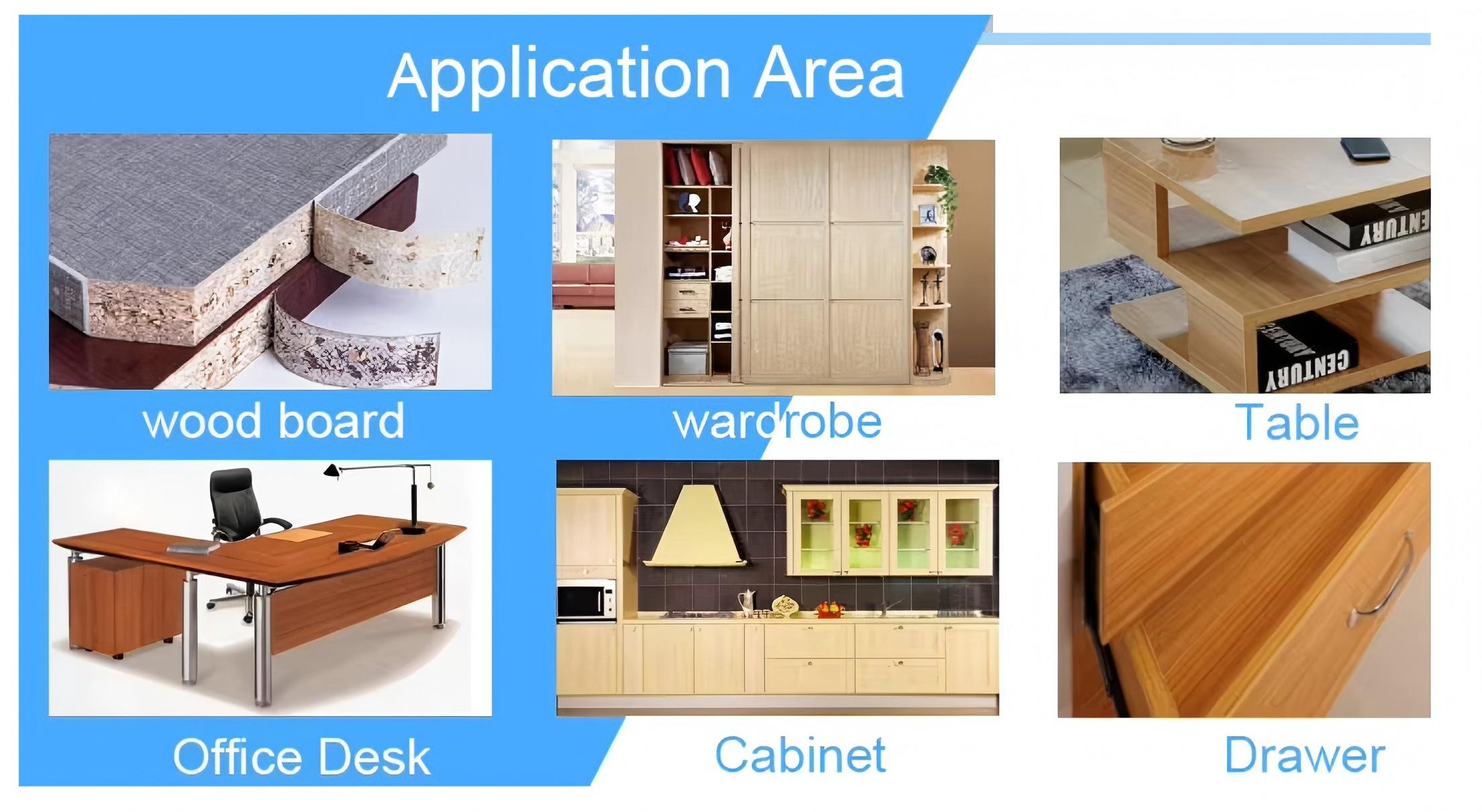
10. Applications in Furniture and Interior Decoration
PVC and PETG edge banding can be used across a wide range of residential, commercial, hospitality, retail, and institutional furniture projects.
Kitchen Cabinets
Cabinet doors, carcasses, drawers, shelves, islands, and tall units can use coordinated edge banding to match matte, high-gloss, wood grain, PET/PETG, acrylic-look, or melamine surfaces.
Wardrobes and Closets
Edge banding creates a finished appearance on doors, shelves, partitions, drawer components, and visible panel edges while helping protect the board substrate.
Office and Commercial Furniture
Desks, workstations, meeting tables, storage cabinets, counters, shelving, and partitions frequently use edge banding because exposed edges experience repeated physical contact.
Hotel and Hospitality Furniture
Hotel wardrobes, bedside furniture, desks, vanities, wall panels, reception furniture, and restaurant fixtures can use custom color and wood-grain edging to maintain consistent interior design.
Decorative Wall Panels
Where panel edges remain visible, matching edge banding helps decorative wall systems achieve a more complete and professionally finished appearance.

Decorative Wall Panels

Furniture Panel Application

11. Common Edge Banding Problems and How to Fix Them
Edge Banding Peels Off
Poor adhesion can be caused by incompatible primer or adhesive, insufficient adhesive temperature, cold boards, contamination, insufficient pressure, excessive feed speed, or incorrect glue application.
Check the backing primer, adhesive type, adhesive temperature, glue quantity, board moisture, panel-edge cleanliness, pressure rollers, feed speed, and ambient production temperature.
Visible Glue Line
A visible joint may result from excessive adhesive, incorrect adhesive color, uneven panel edges, insufficient pressure, poor trimming, unsuitable edge dimensions, or color mismatch between the edging and panel.
White Stress Marks After Trimming
White stress marks can be influenced by material formulation, temperature, excessive cutting pressure, blunt tools, incorrect trimming settings, or excessive material removal. Testing the edging with the actual trimming system is recommended before bulk production.
Chipping or Rough Edges
Poor cutting or trimming can result from worn tools, incorrect cutter settings, excessive feed speed, unsuitable material temperature, or incorrect edge-band thickness. Sharp and correctly adjusted tooling is important for a clean finish.
Color or Gloss Mismatch
For critical projects, approve the edge banding together with the actual furniture panel under the intended lighting. Evaluate front color, edge color, texture, gloss, and the finished joint rather than approving a roll sample in isolation.
12. Quality Control for PVC and PETG Edge Banding
Width and Thickness
Dimensions should remain within the agreed order tolerance because variation can affect feeding, trimming, finished edge profile, adhesive usage, and production consistency.
Color and Decor Consistency
Solid colors should be checked against the approved reference, while wood grain and printed products should also be inspected for background color, pattern repeat, print registration, grain appearance, and batch consistency.
Gloss and Surface Quality
Inspect the surface for gloss consistency, scratches, contamination, dents, bubbles, print defects, coating irregularities, texture variation, and other visible issues.
Primer and Adhesion
Backing treatment should be checked for uniformity and compatibility with the intended adhesive. Production-line trials should evaluate bonding, trimming, corner quality, joint appearance, and resistance under the intended use conditions.
Roll Quality
Rolls should be checked for winding quality, telescoping, deformation, splices, labels, protective packaging, and damage that could affect automatic feeding.
13. How to Choose the Right Edge Banding for Your Project
Step 1: Identify the Furniture Panel
Confirm whether the substrate is MDF, particleboard, plywood, HDF, melamine-faced board, PET/PETG-faced panel, acrylic-look panel, or another decorative board.
Step 2: Match the Surface
Specify the required solid color, wood pattern, texture, gloss, matte level, transparency, metallic effect, or other decorative requirement.
Step 3: Define Width and Thickness
Select the dimensions according to panel thickness, trimming allowance, furniture edge design, edge radius, impact requirement, and machine configuration.
Step 4: Confirm Adhesive and Machine
Provide the edge banding machine model, adhesive type, normal processing temperature, feed speed, pressure conditions, trimming system, and whether the project uses conventional hot melt or zero-joint technology.
Step 5: Test an Approved Sample
Run the sample on the actual panel and production line. Check adhesion, color, gloss, trimming, corner processing, joint appearance, surface quality, and production stability before confirming the bulk order.
14. What B2B Buyers Should Provide for a Quote
PVC, PETG, or requested material.
Required width and thickness.
Required roll length.
Solid color, wood grain, high gloss, matte, transparent, metallic, or other finish.
Physical panel, film, laminate, edge sample, Pantone, or RAL color reference.
Texture or embossing requirement.
Panel material and panel thickness.
Edge banding machine model.
EVA, PUR, pre-glued, zero-joint, or other bonding system.
Required primer or backing treatment.
Expected sample and bulk-order quantity.
Roll label, carton, pallet, and export packaging requirements.
Request PVC & PETG Edge Banding Samples
15. Trends in Furniture Edge Banding
Super-Matte and Anti-Fingerprint Surfaces
Low-gloss furniture remains important in kitchens, wardrobes, office furniture, hospitality interiors, and architectural panels. Edge banding needs to match both the color and low-reflection surface of these panels.
High Gloss and Depth Effects
Glossy furniture fronts continue to use edges with improved smoothness, optical depth, transparency, or coordinated decorative layers to create a more seamless appearance.
Closer Surface-to-Edge Matching
Furniture brands increasingly expect the edging to reproduce not only the panel color but also its texture, grain, gloss, and tactile character. Physical reference control is therefore becoming more important for repeat orders.
Zero-Joint Processing
Furniture manufacturers continue to adopt invisible-joint technologies where the product design and production equipment justify the additional process requirements. Functional-layer compatibility and equipment validation are essential.
More Specific Sustainability Requirements
Professional buyers are increasingly requesting specific information about material composition, restricted substances, production waste, recycled content, recyclability, emissions, and applicable regulations rather than accepting general “eco-friendly” claims.
16. Why Work With Wallis for Edge Banding Projects?
Wallis supports edge banding projects for furniture factories, cabinet manufacturers, decorative panel producers, wholesalers, distributors, interior contractors, and OEM customers. PVC and PETG edging projects can be developed according to panel samples, decorative films, dimensions, surface requirements, processing conditions, and packaging needs.
Custom Color and Decor Matching
Custom projects can be evaluated according to physical boards, decorative films, laminates, wood-grain references, color standards, or existing edge banding samples.
Customized Dimensions and Roll Formats
Width, thickness, roll length, surface, decor, primer, labels, cartons, and export packaging can be discussed according to project requirements and production feasibility.
Sample-to-Production Validation
For customized colors and surfaces, sample approval before bulk production helps reduce mismatch and allows customers to test adhesion, trimming, surface quality, and machine compatibility.
Contact Wallis for Custom Edge Banding
FAQ About PVC & PETG Edge Banding
What is edge banding used for?
Edge banding covers exposed edges of MDF, particleboard, plywood, HDF, melamine boards, laminated panels, and other furniture components. It improves appearance and helps protect the exposed panel edge from chipping, dirt, impact, and direct moisture exposure.
What is the difference between PVC and PETG edge banding?
PVC edge banding is widely used because of its broad decorative range, flexibility, machinability, and cost efficiency. PETG edge banding is often selected for PET/PETG-faced furniture and premium decorative applications such as high-gloss, super-matte, or transparent designs. Final performance depends on the exact grade and surface construction.
Can PVC and PETG edge banding be customized to match our furniture panel?
Yes. Color, wood grain, texture, gloss, matte level, width, thickness, roll length, and other features can be evaluated according to the supplied board, decorative film, laminate, color reference, or approved sample.
How do I choose the correct edge banding width?
The width should be selected according to the panel thickness and the top-and-bottom trimming allowance required by the edge banding machine. Provide the board thickness and machine setup when requesting a recommendation.
Which adhesive is better for edge banding, EVA or PUR?
EVA is widely used for conventional furniture production because of its convenient processing. PUR is often selected when stronger resistance to heat or moisture is required. The correct choice depends on furniture application, panel, edging, machine, operating conditions, and adhesive supplier recommendations.
Why does edge banding peel off?
Common causes include incompatible primer or adhesive, low adhesive temperature, insufficient glue, cold or contaminated boards, incorrect pressure, excessive machine speed, or improper storage. Check the complete bonding process rather than the edging material alone.
Why does PVC edge banding turn white after trimming?
White stress marks can be related to material formulation, low processing temperature, excessive cutting pressure, blunt tools, incorrect trimming settings, or excessive material removal. Testing the approved material on the actual machine is recommended.
Can PETG edge banding have an anti-fingerprint finish?
Selected PETG surface systems can incorporate anti-fingerprint or easy-clean coatings. Buyers should confirm the exact coating construction, gloss target, cleaning method, scratch requirement, and applicable test method before ordering.
Can standard edge banding be used for zero-joint machines?
Not automatically. Laser, hot-air, NIR, and other zero-joint technologies generally require a compatible functional-layer construction. Provide the machine model and activation technology before selecting the edging.
Should furniture manufacturers test samples before bulk ordering?
Yes. Sample testing should use the actual board, adhesive, edge bander, feed speed, temperature, pressure, trimming tools, and finishing process whenever possible. Evaluate color, gloss, adhesion, trimming, joint appearance, corner quality, and final furniture appearance.
What information should I provide when requesting an edge banding quotation?
Provide the material, width, thickness, roll length, color or decor, surface finish, panel sample, panel thickness, edge banding machine, adhesive system, primer requirement, quantity, labels, packaging, and destination. For custom matching, sending a physical board or existing edge sample is recommended.
Conclusion: Choosing the Best PVC or PETG Edge Banding
PVC and PETG edge banding both provide valuable solutions for modern furniture manufacturing, but the best material depends on the complete furniture and production system. PVC offers broad decorative flexibility and cost-effective processing, while PETG can be an attractive option for PET/PETG-faced panels and premium decorative applications.
For B2B buyers, the most important factors are surface-to-edge matching, width, thickness, flexibility, primer, adhesive compatibility, machine settings, trimming performance, surface quality, and repeat-order consistency. Evaluating a physical sample on the actual furniture panel and edge banding line before mass production can significantly reduce production risk.
Request PVC & PETG Edge Banding Samples & Quote