Custom Acrylic Laser Dotted Light Guide Panel for Edge-Lit LED Lighting
Wallis acrylic laser dotted light guide panel, also known as a PMMA light guide plate (LGP), is an optical panel designed to convert light from edge-mounted LEDs into smooth and uniform surface illumination. Precision laser dot patterns control light extraction across the acrylic sheet, helping reduce visible hot spots, dark areas and uneven brightness.
Wallis supplies laser-processed acrylic LGP panels in standard sizes including 1230 × 2450 mm, 1250 × 1850 mm and 1400 × 2200 mm, with thicknesses from 3–12 mm. Custom dimensions, CNC shapes, laser dot distributions and V-cut optical patterns can be developed according to LED position, panel geometry and project drawings.
Typical B2B applications include advertising light boxes, menu boards, retail displays, logo panels, illuminated shelves, exhibition displays, architectural lighting, LED backlight assemblies and customized optical lighting systems.
Acrylic Laser Dotted Light Guide Panel Specifications
| Product Type | Acrylic / PMMA Laser Dotted Light Guide Panel |
| Alternative Names | Acrylic LGP / PMMA Light Guide Plate / Edge-Lit Acrylic Panel / LED Light Guide Panel |
| Material | Optical-Grade Acrylic / PMMA |
| Standard Thickness | 3–12 mm |
| Standard Sizes | 1230 × 2450 mm / 1250 × 1850 mm / 1400 × 2200 mm |
| Other Sizes | 18 × 24 in / 24 × 36 in / Custom Dimensions |
| Optical Processing | Laser Dot Pattern / V-Cutting Line |
| Custom Processing | CNC Cutting / Drilling / Shaping / Edge Processing / Custom Dot Layout |
| LED Configuration | Designed according to panel size, LED position and light-input edges |
| Drawing Formats | JPG / PDF / DWG / DXF |
| OEM / ODM | Supported |
| Typical Applications | Light Boxes, Retail Displays, Menu Boards, Signage, Shelves, Exhibition Displays and Custom LED Lighting |
Note: Final brightness, uniformity, optical efficiency and suitable laser-dot distribution depend on the complete lighting system, including panel size, thickness, LED type, LED pitch, light-entry edges, reflector, diffuser, housing and edge quality.
How Does an Acrylic Light Guide Panel Work?
An acrylic light guide plate uses total internal reflection to carry light from LEDs positioned along one or more edges of the PMMA panel. Without an extraction structure, much of this light would remain trapped inside the acrylic.
Laser-engraved micro-dots interrupt the internal light path at controlled locations. Each dot redirects part of the light toward the panel surface. By varying dot size, spacing or density according to distance from the LED source, the optical design can compensate for light loss and create more uniform illumination.
Light Enters Through the Acrylic Edge
LEDs are positioned close to a polished or properly finished PMMA edge so as much light as possible can enter the panel. Accurate alignment between the LED strip and the acrylic edge is important for optical efficiency.
Internal Reflection Distributes the Light
Once inside the PMMA plate, light travels through the panel by internal reflection. The panel thickness, dimensions, edge finish and optical-grade material quality influence how efficiently light can travel.
Laser Dots Extract Light from the Surface
Precision laser dots redirect controlled portions of light toward the illuminated surface. Dot density can be adjusted across the panel so areas farther away from the LEDs extract more light and compensate for decreasing internal intensity.
Laser Dotting and V-Cutting Light Guide Technologies

LGP Processing Methods
Laser dots are micro extraction points formed by precision laser processing to redirect internally guided light and improve brightness uniformity.
V-cutting creates linear optical grooves that can guide and redirect light according to the required lighting structure.

Working Principle of LGP
LED light enters through the acrylic edge, travels through the PMMA by internal reflection and is progressively extracted by the designed microstructure to create an illuminated surface.
Laser Dotted LGP
Laser dotting allows the optical pattern to be customized according to panel dimensions and LED configuration. It is particularly suitable for custom light boxes and backlight assemblies where the dot distribution must be matched to a specific shape or LED-entry position.
V-Cut Light Guide Plate
V-shaped lines can be used as another light-extraction structure. The pitch, direction and depth of the lines can influence light distribution. Selection between laser dots and V-cutting depends on the optical target, dimensions and manufacturing design.
Key Advantages of Laser Dotted Acrylic LGP
Uniform Surface Illumination
Customized laser-dot density helps compensate for changes in light intensity across the plate. Properly designed panels can therefore reduce bright edges, dark centers and visible lighting gradients.
Slim Edge-Lit Structure
Because LEDs illuminate the panel from the edges instead of sitting directly behind the entire surface, an LGP can support much thinner lighting assemblies than many conventional direct-backlit structures.
Custom Optical Pattern
Dot diameter, density and distribution can be adjusted according to LED location, illuminated area and panel geometry rather than applying the same pattern to every project.
CNC Custom Shapes
PMMA light guide plates can be CNC processed according to drawings for rectangular panels, circles, curved shapes, holes, notches and customized lighting components where production feasibility allows.
Optical-Grade PMMA Clarity
High-quality PMMA provides the transparency and optical stability required for efficient edge-light transmission. Material quality, edge finish and surface condition all affect the final lighting performance.
Suitable for Single- or Double-Sided Lighting Designs
Depending on reflector, diffuser and housing design, LGP assemblies can be engineered for single-sided or double-sided illumination. This should be specified before optical-pattern development.
Standard Acrylic Light Guide Panel Sizes
| No. | Standard Dimension | Thickness |
| 1 | 1230 × 2450 mm | 3–12 mm |
| 2 | 1250 × 1850 mm | 3–12 mm |
| 3 | 1400 × 2200 mm | 3–12 mm |
| 4 | 18 × 24 in | 3–12 mm |
| 5 | 24 × 36 in | 3–12 mm |
| 6 | Custom Size | Custom according to project feasibility |
Wallis also supports OEM/ODM light guide panels according to custom dimensions, shapes and optical-pattern layouts. For non-standard designs, provide a PDF, DWG or DXF drawing showing the finished panel size, LED positions, illuminated surface and mechanical features.
Laser Dotted LGP vs Ordinary Clear Acrylic
| Comparison | Laser Dotted LGP | Ordinary Clear Acrylic |
| Purpose | Designed for controlled edge-light extraction | General transparent sheet material |
| Optical Pattern | Customized laser micro-dots or lines | No dedicated extraction pattern |
| Surface Illumination | Designed for more uniform panel illumination | Primarily transmits light through the sheet |
| Customization | Pattern can be matched to LED position and panel size | Mainly dimensional fabrication |
| Typical Application | Light boxes, LED panels, menu boards and illuminated displays | Glazing, fabrication, guards and general acrylic products |
How to Improve Light Guide Panel Uniformity
Uniform brightness is determined by the complete optical assembly, not only by the acrylic material. The laser pattern, LEDs, edges, reflector, diffuser and housing must work together.
Match laser-dot density to the distance from the LED input edge.
Use consistent LED pitch and stable LED brightness.
Keep the LED source closely aligned with the acrylic entry edge.
Use a smooth, properly processed light-entry edge.
Add reflective material behind single-sided LGP assemblies where required.
Use an appropriate diffuser when the application requires a softer visible surface.
Prevent mechanical gaps between LED strips and the LGP edge.
Prototype large or unusual aspect-ratio panels before mass production.
Applications of Acrylic Laser Dotted Light Guide Panels
Advertising Light Boxes
Laser dotted LGPs are widely used in slim advertising light boxes where uniform illumination is required behind printed graphics, posters or translucent display materials.
Menu Boards
Restaurants, cafés and food-service brands can use LGP backlighting to create thin illuminated menu displays with consistent lighting across the graphic surface.
Retail and POS Displays
Custom acrylic light guides can be integrated into shelves, counters, promotional displays, illuminated branding panels and point-of-sale fixtures.
Exhibition and Museum Displays
Thin edge-lit panels can provide concealed illumination for exhibition graphics, information panels and product presentations where limited installation depth is available.
Architectural and Decorative Lighting
Acrylic LGP panels can be incorporated into decorative walls, furniture, ceilings and interior lighting features where designers require a thin illuminated plane.
Custom Optical and Electronic Assemblies
Customized LGPs can also be developed for specialized displays, control panels, instruments and other optical assemblies. Projects with strict optical requirements should provide drawings and target performance for engineering evaluation.
How to Choose an Acrylic Light Guide Panel
1. Confirm Panel Dimensions
Provide the exact finished length and width. Panel dimensions influence light travel distance, the required LED-entry sides and laser-dot distribution.
2. Select the Thickness
Wallis currently lists thicknesses from 3–12 mm. The appropriate thickness depends on panel dimensions, mechanical requirements, LED geometry and optical design.
3. Confirm LED Input Edges
Tell Wallis whether the LEDs will enter from one edge, two opposite edges or another arrangement. The dot pattern must be designed around the final LED positions.
4. Provide LED Strip Specifications
LED pitch, power, color temperature, strip width and luminous output affect the LGP design. Existing LED information should therefore be included when requesting customized laser patterns.
5. Confirm Single- or Double-Sided Emission
Single-sided panels typically use reflective material behind the LGP, while double-sided illumination requires a different complete optical structure. Specify the required emission direction before production.
6. Specify the Required Brightness and Uniformity
If the project has a target luminance, uniformity ratio or illuminance requirement, provide the numerical target so the optical design can be evaluated against measurable performance rather than general terms such as “high brightness.”
7. Provide the Mechanical Drawing
Custom holes, slots, curves and irregular contours should be included in a PDF, DWG or DXF file so optical and CNC processing can be evaluated together.
Recommended Components for a Complete Edge-Lit LGP System
| Component | Function |
| PMMA Light Guide Plate | Guides edge-entering LED light and distributes it across the panel |
| LED Strip or LED Module | Provides the edge light source |
| Reflective Backing | Redirects rearward light toward the illuminated surface in single-sided systems |
| Diffuser | Helps soften visible extraction patterns and create a smoother surface appearance |
| Aluminum Frame / Heat Sink | Supports the panel and assists LED heat dissipation |
| Power Supply / Controller | Provides compatible power and control for the selected LED system |
OEM and Custom Acrylic LGP Services
Wallis provides one-stop processing support from acrylic material selection through laser optical processing and CNC fabrication. Customized projects can be developed according to drawings and final lighting requirements.
Custom length and width
3–12 mm thickness options
Custom laser dot pattern
V-cut optical processing
CNC cutting and shaping
Hole drilling and custom openings
LED configuration consultation
Reflector and diffuser matching support
Prototype and sample evaluation
Pre-assembled lighting panel support
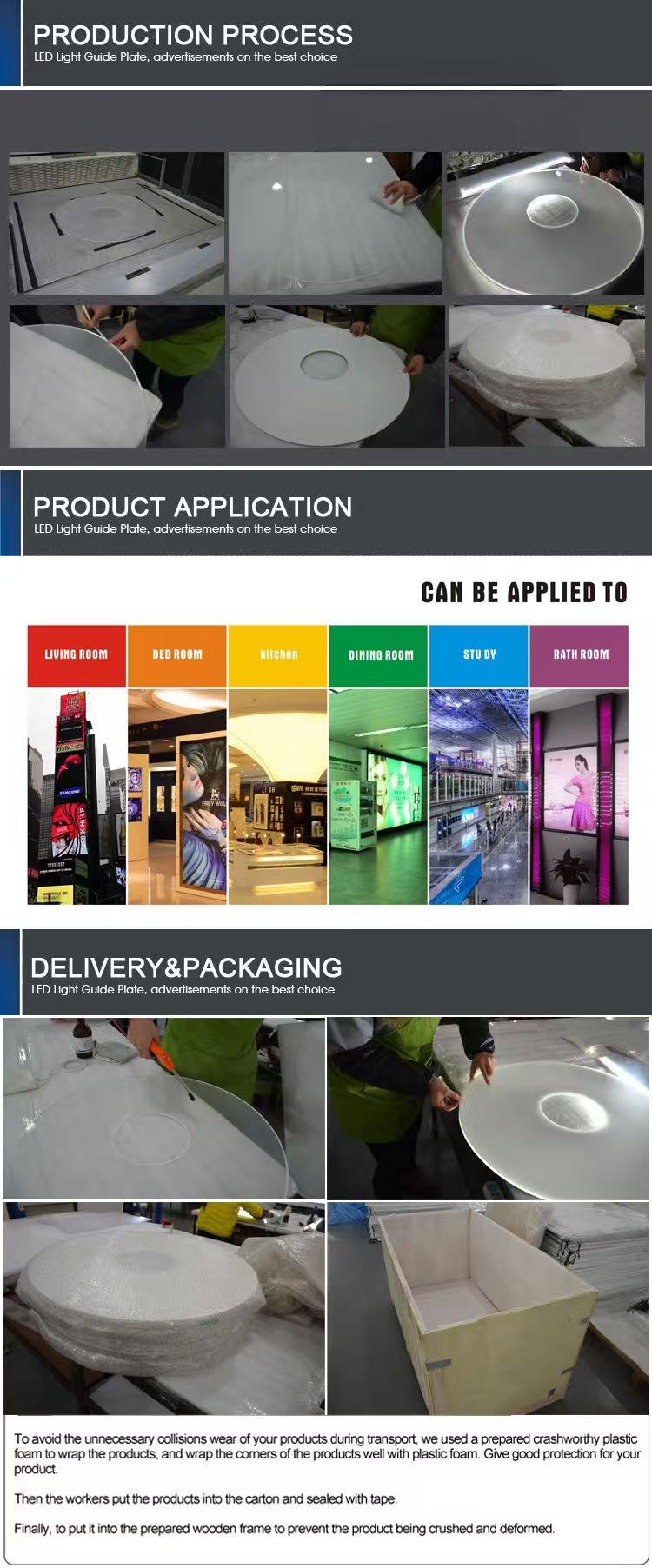
Export packaging
OEM / ODM production

Information Needed for an Accurate LGP Quote
Finished panel length and width
Required thickness
Required quantity
LED type and LED pitch
LED input edge positions
Single- or double-sided illumination
Target brightness or luminance, if specified
Uniformity requirement, if specified
Laser-dot or V-cut preference
CNC holes, slots or custom contour
Reflector and diffuser configuration
Application and installation method
Packaging requirement
PDF, DWG or DXF drawing
Workshop, Packaging and Global Supply
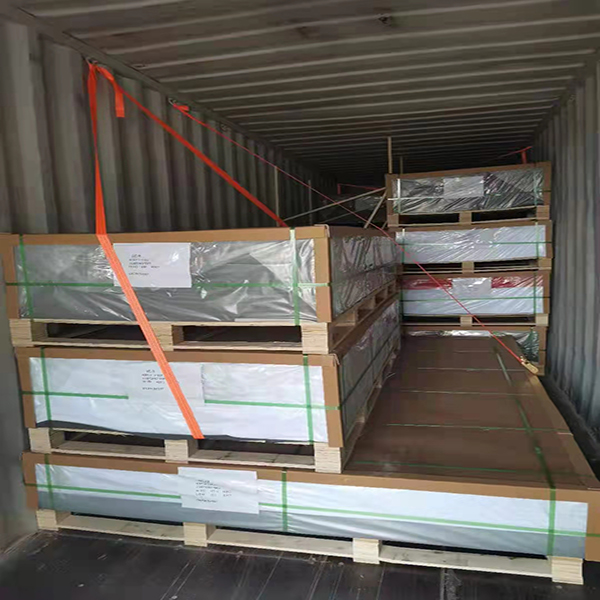
Custom acrylic LGP panels require protection against scratching, edge damage and contamination during transportation. Wallis supports export packaging according to panel size, quantity and delivery requirements.

Export Pallet Package

Container Load

Frequently Asked Questions About Acrylic Light Guide Panels
What is an acrylic light guide panel?
An acrylic light guide panel is an optical PMMA plate designed to guide light from edge-mounted LEDs and distribute it across a larger illuminated surface using laser dots, engraved lines or another light-extraction structure.
What is the purpose of laser dots on a light guide plate?
Laser dots interrupt internal reflection and redirect controlled portions of light out of the PMMA surface. Their density and spacing can be adjusted to improve brightness uniformity across the panel.
What thicknesses are available?
The current Wallis product specification lists acrylic LGP thicknesses from 3–12 mm. Selection should be based on panel size, LED configuration and mechanical requirements.
Can Wallis make custom-size light guide panels?
Yes. Standard dimensions are available, and custom sizes can be CNC processed according to supplied drawings and optical-design requirements.
Can the laser dot pattern be customized?
Yes. Laser-dot size, spacing and density can be adjusted according to the panel dimensions, LED positions and target lighting performance.
What is the difference between laser dots and V-cut lines?
Laser dots use distributed micro-points to extract light, while V-cutting uses linear grooves. Both methods can control light extraction, but the most suitable method depends on panel dimensions, LED arrangement and optical design.
How close should the LED strip be to the LGP edge?
LEDs should generally be positioned very close to and accurately aligned with the light-entry edge so that light efficiently couples into the PMMA. Exact spacing depends on the LED package, strip design and frame structure.
Does the acrylic edge need to be polished?
A smooth, properly processed light-entry edge generally improves optical coupling. The required edge finish should be considered as part of the LGP and LED assembly design.
Can the panel be illuminated from one edge?
Yes, depending on panel dimensions and brightness requirements. Larger panels may benefit from two or more LED input edges to improve uniformity and available light output.
Can an LGP illuminate both sides?
Double-sided illumination is possible with an appropriate optical and mechanical design. A single-sided system usually uses reflective material behind the panel to direct more light toward one surface.
Can the LGP be CNC cut or drilled?
Yes. Wallis supports CNC cutting, trimming, drilling and custom shapes according to production feasibility and customer drawings.
What drawing formats can I send?
Current product information lists JPG, PDF, DWG and DXF formats for custom LGP evaluation and processing.
Is a reflector required behind the LGP?
A reflective backing is commonly used in single-sided edge-lit systems because it redirects light that would otherwise leave the rear surface. Double-sided transparent lighting systems may use a different structure.
Is a diffuser required?
A diffuser is often used where the visible surface must appear softer or where optical extraction details need to be visually blended. The requirement depends on the final application and optical appearance.
Can acrylic LGP be used outdoors?
The standard product is primarily intended for indoor applications. Outdoor projects should specify UV exposure, moisture, temperature and enclosure conditions so a suitable material and protective structure can be evaluated.
What information should I provide for an LGP quotation?
Provide the panel dimensions, thickness, quantity, LED type, LED pitch, light-input edges, single- or double-sided lighting requirement, target brightness, application, CNC features and a PDF, DWG or DXF drawing where possible.
Request a Quote for Custom Acrylic Laser Dotted LGP
Looking for a custom acrylic light guide panel manufacturer for LED light boxes, signage, retail fixtures, menu boards or OEM lighting systems? Wallis provides optical-grade PMMA panels with laser-dot processing, V-cutting, CNC fabrication and project-based optical customization.
Send your dimensions, thickness, LED configuration, drawing and target lighting requirements to receive a suitable LGP recommendation and quotation.