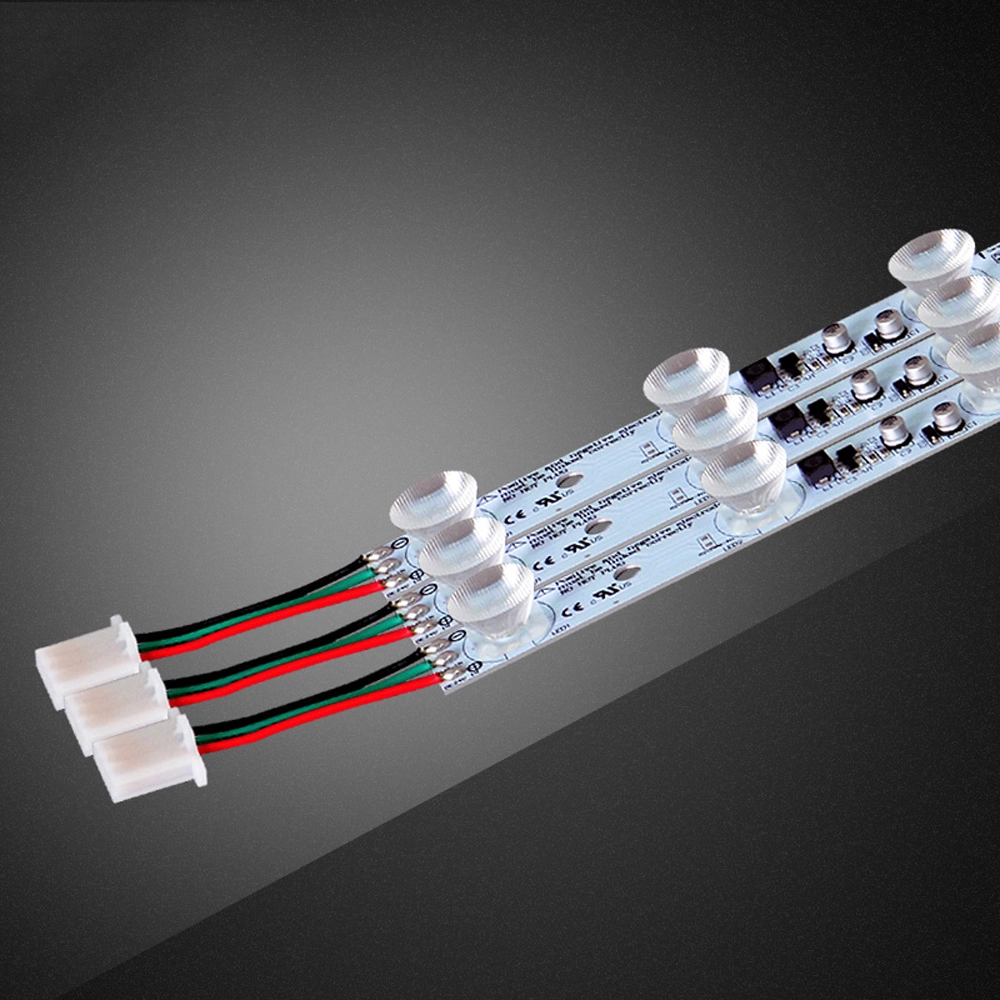
24V High Power Side-Lit LED Module for Advertising Light Boxes
Wallis high power side-lit LED module is a professional edge-lighting solution designed for double-sided advertising light boxes, SEG fabric light boxes, illuminated signage, retail displays and large-format commercial display systems. The listed A-9D470-XPG model combines high-output XPG LEDs, precision PMMA optical lenses and a constant-current circuit to deliver strong and controlled side illumination.
Operating at a nominal DC24V, the main 470 mm model provides 27W power, 2200 lm luminous flux, 6500K cool white output and a 10 × 25° optical beam. The narrow asymmetric beam helps project light across the interior of a light box rather than concentrating brightness close to the LED source.
This side-lighting design is particularly suitable for commercial light boxes with sufficient internal depth, including suitable double-sided structures of approximately 80 mm depth or greater depending on cabinet dimensions, diffuser materials, target brightness and optical layout.
For B2B buyers, sign manufacturers, SEG light box factories and display contractors, Wallis can support module selection, quantity calculation, professional cutting, terminal connector soldering and project-based installation recommendations.
High Power Side-Lit LED Module at a Glance
| Product Type | High Power Side-Lit / Edge-Lit LED Module |
| Main Model | A-9D470-XPG |
| Main Model Length | 470 mm |
| Power | 27W for A-9D470-XPG |
| Input Voltage | DC24V nominal |
| Luminous Flux | Up to 2200 lm for listed 27W model |
| Color Temperature | 6500K |
| Beam Angle | 10 × 25° |
| Optics | PMMA high-efficiency optical lens |
| Driver Design | Constant current, conversion efficiency above 95% |
| Certification | CE and RoHS |
| Warranty | 2 Years |
| Typical Applications | Double-sided light boxes, SEG displays, signage, advertising cabinets and retail displays |
 Key Features of High Power Side-Lit LED Module
High Brightness XPG LED Technology
High-output XPG LEDs provide strong luminous performance for professional advertising and display applications. The A-9D470-XPG model delivers approximately 2200 lm at 27W, helping illuminate large graphics with fewer high-power modules than lower-output lighting solutions.
Precision 10 × 25° Side-Lighting Beam
The 10 × 25° optical beam is designed to direct light horizontally across the interior of the light box. A controlled side-lighting beam helps increase useful light transmission distance and reduce excessive brightness close to the module.
High-Efficiency PMMA Optical Lens
Each high-power LED works with a PMMA optical lens to control light direction and distribution. Correct optical control is especially important in side-lit systems because the light must travel across a wider cabinet area before reaching the graphic surface.
Constant-Current Circuit for Stable Brightness
The constant-current design helps maintain stable LED operating conditions and consistent brightness. The currently listed design has conversion efficiency above 95%, supporting efficient use of the connected DC power supply.
DC24V Commercial Lighting System
A nominal DC24V system is practical for commercial light box installations. The current Wallis product information also specifies a DC24–30V wide input design intended to support stable brightness under suitable operating conditions.
Aluminum-Based Thermal Management
High-power LEDs generate more heat than conventional low-power sign modules. Proper installation on an aluminum structure or compatible heat-dissipation profile helps transfer heat away from the PCB, supporting more stable brightness and long-term reliability.
Professional Cutting and Connector Preparation
Because the aluminum PCB is approximately 2 mm thick, ordinary manual cutting is not recommended. For projects requiring shorter sections, Wallis can use professional equipment to cut suitable sections and solder terminal connectors before shipment.
High Power Side-Lit LED Module Specifications
| Model | Power | Input Voltage | Luminous Flux | Color Temperature | Beam Angle |
| A-9D470-XPG | 27W | 24V | 2200 LM | 6500K | 10 × 25° |
| A-5D360-XPG | 15W | 24V | 800 LM | 6500K | 10 × 25° |
Note: Final module dimensions, electrical loading, permitted connection quantity, IP protection, installation depth and power supply configuration should be confirmed according to the actual light box project before mass production.

PMMA Optical Lens Detail

LED Module Connector Detail

Final Light Box Application
What Is a Side-Lit LED Module?
A side-lit LED module, also commonly called an edge-lit LED module, side-lighting LED bar or edge-light LED bar, is mounted along one or more sides of a light box frame. Instead of shining directly forward from behind the graphic, the LEDs project light horizontally across the interior of the display.
This installation geometry can be particularly effective for suitable double-sided light boxes because one side-lighting system can help distribute illumination toward both graphic faces. The final lighting result depends on optical lens design, box depth, graphic material, internal reflectivity, module spacing and cabinet dimensions.
Side-Lit LED Module vs Backlit LED Module
| Comparison | Side-Lit / Edge-Lit Module | Backlit Module |
| LED Position | Mounted along the edge or sides of the cabinet | Mounted behind the graphic surface |
| Light Direction | Projects light horizontally across the cabinet | Projects light directly toward the graphic |
| Optical Design | Controlled long-throw lens is important | Usually uses wider forward-distribution optics |
| Typical Application | Double-sided light boxes, SEG frames and edge-lit sign cabinets | Single-sided direct backlit signs and display boxes |
| Selection Depends On | Light transmission distance, box depth and lens angle | Module spacing and distance from graphic |
Neither system is universally better. The correct choice depends on the cabinet structure, graphic size, desired depth, single-sided or double-sided design and required brightness.
Why Choose High Power Side-Lit LED Modules?
Strong Light Transmission for Large Light Boxes
High-power LEDs combined with directional lenses are designed to send light farther across the cabinet than conventional low-power modules. This makes side-lit modules suitable for larger advertising displays where light must travel from the edge toward the center.
Uniform Illumination for Double-Sided Graphics
Correctly positioned side-lighting modules can illuminate suitable double-sided display structures without filling the entire rear surface with LED modules. Proper optical layout can therefore reduce dark centers while controlling LED quantity and installation complexity.
6500K Cool White for Advertising Graphics
The listed 6500K color temperature provides a bright, crisp white appearance commonly used for illuminated advertising graphics, commercial signs, retail displays and exhibition light boxes.
Multiple Power Options for Different Cabinets
The listed range includes 27W and 15W models. Different power levels allow lighting designers to select a more appropriate module according to cabinet dimensions, required illumination and installation layout rather than using the same module for every light box.

Applications of High Power Side-Lit LED Modules
Double-sided advertising light boxes
SEG fabric light boxes
Edge-lit signage systems
Frameless illuminated display boxes
Retail display light boxes
Shopping mall advertising panels
Airport advertising displays
Subway and railway advertising light boxes
Exhibition and trade show light boxes
Large-format illuminated sign cabinets
Commercial brand display systems
Custom advertising and signage lighting projects
How to Choose the Right Side-Lit LED Module
1. Confirm Light Box Depth
Cabinet depth affects how the optical beam spreads before reaching the graphic surface. The current Wallis module is particularly intended for suitable light boxes with an internal depth around 80 mm or greater, but the final requirement depends on display width, graphic material and lighting layout.
2. Confirm Light Box Length and Width
The distance the light must travel across the cabinet is one of the most important selection factors. Provide both dimensions rather than only the total display area because module orientation and installation side can significantly affect the lighting result.
3. Confirm Single-Sided or Double-Sided Construction
A double-sided cabinet normally requires a different optical calculation from a single-sided display because both graphic surfaces need adequate illumination. Tell Wallis which structure will be used before selecting module quantity.
4. Choose the Appropriate Power Level
The 27W A-9D470-XPG provides higher total luminous output, while the 15W A-5D360-XPG can be considered where a lower-output module better matches the available installation space and required brightness. Final selection should be based on the complete cabinet rather than wattage alone.
5. Confirm Graphic and Diffuser Material
SEG fabric, acrylic sheets, backlit film and other graphic materials have different light transmission and diffusion characteristics. This directly influences brightness, module spacing and the visibility of hot or dark areas.
6. Confirm Indoor, Outdoor and Waterproof Requirements
Protection requirements should be specified before ordering. Tell Wallis whether the light box will be installed indoors, outdoors or in a humid environment so the appropriate product and enclosure solution can be confirmed.
How to Calculate Side-Lit LED Module Quantity
There is no single module-count formula that works for every light box. Required quantity depends on cabinet length, width, depth, module beam angle, luminous output, graphic transmission, internal reflection, single-sided or double-sided structure and target brightness.
For some rectangular displays, modules can be installed along the shorter opposite sides and project light across the longer dimension. In other structures, additional modules or different mounting sides may be required to maintain uniformity.
For example, the existing Wallis guidance uses a 115 × 250 cm light box to illustrate that side lighting may be positioned along the 115 cm sides when the optical system can adequately cover the longer distance. This should be treated as a project example rather than a universal installation rule.
How to Reduce Dark Areas and Hotspots
Light uniformity depends on the complete optical system rather than LED lumen output alone. A powerful module installed with incorrect spacing or unsuitable cabinet geometry can still create dark centers or excessive brightness near the edges.
Match the optical beam angle with cabinet dimensions.
Maintain consistent spacing between modules.
Keep the optical lenses aligned toward the intended lighting area.
Choose suitable SEG fabric, diffuser or backlit graphic materials.
Use reflective internal surfaces where required by the light box design.
Use shorter module sections where long bars cannot cover the cabinet geometry correctly.
Provide adequate heat dissipation for stable LED output.
Test unusual or large-format cabinets before high-volume production whenever practical.
Power Supply and Installation Considerations
Match the DC24V Power Supply
The listed LED modules use a nominal DC24V supply. Total power supply capacity should be calculated from the number of connected modules, their rated power and an appropriate system design margin.
Calculate Total Electrical Load
A project using multiple 27W modules can create a significant total load. Buyers should calculate the complete installation rather than selecting a power supply based on one module alone.
Confirm Maximum Connection Quantity
Maximum modules per electrical run should be confirmed from the final wiring and product specification before installation. Do not assume an unlimited number of modules can be connected in one continuous chain.
Use Aluminum for Heat Dissipation
A suitable aluminum profile or metal light box frame can help conduct heat away from the high-power module. Good thermal contact is especially important in long-duty-cycle advertising displays.
Custom Side-Lit LED Module Solutions for B2B Buyers
Wallis supports project-based sourcing for light box manufacturers, sign factories, display companies, exhibition contractors, retail fixture manufacturers, distributors and commercial advertising projects.
Module Length Selection
Different module sizes can be combined according to the internal length of the cabinet. This helps reduce unlit end areas where one long module cannot fit the complete installation geometry.
Professional Cutting Service
Where permitted by the module design, Wallis can professionally cut the aluminum PCB into suitable LED sections rather than requiring customers to cut the thick aluminum board with ordinary tools.
Pre-Soldered Terminal Connectors
Terminal connectors can be prepared before delivery when confirmed with the project, helping simplify assembly and reduce wiring work at the customer's installation site.
Project Lighting Layout Support
Buyers can provide light box drawings or frame photos so module direction, quantity and suitable model selection can be evaluated before ordering.
Information Needed for an Accurate Quotation
To recommend the correct LED module and prepare a project quotation, please provide as much of the following information as possible:
Light box length
Light box width
Internal light box depth
Single-sided or double-sided construction
SEG fabric, acrylic or other graphic material
Required brightness level
Indoor or outdoor installation environment
Waterproof protection requirement
Dimming requirement, if applicable
Frame photos, drawings or CAD files
Number of complete light boxes
Required connector or cable configuration
Target order quantity
Frequently Asked Questions About Side-Lit LED Modules
What is the difference between side-lit and edge-lit LED modules?
In light box applications, the terms side-lit and edge-lit are commonly used for the same general lighting geometry: LED modules are positioned along the edge or side of the cabinet and project light inward across the display rather than directly forward from behind the graphic.
Is this LED module suitable for double-sided light boxes?
Yes. The Wallis high-power side-lit LED module is intended for suitable double-sided light box applications. Final performance depends on cabinet depth, dimensions, graphic material, internal reflection and installation layout.
What light box depth is recommended?
Current Wallis guidance recommends this type of high-power side-lighting module for suitable light boxes with a depth of approximately 80 mm or greater. Exact requirements depend on the box size, beam direction, graphic material and target brightness.
What voltage does the side-lit LED module use?
The listed A-9D470-XPG and A-5D360-XPG models use DC24V nominal input. The connected power supply must be sized according to the total number and power of the installed modules.
How bright is the A-9D470-XPG LED module?
The A-9D470-XPG model is rated at 27W with approximately 2200 lm luminous flux and a 6500K cool white color temperature.
What is the beam angle?
The listed models use a 10 × 25° PMMA optical lens. The directional beam helps project illumination across the interior of the light box.
Can the high-power side-lit LED module be cut?
Ordinary cutting is not recommended because the aluminum PCB is approximately 2 mm thick. Where the product design permits, Wallis can use professional equipment to prepare shorter sections and solder suitable terminal connectors before shipment.
Why are different LED module lengths useful?
Different module lengths help fit light boxes with different internal dimensions. Shorter modules can fill areas where a longer module cannot fit, helping reduce unlit sections near the ends of the cabinet.
How many side-lit LED modules do I need?
The required quantity depends on light box length, width, depth, graphic material, module orientation, target brightness and whether the display is single-sided or double-sided. Send Wallis the cabinet dimensions and frame drawings for a project-based calculation.
How can I reduce dark areas in a double-sided light box?
Dark areas can be reduced by selecting the correct module quantity, maintaining consistent spacing, aligning the optical lenses correctly, matching the cabinet depth to the optical beam and using suitable graphic and reflective materials.
Is an aluminum profile required?
An appropriate aluminum mounting structure is recommended for high-power modules because it helps dissipate heat and maintain stable LED operating conditions during extended commercial use.
Can Wallis solder connectors before shipment?
Yes. Connector and wiring preparation can be discussed before production. Pre-prepared terminal connectors can simplify installation and reduce cutting and soldering work at the customer's site.
What certifications does the LED module have?
The current Wallis product information lists CE and RoHS compliance. Buyers requiring specific certification documentation for a market or project should confirm the applicable certificate before ordering.
What is the warranty?
The currently listed warranty for this Wallis side-lit LED module series is 2 years. Final warranty conditions should be confirmed with the quotation and order specification.
What information should I provide for a quotation?
Provide the light box length, width and depth, graphic material, single-sided or double-sided structure, required quantity, waterproof requirement, dimming requirement, frame photos or drawings and any connector or installation requirements.
Request a Quote for High Power Side-Lit LED Modules
Looking for a high power side-lit LED module supplier for double-sided light boxes, SEG displays, illuminated signage or commercial advertising systems? Wallis provides 24V high-output edge-lighting modules with directional PMMA optics and project-based technical support.
Send your light box dimensions, drawings, required quantity and installation conditions to receive a suitable module recommendation, quantity calculation and quotation.


 Key Features of High Power Side-Lit LED Module