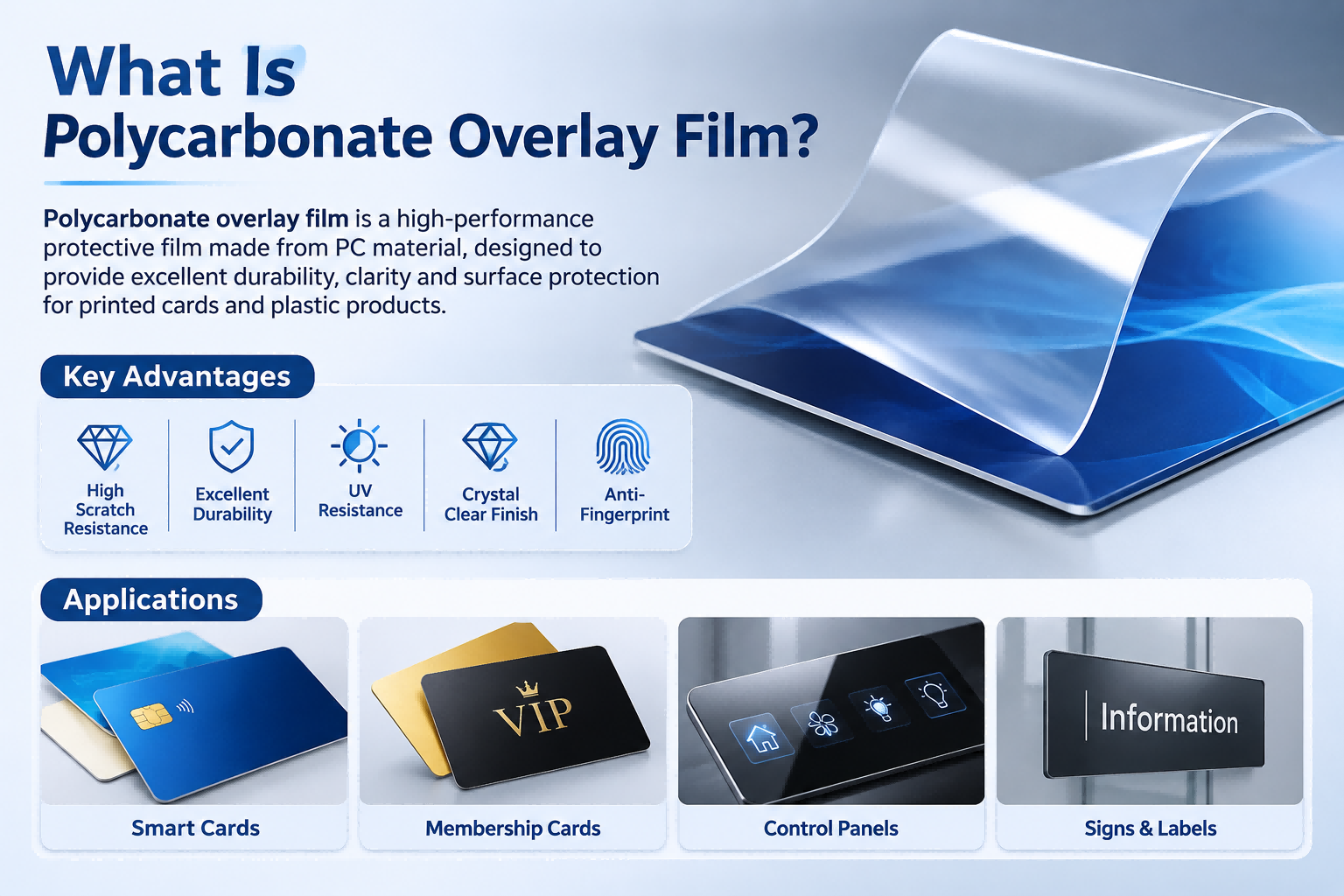
Wallis supplies transparent polycarbonate (PC) overlay film for secure ID cards, driving licences, residence permits, passport data pages and multilayer smart-card manufacturing. The film serves as a clear protective or functional layer in a qualified PC card structure, helping preserve printed graphics and support downstream lamination and personalization.
For different card constructions, Wallis offers laserable, non-laserable, coated, non-coated and strong-coated PC overlay grades. Typical thickness options include 0.05 mm, 0.07 mm, 0.08 mm and 0.10 mm, with sheet formats and OEM specifications selected for the buyer’s card stack and laminator.
Material selection matters: a transparent overlay is not automatically laser-reactive, adhesive-coated or supplied with a magnetic stripe. Confirm the grade, coating orientation, laser system and card-layer sequence before approving bulk production.
Request PC Overlay Samples & Quote
Polycarbonate Overlay Film Video
What Is Polycarbonate Overlay Film?
Polycarbonate overlay film is a thin transparent PC sheet used on the exterior or within a multilayer laminated card. It provides an optical and protective interface over printed or functional layers, while compatible PC materials are joined under controlled heat and pressure during the card-making process.
In an all-PC construction, suitable polycarbonate layers may fuse without a separate adhesive. A specially coated grade may be needed for selected mixed-material or printed interfaces. Neither bonding method should be assumed suitable until the actual ink, core, inlay and overlay layers are tested together.

Polycarbonate Overlay Technical Specifications
Wallis offers a range of PC overlay grades and dimensions for different card structures. Confirm the selected specifications in the final purchase order and approved sample.
| Specification | Available Options |
| Material | Polycarbonate (PC) |
| Color | Transparent |
| Thickness Range | 0.04mm–0.15mm; customized thicknesses can be discussed |
| Common Thicknesses | 0.05mm / 0.07mm / 0.08mm / 0.10mm |
| Standard Sizes | A4 / A3 / 295×365mm / 295×485mm / 505×590mm / customized |
| Product Grades | Laserable overlay / non-laserable overlay / coated overlay / non-coated overlay / strong-coated overlay |
| Optional Magnetic Configuration | HICO or LOCO options; 300 Oe, 600 Oe, 2750 Oe and 3000 Oe configurations subject to project confirmation |
| Primary Applications | Secure ID cards, driving licenses, residence permits, passport data pages, access cards, banking cards and smart-card structures |
| OEM Service | Custom thickness, sheet size, coating grade, packaging and project-specific material matching |
Specification note: 0.04–0.15 mm is the general product range; standard stock and available custom thicknesses depend on grade. Magnetic-stripe constructions require separate confirmation of stripe type, coercivity, placement and compatibility.

High Transparency and Durable Surface Protection

Flexible Film with Wear-Resistant Performance
Choose the Right PC Overlay Grade
| Material grade | Primary function | What the buyer should verify |
| Laserable PC overlay | Supports laser-generated text, portraits or variable data in a designed card layer. | Laser wavelength, layer position, optical contrast and marking trials. |
| Non-laserable clear overlay | Provides a transparent protective layer where laser reaction is not needed. | Haze, clarity, surface texture, laminating and wear performance. |
| Coated PC overlay | Uses a specified coating to support bonding at a qualified interface. | Coating side, adjoining ink/core, peel target and lamination cycle. |
| Strong-coated PC overlay | Project-specific bonding treatment for more demanding interface requirements. | Actual bond strength, storage conditions and multi-layer compatibility. |
| Uncoated PC overlay | Can be used where compatible PC layers fuse directly. | All-PC layer combination, heat/pressure settings and delamination tests. |
| Magnetic-stripe construction | Project-specific composite option rather than an inherent property of all clear PC overlays. | HICO/LOCO, coercivity (Oe), stripe location and magnetic encoding requirement. |
Laserable vs Non-Laserable Overlay
A laserable overlay uses a laser-responsive formulation that can form visible images or characters under compatible personalization equipment. A non-laserable overlay remains primarily a clear cover or intermediate film. This distinction affects both the security-document design and the permitted laser depth.
Coated vs Uncoated PC Overlay
Coated PC films are selected for a defined bonding interface; uncoated films are often evaluated where suitable PC layers are fused directly. The coating type alone does not determine card durability—finished-card peel resistance, warpage and optical appearance should be validated in production trials.
Why Coating Side and Layer Position Matter
The side that faces the printed core, the location of any laser-reactive layer and the surrounding inlay or overlay materials can all affect adhesion and personalization. Buyers should supply a card cross-section or layer drawing for correct product matching.

Multilayer PC Card Construction

Clear Protective Overlay for Card Lamination
Benefits of Polycarbonate Overlay for Secure Card Production
Clear Protection for Printed Information
The transparent PC surface helps protect portraits, numbers, logos and other graphics in the card stack while maintaining visibility. Optical results depend on film haze, surface texture and lamination quality.
Reliable Processing in Qualified PC Card Structures
Appropriate film grades can support heat-and-pressure lamination, sheet registration, punching and other converting operations. The process window must be confirmed for the individual card design rather than applied universally.
Laser Personalization for Selected Grades
Laser-reactive PC overlay can support permanent internal personalization in approved card constructions. Laser contrast, resolution and tactile effects depend on the film formulation, laser optics, wavelength and marking depth.
Consistent Gauge and OEM Sheet Formats
Thin overlay grades help manufacturers design multilayer cards within an agreed finished gauge. Controlled thickness and sheet dimensions support registration, stacking, lamination and downstream die cutting.
Thickness and Sheet Size Selection
Common Wallis thickness references are 0.05 mm (50 μm), 0.07 mm (70 μm), 0.08 mm (80 μm) and 0.10 mm (100 μm). Film selection should consider the total thickness budget, the position of printed and electronic layers, and the required mechanical performance.
| Selection factor | Thinner overlay (e.g., 0.05–0.07 mm) | Thicker overlay (e.g., 0.08–0.10 mm) |
| Card construction | Provides a lower contribution to overall thickness when several functional layers are required. | Allocates more of the thickness budget to the cover layer. |
| Handling | Confirm sheet feeding, static control, curling and stack registration. | Confirm punch pressure, heat transfer and cooling conditions. |
| Final qualification | Check bonding, optics and marking when a laserable grade is selected. | Check total gauge, bending, edge quality and final card stiffness. |
| Buyer decision | Match the full card drawing, not simply the overlay thickness. | Approve by finished-card testing on the intended equipment. |
Standard format references include A4, A3, 295 × 365 mm, 295 × 485 mm and 505 × 590 mm. Confirm the usable sheet area, grain/texture orientation, sheet tolerance, protective film and actual cut size before quotation.

Precision Sheet Cutting

Protected Material Packaging

Controlled Thin-Gauge Thickness
How PC Overlay Fits into a Multilayer Card
A secure polycarbonate card may combine a protective surface, printed layers, optional laser-personalization layers, a white or transparent PC core and a chip or antenna inlay. The exact sequence differs by credential program.
Outer overlay: provides the chosen surface finish and printed-layer protection.
Laser-reactive layer: allows portraits, names or security graphics to be personalized at a controlled depth when specified.
Printable layer: receives approved ink and static artwork prior to assembly.
Core and inlay: provide opacity, card body thickness and any electronic functions required by the program.
Lamination: applies qualified heating, pressure and cooling to produce the complete card stack.
Applications of PC Overlay Film
| Application | Role of overlay film | Buyer priority |
| National ID cards and residence permits | Protects graphics and supports specified security-layer designs. | Durability, optical clarity, personalization process and traceability. |
| Driving licences | Supports thin, durable card constructions and readable images. | Card gauge, abrasion, bending and personalization. |
| Passport data pages | Can form part of a multilayer PC data page. | Interlayer bonding, laser engraving and embedded components. |
| Access and smart cards | Provides a clear protective layer around printed or inlay structures. | Inlay compatibility, punching, lamination and surface finish. |
| Selected banking or financial-card structures | May serve as a protective film in qualified designs. | Issuer specifications and project-specific approvals; not automatic payment certification. |

Secure Identity-Document Applications

Laser Personalization of PC Cards
Sample Validation and Card Lamination Workflow
A reliable B2B qualification process begins with the complete finished-card structure. Use the production review table below as a technical qualification checklist.
| Step | Information to Confirm | Purpose |
| 1. Card Structure | Layer sequence, core material, inlay, printed layer and finished thickness | Select the correct overlay grade and gauge |
| 2. Personalization | Laserable or non-laserable requirement, laser source and marking position | Prevent selection of an incompatible film grade |
| 3. Printing and Security Features | Ink system, hologram, fluorescent ink, magnetic stripe and other integrations | Confirm surface and process compatibility |
| 4. Lamination Trial | Temperature, pressure, dwell time, plate finish and cooling cycle | Evaluate bonding, clarity, deformation and surface finish |
| 5. Pilot Production | Printing, lamination, laser marking, die cutting and finished-card testing | Approve the material before commercial volume |
Recommended Quality and Acceptance Tests
Thickness and cut dimensions measured against the approved sample or drawing.
Optical transmission, haze, visible defects, coating condition and surface texture.
Peel or interlayer bond strength after the complete heat/pressure/cooling cycle.
Laser image contrast and registration where a laserable grade is specified.
Flatness, edge quality, warpage, die cutting and finished-card bending performance.
Packaging cleanliness, batch identification and material traceability.
Common PC Overlay Processing Issues and Solutions
| Production symptom | Possible cause to investigate | Recommended buyer action |
| Interlayer peeling or delamination | Incorrect film/coating combination, incompatible ink, inadequate heat or pressure. | Verify coating orientation, adjacent layer and lamination window with cross-section trials. |
| Trapped bubbles or cloudy areas | Contamination, residual moisture, air entrapment or incompatible material stack. | Review cleaning, storage, humidity, preconditioning and pressing/cooling cycle. |
| Warping or inconsistent flatness | Unbalanced stack, uneven heating/cooling, or thickness mismatch. | Review symmetry, material gauges, pressure distribution and cooling under load. |
| Weak laser contrast | Non-laserable grade, incorrect layer depth or unsuitable laser parameters. | Confirm grade and test the intended laser system and focal settings. |
| Scratches or film marks | Unprotected handling, surface contamination or lamination-plate damage. | Inspect handling, surface film, plate finish and packaging separators. |
These are troubleshooting starting points rather than confirmed diagnoses. Process settings and acceptance criteria must be established with the buyer’s card machinery and finished construction.
Packaging, Handling and Export Supply
Keep PC overlay film clean, flat and protected from abrasive dust, moisture, heat and scratching. Wallis can discuss protected sheets, carton packing, pallet loading, labeling and batch identification for export orders. Final packaging specifications should be agreed with the order and desired film cleanliness.

Protected Palletized Export Packaging

International Bulk Shipment Support
Why Choose Wallis for Polycarbonate Overlay Supply?
Wallis supports B2B buyers with PC overlay film, PC core sheets and related card-layer materials. Customers can request OEM dimensions, transparent or specialized grades, coating options, sample supply and coordinated export packaging for card-material projects.
Selection Support Based on Your Card Stack
The quotation process can start from the layer drawing, which helps distinguish a transparent protective film from a laser-responsive or adhesion-coated film and minimizes grade-selection errors.
Samples Before Commercial Orders
Small-scale printing, lamination, personalization and cutting trials help buyers compare suitable grades and select specifications before approving volume purchases.
Custom Sizes and Distributor Supply
Card factories and materials distributors can discuss sheet dimensions, gauge, protective packing, labels and repeat-order requirements according to technical feasibility and commercial volume.

Professional B2B Team

Global Customer Cooperation

Card Material Manufacturing Support
Frequently Asked Questions
What is polycarbonate overlay film used for?
Polycarbonate overlay is a transparent protective or functional film in a multilayer card. Applications include secure ID cards, driving licences, residence permits and selected passport data-page constructions.
Is PC overlay the same as PVC overlay?
No. Polycarbonate and PVC are different thermoplastics with different processing behavior. Card-layer materials should be selected according to the complete card construction and the intended lamination process.
What is the difference between laserable and non-laserable PC overlay?
A laserable grade is designed to generate visible laser marks under compatible equipment. A non-laserable grade normally serves as a transparent protective or intermediate layer without the same intended laser response.
Can a standard transparent overlay be laser engraved?
Not automatically. Specify a laser-reactive grade when laser personalization is required, and test the actual laser wavelength, focus and film position.
What is the difference between coated and uncoated PC overlay?
A coated grade has a project-specific bonding treatment. An uncoated grade may be suitable for direct fusion in compatible PC structures. The choice depends on the ink, core, lamination equipment and bond-strength requirements.
What thicknesses does Wallis offer?
The general product range is 0.04–0.15 mm, with common options including 0.05, 0.07, 0.08 and 0.10 mm. Availability must be confirmed for the selected product grade.
Can Wallis cut PC overlay to custom sheet sizes?
Customized sheet sizes may be available based on the requested grade, thickness, production format and quantity. Provide your lamination plate size or card-layout drawing.
Can polycarbonate overlay be used with RFID or chip inlays?
It can be considered in a suitable multilayer card design, but final lamination, inlay performance, dimensional stability and other relevant requirements must be verified through full-card testing.
Does PC overlay include a magnetic stripe?
The ordinary transparent overlay is not inherently a magnetic-stripe product. HICO or LOCO configurations are separate project requirements; provide stripe placement, coercivity and encoding specifications for technical evaluation.
What temperature is required for PC card lamination?
There is no single approved setting for every grade and card stack. Establish the temperature, pressure, dwell time and cooling cycle with the overlay, printed layers, core, inlay and actual lamination equipment.
What should I test before a bulk purchase?
Check optical clarity, thickness, coating side, layer adhesion, laser response if specified, flatness, die-cutting quality and card durability against your approved sample.
How can I request a technical quote for PC overlay film?
Send the grade, film thickness, size, coating orientation, laser requirements, stack drawing, annual volume, destination and required testing documentation. Wallis can then review a suitable quotation and sample plan.
Request Polycarbonate Overlay Samples and OEM Pricing
Source polycarbonate overlay film from Wallis for secure card lamination and document manufacturing. Share your required film grade, thickness, sheet dimensions, coating, printing process, layer sequence and projected order volume for technical review.
Contact Wallis for PC Overlay Pricing