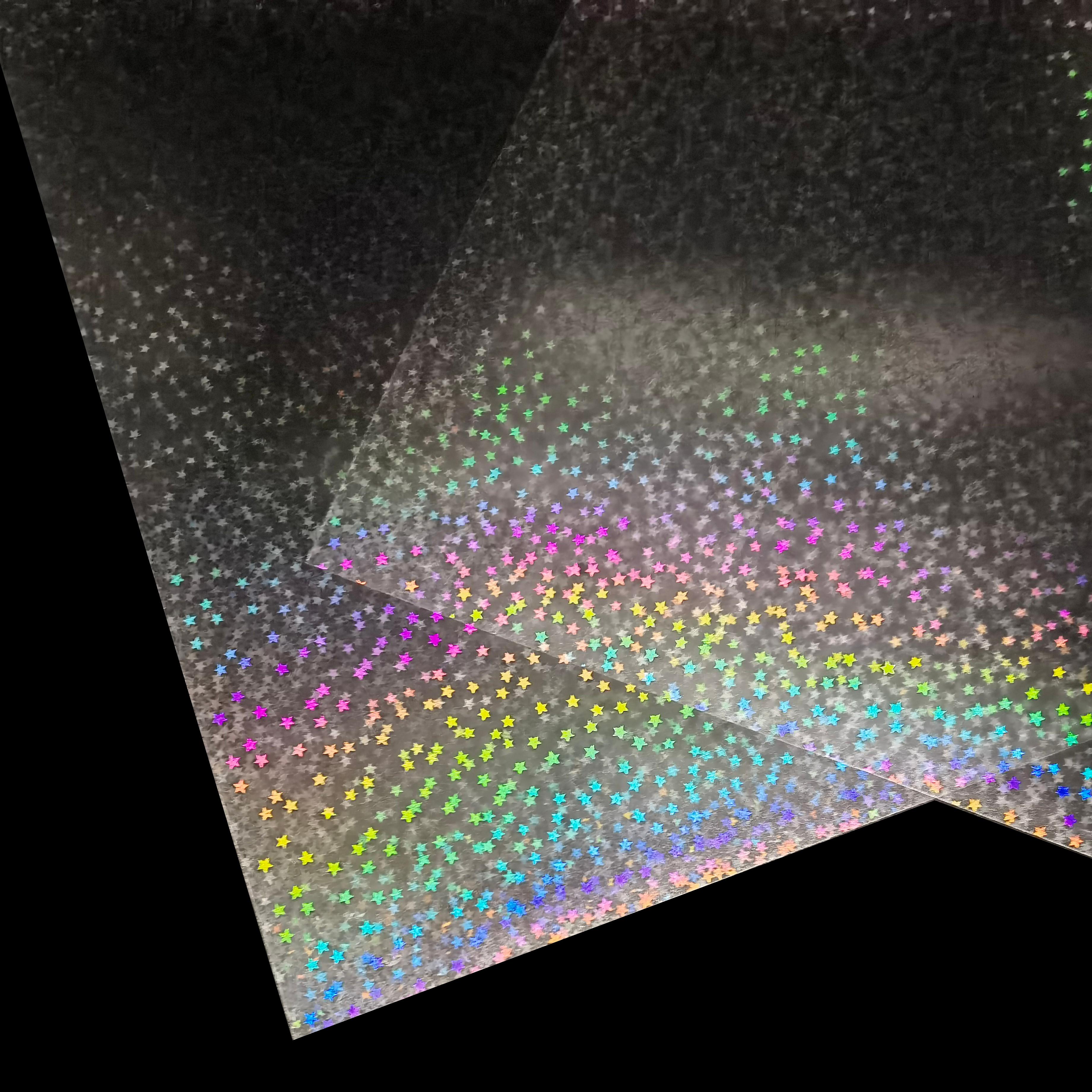
Custom Holographic PVC Rainbow Overlay Film for Card Manufacturing
Wallis holographic PVC rainbow overlay film is a transparent decorative and protective card-lamination material developed for professional plastic card manufacturers. The overlay adds an angle-dependent rainbow or diffractive pattern while allowing printed graphics, text, photographs, barcodes and other card information to remain visible.
The material can be supplied with standard rainbow patterns or project-specific optical designs for membership cards, gift cards, VIP cards, hotel key cards, access cards, identification cards, banking-related card projects and other laminated PVC card applications. Thickness, sheet size, pattern direction, transparency, coating grade, packing and private labeling can be discussed for OEM production.
Important product distinction: this page describes sheet-form PVC overlay for controlled card lamination. Desktop card-printer overlaminates, pressure-sensitive cold-lamination films, hot-stamping foils and rigid holographic PVC core sheets are different products and should not be treated as interchangeable.
Holographic PVC Overlay Specifications
| Parameter | B2B Specification | Buyer Confirmation |
| Product Type | Transparent or semi-transparent holographic PVC card overlay film | Confirm sheet-form hot-lamination overlay rather than printer ribbon, pressure-sensitive film or hot-stamping foil. |
| Base Material | PVC overlay grade for compatible PVC card structures | Other card-body materials require bonding and finished-card testing before approval. |
| Current Thickness Range | Approximately 0.04–0.10mm according to the supplied product information; customized options subject to confirmation | Specify each front and back overlay thickness and the target finished-card thickness. |
| Sheet Size | Customized width and length; common card-production formats can be evaluated | Provide press size, printed-core size, card matrix, trim margin and feed direction. |
| Optical Effect | Rainbow, dot, star, grid, geometric, light-beam, logo or project-specific holographic pattern | Approve a physical effect sample because appearance changes with lighting, substrate color and viewing angle. |
| Transparency | Transparent or semi-transparent, depending on pattern density and construction | Define acceptable visibility of photographs, fine text, QR codes, barcodes and security printing. |
| Surface Finish | Glossy holographic; other finishes subject to project evaluation | Confirm gloss, haze, texture and scratch requirements on the final laminated card. |
| Lamination | Designed for qualified card hot-lamination processes with compatible coating, inks and core sheets | Temperature, pressure, dwell time, cooling and stacking conditions must be validated on the buyer’s equipment. |
| Printing | Normally laminated over a printed card core; direct printing requires a suitable treated or coated grade | Identify ink system, printing side, curing method and whether the overlay itself will be printed. |
| Customization | Pattern, logo, text, orientation, size, coating, packing and labeling | Custom security artwork may require origination, proofing, registration criteria and project-specific minimum quantities. |
All final values—including thickness tolerance, sheet tolerance, optical density, haze, coating strength, lamination window, peel performance, pattern registration and order quantity—should be confirmed in the approved specification, quotation and physical sample.
What Is Holographic PVC Card Overlay?
Holographic PVC card overlay is a thin transparent layer placed above or below a printed card core during hot lamination. The overlay helps form the outer card surface while carrying a diffractive optical pattern that produces changing rainbow colors under different lighting and viewing angles.
In a qualified card structure, the overlay can combine three functions: protecting printed information from routine handling, supporting bonding between card layers, and adding a visible decorative or verification feature. Performance depends on the complete card construction rather than the overlay alone.
Typical Laminated Card Structure
| Layer | Typical Function | Critical Check |
| Front Holographic Overlay | Optical effect, printed-image protection and surface finish | Pattern orientation, transparency, coating side and feature placement |
| Printed Front Core | Artwork, personalization background, text and brand colors | Ink cure, total ink coverage and bonding compatibility |
| Middle Core or RFID Prelam | Card thickness, stiffness, chip and antenna structure where applicable | Layer thickness, antenna clearance, chip position and lamination pressure |
| Printed Back Core | Reverse graphics, instructions, signature or magnetic-stripe background | Registration, ink compatibility and functional-area clearance |
| Back Overlay | Reverse-side protection; may be clear, holographic or magnetic-stripe overlay | Thickness balance, stripe position, coating and final flatness |
Overlay Is Different from Holographic Core Sheet
A holographic overlay is generally a thin transparent outer layer. A holographic PVC core sheet is thicker and acts as a structural or decorative card-body layer. Selecting the wrong product can change final thickness, print opacity, lamination behavior and punching quality.
Overlay Is Different from Printer Overlaminate
Roll-form overlaminates used in desktop card printers are engineered for specific printer and laminator models. Sheet-form PVC overlay for industrial hot-press card production should not be assumed to fit those machines.
Available Holographic Effect Options
| Overlay Option | Visual or Security Purpose | Best-Fit Card Projects | Approval Focus |
| Transparent Rainbow Pattern | Adds an angle-dependent color spectrum while keeping underlying printing visible | Membership, gift, hotel, access and promotional cards | Transparency over photographs, text and barcodes |
| Standard Repeating Pattern | Uses stars, dots, grids, waves or geometric motifs for consistent decoration | High-volume commercial card programs | Pattern repeat, direction, seam and card-to-card consistency |
| Custom Logo or Text Pattern | Integrates a brand mark, institution name or project-specific visual element | Brand programs, premium cards and controlled-issue projects | Artwork ownership, origination proof, logo scale and registration |
| Fine-Line or Microtext Concept | Can provide more detailed visual authentication when supported by the selected production process | Identification and higher-security programs | Feature resolution, readability, authentication method and approved master |
| Partial or Registered Holographic Area | Places the effect in a defined area rather than across the full card | Cards with portraits, windows, chips, signatures or controlled branding zones | X/Y registration tolerance, card matrix and punching alignment |
| Decorative Dense Effect | Creates a stronger visual impact but may reduce visibility of the printed design | VIP, luxury, entertainment and gift cards | Opacity, white-underprint strategy and artwork contrast |
A standard holographic pattern can improve visual differentiation, but it should not be represented as a complete anti-counterfeiting system by itself. Higher-security projects should define authentication features, controlled artwork, issuance controls and the complete credential-security architecture.
Hot Lamination, Cold Lamination and Hot Stamping Compared
| Process | Material Format | How It Is Applied | Important Limitation |
| Industrial Hot-Press Card Lamination | Sheet-form PVC overlay | Heat, pressure, dwell time and controlled cooling bond all card layers | Requires matching core, ink, coating and lamination parameters |
| Pressure-Sensitive Cold Lamination | Self-adhesive film | Pressure-sensitive adhesive bonds without a card hot-press cycle | This is a different adhesive construction and is not the default product described here |
| Hot Stamping | Transfer foil on a carrier | Heat and pressure transfer selected holographic areas to the card surface | Not a full protective overlay layer; tooling and transfer conditions differ |
| Desktop Printer Overlamination | Model-specific roll laminate or patch laminate | Applied by an integrated or external card-printer laminator | Must match the printer model, patch geometry, sensor marks and roll core |
Why the Lamination Window Must Be Tested
Excessive temperature or dwell time may distort the optical pattern, cause haze, shrink the sheet or create card warpage. Insufficient heat, pressure or coating compatibility may cause bubbles, edge lifting or delamination. The correct window must be established using the actual printed core, overlay thickness, press, separator plates and cooling cycle.
Printing and Artwork Compatibility
For most card structures, artwork is printed on the card core and the holographic overlay is laminated over it. Direct printing on the overlay should only be specified when the supplied surface has been developed and tested for the relevant ink system.
| Production Method | Recommended Evaluation | Typical Risk |
| Offset-Printed Core + Overlay | Check oxidative or UV ink cure, ink coverage, coating grade and peel strength after lamination | Poor bonding over heavy ink coverage or incompletely cured ink |
| Silk-Screen-Printed Core + Overlay | Check ink thickness, solvent release, surface flatness and edge bonding | Raised ink deposits, trapped solvent or local bubbles |
| UV Digital-Printed Core + Overlay | Verify cured ink chemistry and adhesion to the chosen coated overlay | Delamination where ink and overlay coating are incompatible |
| Direct Printing on Overlay | Use a project-specific printable grade and test surface energy, ink adhesion and curing | Weak ink adhesion, scratching or visual distortion |
| Barcode, QR Code and Fine Text | Scan and inspect after final lamination under multiple lighting angles | Dense holographic effects can reduce contrast or scanner readability |
Applications for Holographic PVC Overlay
Membership, Loyalty and VIP Cards
A transparent rainbow overlay can increase visual differentiation and protect printed brand graphics on cards used by retailers, clubs, entertainment venues, gyms, restaurants and premium membership programs.
Gift, Prepaid and Promotional Cards
Holographic effects can support seasonal campaigns, limited editions and high-impact promotional artwork. Buyers should verify barcode readability, scratch performance and packaging-line compatibility on the finished card.
Hotel Key and Access Cards
The overlay can be integrated into compatible magnetic-stripe, RFID or contactless card structures. Pattern placement must avoid interfering with functional zones, and the complete card should be tested in the intended lock or reader system.
Identification and Controlled-Issue Cards
Custom optical patterns can provide a visible authentication cue. Government, financial and high-security projects should define the required standards, security level, artwork control, traceability and validation process rather than relying on a generic rainbow effect.
Banking-Related and Smart Card Projects
For payment or dual-interface projects, the overlay must be evaluated as part of the full approved card construction. Chip-module milling, antenna position, magnetic stripe, signature panel, embossing, personalization and applicable program requirements must all be considered.
Quality Control for B2B Card Production
| Inspection Item | What to Check | Recommended Stage |
| Thickness and Sheet Size | Average thickness, cross-sheet uniformity, length, width, squareness and edge quality | Incoming inspection and batch release |
| Transparency and Haze | Visibility of portraits, text, graphics and machine-readable elements after lamination | Sample approval and finished-card inspection |
| Pattern Appearance | Color shift, brightness, pattern density, repeat consistency, defects and contamination | Incoming inspection under defined lighting |
| Pattern Direction and Registration | Longitudinal/transverse orientation, X/Y position and alignment to card cutting layout | Artwork proof, trial sheet and production start-up |
| Coating Side and Bonding | Correct coating orientation, peel behavior, edge bonding, bubbles and delamination | Lamination trial and aging evaluation |
| Surface Quality | Scratches, dents, blocking, dust, gloss variation and handling marks | Incoming and final inspection |
| Finished-Card Geometry | Total thickness, flatness, warpage, edge condition and punching quality | After lamination, cooling and card punching |
| Functional Compatibility | Barcode/QR scanning, magnetic-stripe encoding, RFID reading, chip-module processing and personalization | Pilot production using actual equipment |
Recommended Golden Sample Process
Confirm the card structure, finished thickness, overlay position and functional zones.
Select a standard pattern or approve custom optical artwork and orientation.
Produce a material sample using the proposed thickness, coating and sheet layout.
Print the actual card core with production ink and normal ink coverage.
Laminate, cool and punch cards using the buyer’s intended equipment and process.
Inspect appearance, peel strength, bubbles, warpage, scanning and functional performance.
Approve and retain a signed physical Golden Sample as the visual and process reference for bulk production.
Customization Information Required for a Quote
| Information | Details to Provide |
| Card Application | Membership, gift, hotel, access, ID, banking-related, RFID/NFC or other card type |
| Card Construction | Front overlay, printed cores, middle core or inlay, back overlay and target finished thickness |
| Overlay Requirement | Thickness, sheet size, coating grade, transparency, gloss and front/back usage |
| Holographic Effect | Standard rainbow, star, dot, grid, geometric, logo, text, partial feature or registered pattern |
| Layout | Card matrix, pattern direction, repeat length, X/Y registration and functional-area clear zones |
| Printing Process | Offset, UV offset, silk screen, UV digital or other system; identify ink supplier and curing method where possible |
| Lamination Equipment | Press model, plate type, normal temperature, pressure, dwell time and cooling method |
| Quality Requirements | Transparency, haze, peel, scratch, card flatness, scanning, RFID, magnetic stripe or other acceptance criteria |
| Commercial Information | Sample quantity, estimated order volume, packaging, labels, destination and requested documentation |
Packaging and Handling
Holographic overlay sheets should be protected from dust, scratching, moisture, edge impact and uncontrolled heat during storage and international transportation. Packing can include protective film, moisture-resistant wrapping, cartons, pallets, corner protection and customized labels according to the confirmed specification.
Keep the coating side and pattern direction clearly identified.
Store sheets flat in the original packaging and avoid heavy uneven loads.
Allow material to acclimatize to the production environment before opening.
Use clean gloves and dust-controlled handling for optical-quality surfaces.
Confirm storage period and conditions in the final technical documentation.
Why Source Holographic Overlay from Wallis?
Wallis supports card manufacturers, security printers, plastic-card converters, distributors and OEM programs with holographic overlay material selection, physical samples, customized pattern development, sheet conversion, export packing and related card-material sourcing.
Standard and custom holographic effect options.
Customized overlay thickness, size, pattern direction, coating and packaging.
Sample support for printing, lamination, punching and finished-card testing.
Related PVC core, printable sheet, magnetic-stripe overlay and RFID inlay materials.
B2B communication based on drawings, specifications, approved samples and batch requirements.
Customer Feedback
The following original customer-feedback image has been retained from the supplied page content.
![Customer feedback about Wallis card materials]()
Frequently Asked Questions
What is holographic PVC overlay film used for?
It is laminated over a printed plastic-card core to add a transparent rainbow or custom optical effect, protect printed graphics and help form the finished card surface.
Is holographic overlay the same as holographic PVC core sheet?
No. Overlay is usually a thin transparent outer layer. Holographic core sheet is a thicker structural or decorative layer inside the card body. Their thickness, printing and lamination roles are different.
What thicknesses are available?
The supplied product information lists approximately 0.04–0.10mm. The correct thickness depends on the front and back overlays, core layers, RFID inlay and target finished-card thickness. Final options must be confirmed in the quotation and approved sample.
Can the holographic pattern and logo be customized?
Custom logos, text, geometry and project-specific visual patterns can be evaluated. Development normally requires artwork review, origination, physical proofing, registration criteria and commercial confirmation.
Does a holographic overlay guarantee that a card cannot be counterfeited?
No single decorative overlay can guarantee complete protection. A custom holographic feature can support visual authentication, but secure credentials also require controlled artwork, issuance, data security, personalization and other project-specific safeguards.
Can the overlay be printed directly?
The normal structure places the overlay over a printed core. Direct printing is possible only when the supplied overlay has a suitable printable treatment and passes adhesion, curing and lamination tests with the buyer’s actual ink system.
Is this suitable for standard PVC hot lamination?
It is intended for qualified PVC card lamination, but the buyer must validate temperature, pressure, time, cooling, coating and ink compatibility through a production sample.
Can it be used with PETG, ABS or PC card bodies?
Material combinations may be possible, but bonding, dimensional stability and finished-card durability must be tested. A PVC overlay should not automatically be assumed to bond correctly to every alternative card substrate.
Can the overlay be used on RFID or NFC cards?
Yes, when included in a validated RFID or NFC card construction. The full card should be tested after lamination and punching to verify antenna performance, chip position, card flatness and target reading behavior.
How should pattern registration be specified?
Provide the complete sheet layout, card matrix, punching line, feature coordinates, feed direction, pattern repeat and acceptable X/Y tolerance. A registered trial sheet should be approved before bulk production.
What should be tested before a bulk order?
Test appearance, transparency, haze, print visibility, coating side, peel strength, bubbles, edge bonding, scratches, warpage, final thickness, punching and any barcode, magnetic-stripe, chip or RFID functions.
What information is required for a fast quotation?
Send the card application, layer structure, finished thickness, overlay thickness, sheet size, pattern, transparency, registration, ink process, lamination settings, estimated quantity, packing and destination.