Solid Diamond Embossed Polycarbonate Sheet for Light Diffusion and Privacy
Wallis solid diamond embossed polycarbonate sheet is a durable textured PC panel designed for architectural glazing, roofing, skylights, partitions, privacy screens, canopies, signage, displays and industrial protective applications.
The embossed diamond surface scatters direct light, reduces harsh glare and limits clear see-through visibility while still allowing natural light to pass through the panel. This makes it suitable for projects requiring a balance of light diffusion, visual privacy, impact resistance and decorative appearance.
Manufactured from virgin polycarbonate resin, Wallis textured PC panels are available in 1–20mm thickness, widths up to 2100mm, standard export lengths of 5800mm and 6000mm, and customized cut sizes. Available colors include clear, green, opal, bronze, blue, orange and red.
UV-protected grades can be supplied for outdoor applications. Buyers should specify whether UV protection is required on one side or both sides, together with the project location, installation direction and expected outdoor service conditions.
Diamond Textured Polycarbonate Sheet Specifications
| Product Type | Solid Embossed Diamond Textured Polycarbonate Sheet |
| Material | Virgin Polycarbonate / PC Resin |
| Surface | Diamond Embossed / Textured Surface |
| Thickness | 1.0–20mm or Customized |
| Standard Widths | 1220 / 1560 / 1820 / 2100mm |
| Standard Lengths | 5800 / 6000mm; custom cut lengths available |
| Colors | Clear / Green / Opal / Bronze / Blue / Orange / Red / Customized |
| Listed Light Transmission | Approximately 50% for the currently listed grade; actual value depends on thickness, texture and color |
| UV Protection | Optional co-extruded UV-protective surface for outdoor applications |
| Texture Functions | Light Diffusion / Glare Reduction / Privacy / Decorative Surface |
| Fabrication | Cutting / CNC Routing / Drilling / Cold Bending / Thermoforming |
| Typical Applications | Skylights, Canopies, Partitions, Privacy Screens, Displays, Signage, Machine Guards and Decorative Panels |
| Customization | Thickness / Width / Length / Color / UV Side / Cutting / Packaging |
Note: Light transmission, impact strength, fire performance, UV warranty, allowable span, bending radius and outdoor service life should be confirmed for the exact thickness, color and UV configuration ordered.
Technical Property Data
The following table combines Wallis' currently listed product data with corrected engineering units. Values without a stated test method should be confirmed against the final technical data sheet or batch test report before they are used as contractual specifications.
| Property | Unit | Listed / Reference Value | Technical Note |
| Impact Strength | J/m | 88–92 | Confirm test standard and specimen thickness |
| Light Transmission | % | Approximately 50 | Depends strongly on color, thickness and texture depth |
| Density | g/cm³ | Approximately 1.2 | Corrected from the original incorrect unit of g/m |
| Elongation at Break | % | ≥130 | Confirm test standard and sheet grade |
| Coefficient of Linear Thermal Expansion | mm/m·K | Approximately 0.065 | Thermal-expansion clearance is required during installation |
| Listed Service Temperature | °C | −40 to +120 | Continuous-use limits depend on load, exposure and sheet grade |
| Typical PC Thermal Conductivity | W/(m·K) | Approximately 0.2 | The original 2.3–3.9 W/m²·°C value appears to be an unrelated U-value range |
| Flexural Strength | N/mm² | Approximately 100 | Confirm test standard and production grade |
| Modulus of Elasticity | MPa | Approximately 2400 | Useful for engineering deflection calculations |
| Tensile Strength | N/mm² | ≥60 | Confirm test standard and production grade |
| Sound Reduction | dB | Project-Specific | Requires a stated acoustic test standard, thickness and complete installation assembly |
Engineering values should not be transferred automatically between different sheet colors, UV grades, recycled-content formulations or surface patterns. Request the final TDS for the exact product configuration.

Solid Embossed Diamond Textured Polycarbonate Sheet

Diamond Textured PC Surface

Colored Textured PC Panel
What Is Diamond Embossed Polycarbonate Sheet?
Diamond embossed polycarbonate is a solid PC sheet containing a repeating raised or recessed diamond-shaped surface pattern. The texture is normally formed during sheet extrusion, creating an integrated surface rather than a separate printed decorative layer.
When light reaches the textured surface, the diamond geometry changes the direction of transmission and reflection. This produces softer, more widely distributed illumination than a smooth transparent panel and makes objects behind the sheet less clearly visible.
Light Diffusion
The textured surface scatters incoming light in multiple directions, reducing concentrated bright spots and creating a softer lighting effect for skylights, partitions, decorative panels and lighting components.
Glare Reduction
Compared with a smooth glossy surface, diamond embossing reduces direct specular reflection and can help control harsh glare in brightly lit architectural or interior environments.
Semi-Privacy
The surface pattern distorts visible details behind the panel while still transmitting light. It is therefore useful for partitions, doors, privacy screens and decorative glazing where complete opacity is not required.
Decorative Appearance
Diamond patterns add depth, reflection and visual movement to the surface, allowing the sheet to function as both an engineering glazing material and a decorative architectural panel.
Key Advantages of Diamond Textured PC Panels
High Impact Resistance
Solid polycarbonate provides high impact resistance for glazing, partitions, machine guards and protective panels. It is less likely than ordinary glass to break into dangerous sharp fragments after accidental impact.
Lightweight Alternative to Glass
With a density of approximately 1.2g/cm³, polycarbonate is significantly lighter than glass. This can reduce transportation weight, manual handling difficulty and structural loading.
Decorative Privacy Without Blocking All Light
Diamond texture provides visual screening and softer light without producing a completely opaque wall, making it suitable for offices, bathrooms, public buildings and retail interiors.
Custom Thicknesses and Colors
Wallis supports clear, opal, bronze, blue, green, orange and red options in different thicknesses and panel dimensions for project-specific visual and performance requirements.
Easy Fabrication
Suitable PC grades can be cut, drilled, routed, cold bent and thermoformed. This gives fabricators more flexibility for custom signs, curved structures, protective panels and architectural components.
Outdoor UV-Protected Options
Co-extruded UV-protected configurations help reduce yellowing and degradation during outdoor exposure. Exterior projects should use the correct UV grade and install the protected surface facing the sun.


Diamond PC Sheet Performance

Decorative Textured PC Panel
Diamond Textured vs Smooth Polycarbonate Sheet
| Comparison | Diamond Textured PC | Smooth Clear PC |
| Visual Clarity | Distorted view for semi-privacy | Clear see-through visibility |
| Light Distribution | Diffuses and scatters light | Primarily transmits light directly |
| Glare | Reduced direct glare | More specular reflection |
| Appearance | Decorative patterned surface | Clean flat surface |
| Typical Applications | Partitions, decorative glazing, diffusers, canopies and privacy panels | Safety glazing, machine guards, windows and clear protective panels |
Applications of Diamond Embossed Polycarbonate Sheets
Interior Partitions and Privacy Screens
Diamond textured panels allow natural or artificial light to pass through while obscuring detailed visibility, making them suitable for office partitions, bathroom screens, room dividers and semi-private public spaces.
Skylights and Daylighting Panels
The embossed surface diffuses incoming daylight and helps reduce concentrated glare. UV-protected grades can be considered for skylights and roof-light applications subject to structural and installation requirements.
Canopies, Awnings and Covered Walkways
Lightweight textured polycarbonate provides impact-resistant shelter while allowing diffused daylight into entrances, patios, walkways and commercial covered areas.
Architectural and Decorative Glazing
The diamond surface can be used as a decorative element in wall panels, doors, atriums, retail interiors, furniture and branded environments.
Signage and Display Panels
Textured PC panels provide a distinctive background or light-diffusing surface for signs, exhibition displays, point-of-sale fixtures and illuminated decorative components.
Machine Guards and Industrial Screens
Impact-resistant solid PC can be used for protective barriers and equipment enclosures where full optical transparency is not required. Machine-guard suitability should be checked against the required safety standard and impact rating.
Greenhouse and Agricultural Structures
UV-protected textured panels may be considered for selected agricultural glazing where light diffusion is beneficial. Crop-light requirements, sheet thickness and thermal performance should be evaluated for the specific greenhouse design.

Applications of Diamond Textured PC Sheet
How to Choose the Right Diamond PC Sheet
1. Confirm the Required Thickness
Thin sheets can be used for decorative overlays, signs and supported panels, while thicker sheets provide greater stiffness for partitions, protective panels and larger architectural components. Final thickness should be selected using panel dimensions, support spacing and load requirements.
2. Select the Color and Light Transmission
Clear or lightly tinted grades provide more daylight, while opal, bronze and darker colors provide greater privacy and lower visible light transmission. Request physical samples where color or privacy performance is important.
3. Confirm Indoor or Outdoor Use
Interior panels may not require the same UV protection as outdoor glazing. Exterior applications should specify one-side or two-side UV protection and ensure the protected surface is installed toward solar exposure.
4. Define the Required Privacy Level
Privacy depends on diamond size, texture depth, sheet color, panel thickness, lighting direction and viewing distance. Sample evaluation is recommended before large partition or privacy-screen projects.
5. Confirm Fabrication Requirements
Tell Wallis whether the sheet will be cut, drilled, CNC routed, cold bent, thermoformed, printed or bonded. Fabrication tests may be required for complex shapes and appearance-sensitive projects.
6. Confirm Texture Orientation
Confirm whether the embossed surface should face the visible side, protected side or interior side of the installation. Orientation can affect appearance, cleaning and visual privacy.
Cutting, Drilling and Fabrication Guidelines
Saw Cutting and CNC Routing
Diamond polycarbonate can be cut using suitable fine-tooth saw blades or CNC tools designed for plastics. The sheet should be fully supported to reduce vibration and edge chipping.
Drilling
Use sharp drills suitable for polycarbonate and avoid excessive pressure or heat. Outdoor fastening holes should include sufficient clearance for thermal expansion.
Cold Bending
Some sheet thicknesses can be cold curved within an appropriate minimum bending radius. Excessively tight bending can create stress, distortion or long-term cracking.
Thermoforming
Polycarbonate can be thermoformed after appropriate drying and controlled heating. Deep forming may stretch or visually distort the diamond texture, so prototype evaluation is recommended.
Printing and Bonding
Ink, adhesive and sealant systems should be tested for compatibility with polycarbonate. Aggressive solvents can cause stress cracking or surface damage.
Installation Considerations
Allow for Thermal Expansion
Polycarbonate expands approximately 0.065mm per meter for each 1°C temperature change. Frames, holes and edge clearances should allow movement instead of rigidly clamping the panel.
Install the UV Side Correctly
On one-side UV-protected sheets, the marked protected surface must face sunlight. Keep the identifying protective film in place until orientation has been confirmed.
Avoid Over-Tightening Fasteners
Over-tightened fasteners can create local stress, cracks or visible panel distortion. Use compatible washers and gaskets to distribute pressure.
Use Compatible Sealants
Sealants and adhesives should be confirmed as polycarbonate-compatible and free from solvents or plasticizers that could attack the sheet.
Cleaning and Maintenance
Clean textured PC panels using clean water, mild polycarbonate-compatible detergent and a soft cloth or sponge. Avoid abrasive pads, sharp scrapers and aggressive solvent cleaners.
Because dirt can collect within the embossed surface pattern, rinse loose particles away before wiping. Do not apply excessive pressure that could scratch the raised texture.
Why Choose Wallis Diamond Textured Polycarbonate?
Virgin polycarbonate resin options
1–20mm thickness range
Widths up to 2100mm
Custom cut lengths and panel dimensions
Clear, opal, bronze, blue, green, orange and red colors
UV-protected outdoor grades
Light-diffusing and privacy texture
CNC, cutting, drilling and thermoforming support
Sample evaluation before bulk production
Custom protective film and packaging
OEM / ODM supply for distributors and project buyers

Quality Inspection and Testing
Quality inspection for textured polycarbonate can include dimensional measurement, surface-pattern inspection, light transmission, haze, impact performance, UV aging and appearance evaluation.

Transmittance & Haze

Taber Abrasion Tester

Salt Spray Tester

UV Weathering Tester
Information Needed for an Accurate Quote
Required thickness
Required width and length
Full sheet or cut-to-size panels
Required color
Required quantity
Indoor or outdoor application
One-side or two-side UV protection
Required light transmission or privacy level
Texture side orientation
Cutting, drilling, bending or thermoforming requirements
Fire-performance requirement
Project location and service temperature
Protective-film requirement
Packaging and delivery requirements
Global B2B Supply
Wallis supplies textured polycarbonate sheets to construction-material distributors, glazing contractors, signage manufacturers, display factories, interior contractors and industrial panel fabricators.

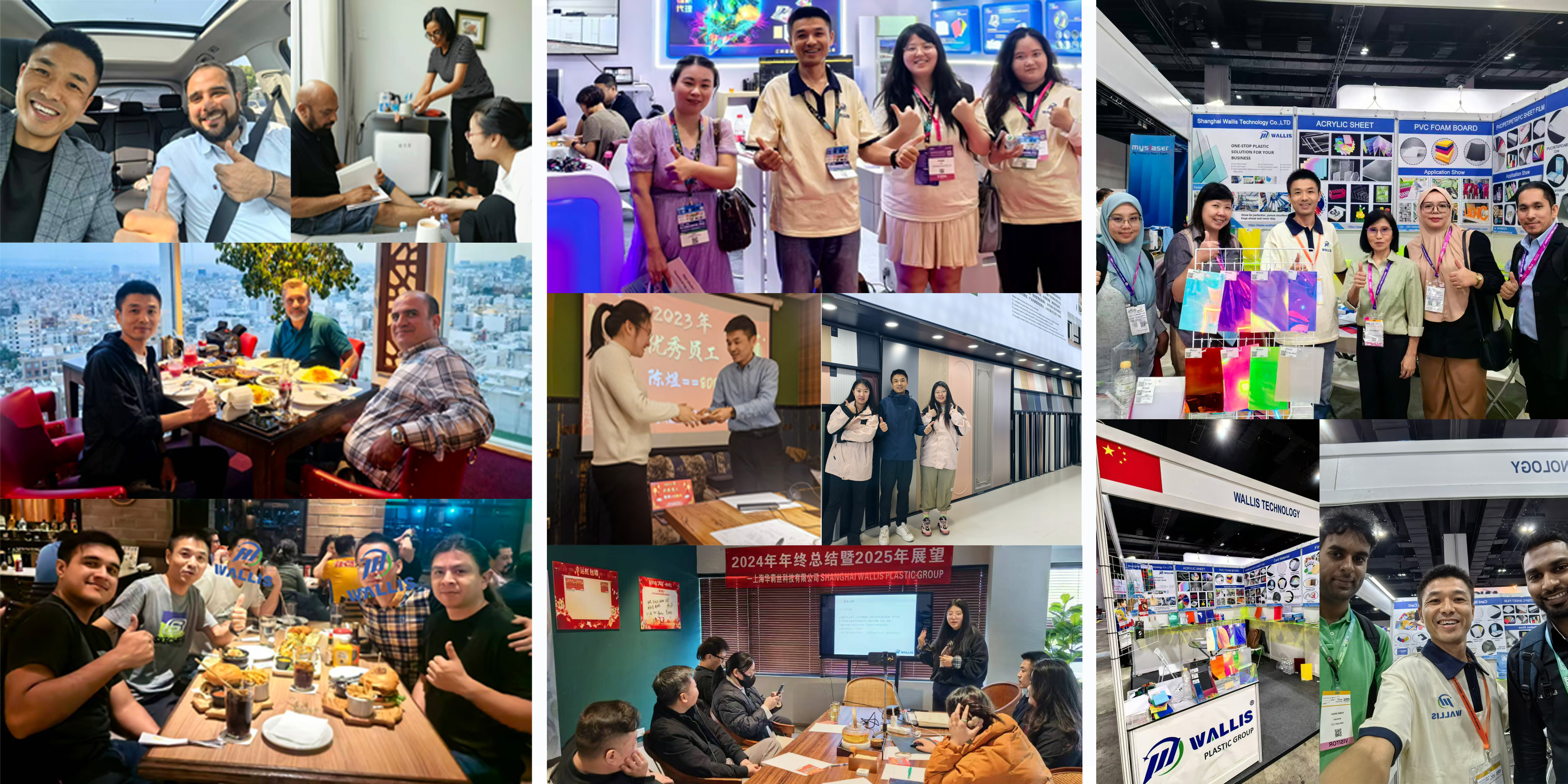
Company Daily Operations
Customer Feedback
Wallis supports sample confirmation, specification review, custom dimensions, packaging and project communication for international polycarbonate-sheet buyers.

Frequently Asked Questions About Diamond Textured Polycarbonate
What is diamond embossed polycarbonate sheet?
It is a solid polycarbonate sheet with an integrated diamond-shaped surface texture. The texture diffuses light, reduces glare, provides semi-privacy and adds a decorative visual effect.
What thicknesses can Wallis supply?
Wallis currently lists thicknesses from 1–20mm. Available textured thicknesses may depend on color, panel width and minimum production quantity, so the exact specification should be confirmed before ordering.
What widths are available?
Current standard widths include 1220mm, 1560mm, 1820mm and 2100mm. Custom-cut panel widths can also be discussed.
What colors are available?
Wallis currently lists clear, green, opal, bronze, blue, orange and red. Custom colors may be available subject to production quantity and color-matching requirements.
Does diamond texture provide complete privacy?
It normally provides semi-privacy rather than complete opacity. Privacy varies with texture depth, color, lighting direction, viewing distance and the distance between the panel and objects behind it.
How does the texture reduce glare?
The diamond pattern scatters light rather than reflecting or transmitting it in one concentrated direction. This produces a softer and more diffuse appearance.
What is the light transmission?
The current page lists approximately 50% for the shown grade. Actual transmission can vary substantially with thickness, color, diamond pattern and UV formulation, so request data for the exact configuration.
Can diamond polycarbonate be used outdoors?
Yes, when an appropriate UV-protected grade is selected and installed correctly. Confirm whether the sheet has one-side or two-side UV protection and install the protected side toward sunlight.
Can the sheet replace glass?
It can replace glass in many decorative, privacy and impact-resistant glazing applications. Structural design, fire requirements, optical expectations and building regulations should still be checked for each project.
Can the sheet be cut and drilled?
Yes. It can be cut, CNC routed and drilled using suitable plastic-processing tools. The sheet should be properly supported and outdoor holes should allow thermal movement.
Can textured polycarbonate be cold bent?
Some configurations can be cold curved within an appropriate minimum radius. The required radius depends on sheet thickness, orientation and installation conditions.
Can the sheet be thermoformed?
Polycarbonate can be thermoformed after suitable drying and controlled heating. Forming may stretch or distort the diamond texture, so a prototype should be tested before mass production.
Which side should face outward?
For outdoor one-side UV sheets, the UV-protected side must face sunlight. Texture orientation should be selected according to appearance, privacy, cleaning and project design.
Is diamond textured polycarbonate scratch-resistant?
The texture can make minor marks less visually obvious than on a smooth glossy surface, but standard polycarbonate is not scratch-proof. A separate hard-coated grade is required where high abrasion resistance is critical.
How should the sheet be cleaned?
Use clean water, mild polycarbonate-compatible detergent and a soft non-abrasive cloth. Rinse away dust before wiping and avoid aggressive solvents or abrasive cleaning pads.
Can Wallis supply custom-cut panels?
Yes. Custom-cut dimensions can be discussed according to thickness, width, quantity, tolerance and fabrication requirements.
Can I request samples before a bulk order?
Yes. Sample evaluation is recommended for confirming color, texture, privacy, light diffusion, thickness and fabrication compatibility before bulk production.
What information should I provide for a quotation?
Provide the thickness, width, length, color, quantity, indoor or outdoor use, UV-side requirement, privacy or light-transmission target, fabrication requirements and packaging method.
Request a Quote for Diamond Textured Polycarbonate Panels
Looking for a diamond embossed polycarbonate sheet manufacturer for roofing, partitions, privacy screens, signage, decorative glazing or industrial panels? Wallis supplies solid textured PC sheets in customized thicknesses, colors and dimensions for B2B projects.
Send your thickness, panel size, color, quantity, UV requirement and application to receive a suitable product recommendation, sample and factory quotation.