Polycarbonate Core Sheet for Secure ID Cards and Passport Data Pages
Wallis polycarbonate core sheet is supplied to security printers, card manufacturers, inlay producers, system integrators and document contractors developing multilayer identity credentials. White, transparent and project-specific PC grades can be configured for national ID cards, driving licences, residence permits, e-passport data pages, access credentials and other long-life card structures.
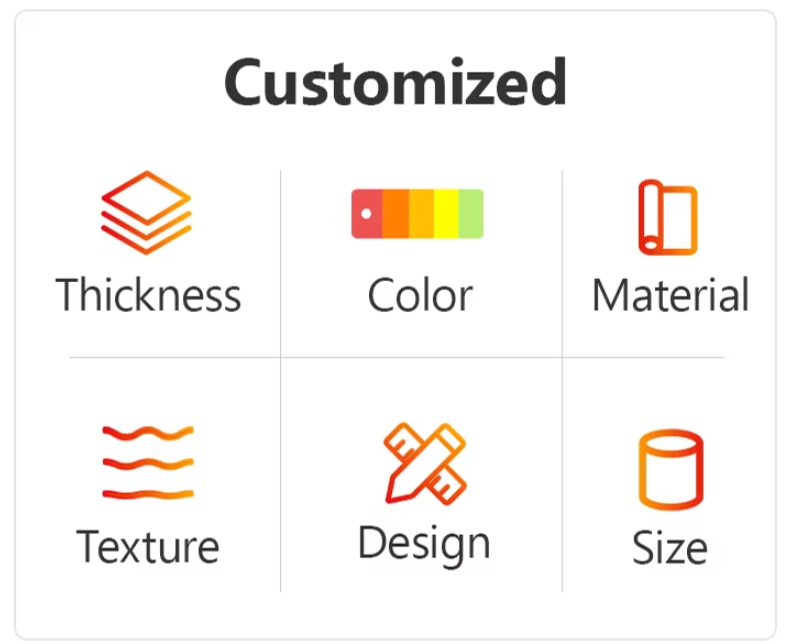
Available thicknesses range from 50μm to 800μm, with standard sheet formats such as 505×590mm and 295×485mm. Buyers can specify thickness, opacity, color, surface texture, printing treatment, laser response, protective film and export packaging according to the approved document construction and production equipment.
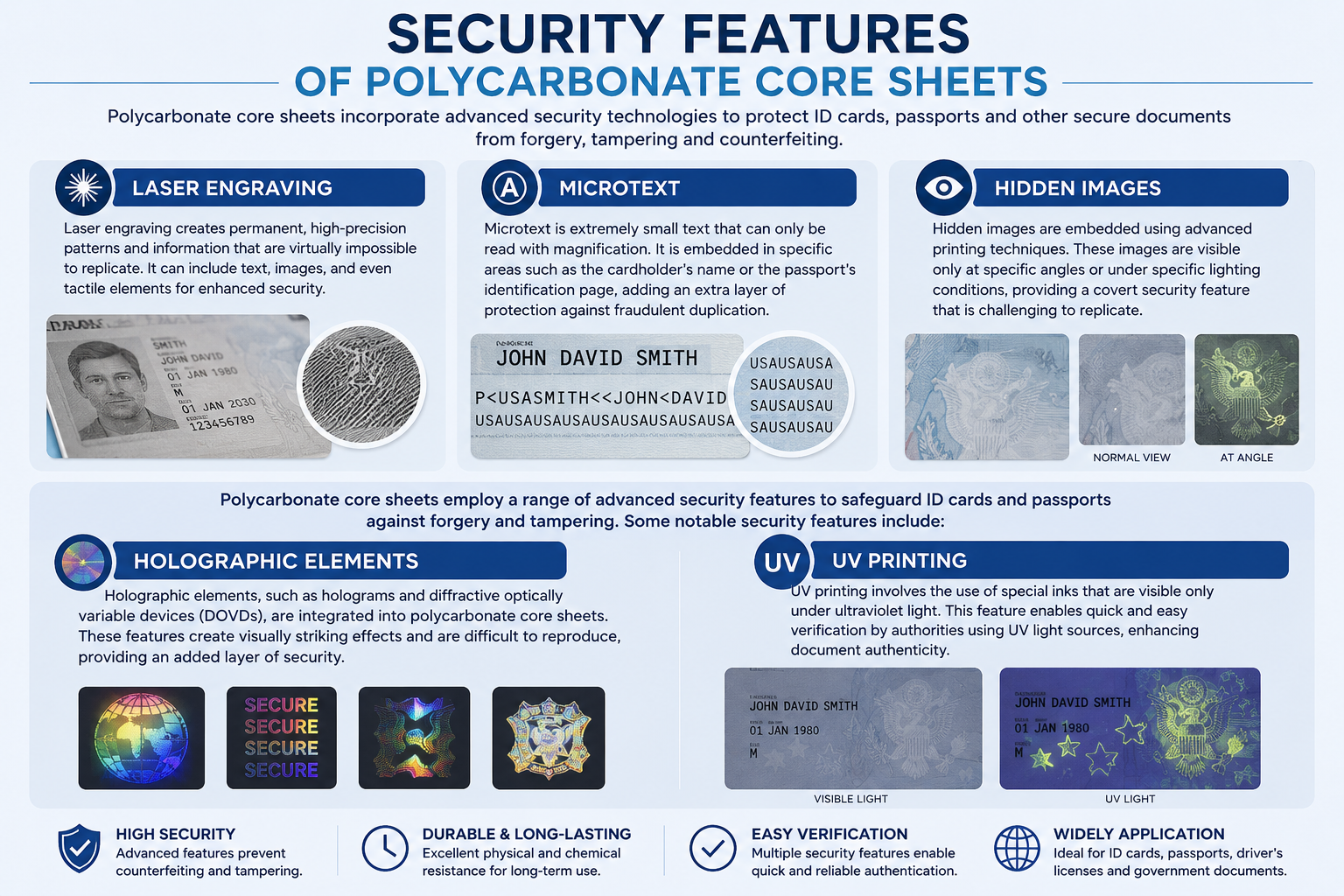
Important selection note: “PC core sheet,” “printable PC film,” “laserable PC film” and “transparent PC overlay” describe different functional layers. Laser marking performance is formulation- and layer-specific; it must be confirmed with the actual laser system, layer stack and personalization target before bulk production.
Full-PC document structures: designed for compatible polycarbonate layers that fuse under controlled heat and pressure.
Project-specific printing: offset, screen and UV printing can be evaluated with the selected ink and curing system.
Laserable options: available when the specified layer must generate controlled grayscale or black contrast.
OEM conversion: customized thickness, sheet size, color, surface and packaging for industrial production.
Sample validation: printing, lamination, laser, cutting and finished-document tests before commercial approval.
Request PC Core Sheet Samples and Technical Review

Technical Specifications for B2B Procurement
The values below describe the current product range and typical reference data. Final tolerances, optical properties, laser response, lamination parameters and acceptance criteria should be recorded in the approved technical specification or Golden Sample for each project.
| Parameter | Available Specification |
| Material | Polycarbonate (PC) film or sheet for multilayer security-document structures |
| Functional Role | Core, printed core or project-specific internal structural layer; confirm whether the selected grade is laserable |
| Thickness Range | 50–800μm (0.05–0.80mm); final availability depends on grade, color, surface and order volume |
| Standard Sheet Sizes | 505×590mm, 295×485mm and customized dimensions |
| Color and Opacity | White, transparent or customized; define opacity, whiteness and color tolerance when required |
| Surface Options | Matte, fine matte, glossy or project-specific texture; printing treatment available by grade |
| Printing Processes | Offset, silk-screen and UV printing subject to ink, pretreatment, curing and lamination trials |
| Laser Personalization | Laserable formulations available; specify laser wavelength, focal strategy, target contrast and layer position |
| Lamination | Controlled high-temperature PC lamination; temperature, pressure, dwell and cooling depend on the complete stack |
| Electronic Integration | Can be evaluated with contactless inlays, contact modules and transparent-window structures |
| Packaging | Protective film, moisture-resistant wrapping, cartons, pallets and customized batch labels |
| MOQ and Lead Time | Confirmed according to grade, dimensions, color, surface, tolerances and production schedule |
Typical Physical Properties
These figures are useful for initial engineering discussion but are not a guaranteed universal specification for every PC grade. The final TDS, inspection method and tolerance should be confirmed for the selected material.
| Property | Direction / Method | Unit | Typical Reference |
| Density | — | g/cm³ | 1.22 ±0.05 |
| Tensile Strength | Machine / horizontal | MPa | ≥50 |
| Tensile Strength | Transverse / vertical | MPa | ≥50 |
| Vicat Softening Temperature | Specified test condition to be confirmed | °C | 145 ±2 |
| Surface Dyne Level | Treated printable surface | dynes/cm | ≥38 |
| Thickness Tolerance | Project-specific measurement plan | μm or % | Confirm by grade and purchase specification |
| Shrinkage / Flatness | After approved lamination cycle | — | Define with the complete card stack |
PC Core, Printable Film and Overlay: What Is the Difference?
A secure polycarbonate document usually contains several PC layers with different jobs. Using the correct terminology in the RFQ prevents buyers from receiving a transparent overlay when they need an opaque printable core, or a non-laserable film when they need internal laser personalization.
| Layer Type | Primary Function | Key RFQ Questions |
| White / Opaque PC Core | Provides opacity, color background, thickness and structural support; may also carry printed graphics | Required thickness, whiteness, opacity, surface, printing method and whether laser response is needed |
| Transparent PC Core / Window Film | Creates transparent areas, windows or internal structural layers | Optical clarity, haze, texture, thickness, window geometry and lamination compatibility |
| Printable PC Film | Receives offset, screen or UV inks before lamination | Printing side, dyne level, ink system, curing, adhesion and color target |
| Laserable PC Film | Generates controlled laser contrast for text, portrait or security graphics | Laser system, wavelength, focal depth, grayscale, black density, tactile requirement and layer position |
| Non-Laserable PC Overlay | Protects the printed or laserable layers without adding unwanted laser reaction | Transparency, surface texture, thickness, scratch behavior and plate release |
| Coated / Bonding PC Overlay | Uses a coating to improve bonding in a specified hybrid or printed construction | Coating side, compatible substrate, peel target, heat cycle and storage conditions |
Typical Full-PC Security Document Structure
The exact number and position of layers are determined by the document designer. The following example shows why the core sheet must be selected as part of a complete stack rather than as an isolated commodity.
| Example Position | Possible Material | Purpose and Validation |
| Outer Surface | Transparent non-laserable or protective PC overlay | Surface texture, abrasion protection, optical clarity and compatibility with personalization depth |
| Laser Personalization Layer | Transparent or white laserable PC film | Portrait, text, grayscale, CLI/MLI or project-specific laser graphics |
| Printed Layer | Printable white or transparent PC film | Guilloche, microtext, UV graphics, backgrounds and variable design elements |
| Structural Core | White, transparent or colored PC core sheet | Builds document thickness, rigidity, opacity and internal layer integrity |
| Electronic Inlay Layer | PC-compatible antenna and chip inlay | Chip position, antenna tuning, pressure distribution and post-lamination RF performance |
| Window / Security Layer | Transparent PC insert or customized window layer | Window geometry, registration, edge fusion and optical quality |
| Reverse Layers | Mirrored printed, laserable and overlay arrangement as designed | Balanced thickness, flatness, bending behavior and finished document symmetry |
Why Polycarbonate Is Selected for Security Credentials
Cohesive Multilayer Lamination
Compatible polycarbonate layers can form a cohesive card body under a validated heat, pressure and cooling cycle. The security value comes from the complete bonded construction: layer formulation, printed inks, inlay design, windows, overlays and personalization must all be engineered together.
Permanent Internal Laser Personalization
Laserable PC grades can create text, numbers, portraits and grayscale information below the document surface. The selected grade must be tested for contrast, resolution, focal depth, layer discoloration and impact on nearby transparent or printed layers.
High-Opacity and Transparent Design Options
White opaque films can conceal antennas and provide a controlled print background, while transparent films can support windows and optical security layouts. Opacity, whiteness, haze and surface texture should be specified as measurable values where the document design depends on them.
Dimensional Stability During Industrial Processing
PC core sheets are used in elevated-temperature lamination systems, but dimensional performance depends on the grade and cycle. Measure machine-direction and transverse shrinkage, sheet curl, finished thickness and flatness after the actual heating and cooling sequence.

Polycarbonate vs. PVC and PETG Card Core Materials
The correct core material depends on document life, personalization technology, production equipment, cost target and compliance requirements. PC is not automatically the best choice for every commercial card, and PVC or PETG should not be substituted into an approved full-PC security document without requalification.
| Selection Factor | Polycarbonate Core | PVC Core | PETG Core |
| Typical Programs | National IDs, driving licences, residence permits, passport data pages and durable secure credentials | Bank, membership, gift, hotel, telecom and general commercial cards | Commercial cards and selected lower-temperature durable or reduced-PVC structures |
| Lamination System | Higher-temperature compatible PC stack with controlled cooling | Conventional PVC card lamination cycle | PETG-specific or compatible hybrid cycle |
| Laser Personalization | Purpose-made laserable grades widely used for internal personalization | Generally relies on printing or other personalization unless specially formulated | Special grades may be available; validate actual laser behavior |
| Transparent Windows | Well suited to full-PC transparent-window designs when engineered as a stack | Possible with inserts or overlays but different fusion behavior | Possible in compatible PETG structures |
| Material Mixing | Best performance normally requires a validated compatible layer family | Hybrid structures need adhesion and shrinkage trials | Hybrid structures need adhesion and thermal-cycle trials |
| Qualification | Full document testing, security design approval and project-specific acceptance | Printing, lamination and finished-card validation | Printing, lamination, durability and finished-card validation |
B2B Applications
National ID Cards and Residence Permits
PC core material can be specified in multilayer government credentials that require durable card geometry, internal laser personalization and integration with visual or electronic security features. Final suitability is controlled by the issuing authority and approved document specification.
E-Passport Data Pages
For passport data pages, the core sheet is only one component of the construction. Buyers must also define hinge integration, chip and antenna placement, transparent windows, layer sequence, personalization technology, page stiffness and booklet assembly requirements.
Driving Licences and Vehicle Credentials
Driving-licence programs may use opaque and transparent PC layers for printed graphics, laser portraits, tactile effects and machine-readable information. Material acceptance should include dimensional, optical, bending and personalization tests.
Secure Enterprise and Access Credentials
Long-life employee, police, military, healthcare and access credentials can use PC structures when the project requires robust construction and controlled personalization. Access technology compatibility must be verified separately from the plastic substrate.
Contactless and Dual-Interface Smart Documents
PC-compatible inlays can be embedded within a balanced layer stack. Validate antenna frequency, chip position, module cavity, coil or etched antenna geometry, lamination pressure and read performance before and after personalization.
OEM Customization Options
| Customization Item | Options to Discuss | Information Required from Buyer |
| Thickness and Sheet Size | 50–800μm range, standard or custom-cut sheets | Layer drawing, finished thickness, plate size, collation and cutting layout |
| Color and Opacity | White, transparent or project-specific color | Color target, opacity or transmission requirement, approval method |
| Surface Texture | Matte, fine matte, glossy or specified texture | Printing process, plate finish, tactile target and document appearance |
| Printing Treatment | Offset, screen or UV-printable surface by grade | Ink brand, curing system, dyne target and adhesion method |
| Laser Response | Non-laserable, laserable or project-specific contrast | Laser equipment, wavelength, focal depth, black density and grayscale target |
| Protective Film | One-side or two-side protection where available | Peel direction, clean-room requirements and production handling |
| Packaging | Cartons, pallets, moisture barrier and private labels | Pack quantity, pallet limits, destination and batch traceability format |

Recommended Sample-to-Production Workflow
Submit the document stack: provide a layer drawing with thickness, function, color, printing, laser and electronic elements for every layer.
Confirm the candidate grades: distinguish core, printable, laserable, non-laserable and coated materials before samples are cut.
Run incoming inspection: record thickness, dimensions, flatness, appearance, color, protective film and batch identification.
Print production samples: use the actual offset, screen or UV ink, curing settings and artwork coverage.
Laminate the full stack: use the planned steel plates, cushions, release layers, pressure, heating and cooling sequence.
Test personalization: evaluate laser contrast, grayscale, focal depth, text resolution and interaction with printed or transparent features.
Complete document tests: inspect peel resistance, flatness, bending, torsion, edge quality, window registration and RFID performance where applicable.
Approve a Golden Sample: sign the accepted construction, process window, inspection method, packing and defect criteria before bulk supply.
Discuss Your PC Card Stack with Wallis
Quality Control and Acceptance Plan
| Inspection Stage | Recommended Checks | B2B Acceptance Basis |
| Incoming Material | Thickness map, sheet dimensions, squareness, flatness, surface defects, protective film and batch label | Approved specification, sampling plan and calibrated measurement method |
| Optical Properties | Whiteness, color difference, opacity, transmission, haze and gloss where applicable | Buyer-defined instrument, illuminant, backing and tolerance |
| Printing | Dyne level, wetting, image density, ink adhesion, curing, blocking and color consistency | Actual ink system and approved printed sample |
| Lamination | Layer registration, fusion, peel behavior, shrinkage, curl, bubbles, plate release and finished thickness | Approved full-stack cycle and cooled sample |
| Laser Personalization | Contrast, grayscale, resolution, focal depth, repeated data and edge artifacts | Actual laser system and approved personalization file |
| Electronic Performance | Chip function, antenna continuity, frequency response and read distance before and after lamination | Specified reader, test position and encoding condition |
| Conversion | Die cutting, milling, punching, edge quality, dimensions and module cavity position | Approved drawing and downstream equipment tolerance |
| Packaging | Surface protection, moisture barrier, pack quantity, pallet condition and traceability labels | Purchase order and approved packing instruction |
Troubleshooting Common PC Card Production Issues
| Issue | Possible Causes | Checks and Corrective Actions |
| Weak Layer Bonding | Incompatible grade, under-heating, insufficient pressure, cured ink barrier or contamination | Confirm layer family and orientation; inspect ink coverage; adjust validated heat, pressure and dwell window |
| Card Curl or Warpage | Unbalanced stack, directional shrinkage, uneven heating or early pressure release | Balance layer thickness; record MD/TD direction; cool under controlled pressure |
| Low Laser Contrast | Wrong grade, incorrect focal depth, low energy or laserable layer positioned too deep | Verify formulation and layer position; optimize laser parameters using a controlled test matrix |
| Unwanted Laser Darkening | Laser-sensitive material used where a clear non-reactive layer was required | Replace with verified non-laserable film or revise focal strategy and layer sequence |
| Ink Delamination | Low surface energy, incompatible ink, incomplete curing or heavy ink coverage | Check dyne and treatment age; test ink adhesion before and after lamination |
| Visible Antenna or Chip | Insufficient opacity, thin core, poor component placement or pressure imprint | Increase validated opacity; revise layer balance and inlay cavity; evaluate cushion and steel plate system |
| Window Registration Error | Cut insert tolerance, collation movement or thermal shrinkage | Define X/Y registration tolerance; use alignment marks and measure after cooling |
Packaging, Storage and Global Shipping
PC sheets should remain clean, flat and protected from moisture, dust, scratches and excessive temperature changes. Keep materials in their original packaging until use, allow conditioned material to reach the production-room environment before opening, and follow first-in-first-out control where surface treatment age affects printing.
Use protective film, interleaving or clean wrapping appropriate to the selected surface.
Store sheets flat on supported pallets and avoid localized loads that can introduce curl.
Protect cartons from condensation during warehouse transfer and international shipping.
Identify grade, thickness, surface, printable side, batch number and quantity on each package.
Keep laserable and non-laserable grades physically separated to prevent production mix-ups.
Why Source Polycarbonate Core Sheet from Wallis?
Wallis supplies card-material systems rather than treating every PC film as the same product. The B2B review can cover core sheets, printable layers, transparent overlays, laserable films, inlay structures and packaging so buyers can compare the proposed materials against one complete document stack.
Application-based grade selection: distinguish opacity, printability, laser response and overlay function.
Custom converting: thickness, dimensions, surface, color and protective packaging for production layouts.
Sample-first validation: materials for printing, lamination, laser and finished-document trials.
Batch communication: purchase specifications, labels and quality criteria for repeat supply.
Export coordination: protective packing and shipping support for card factories, distributors and security-document contractors.
Request B2B PC Core Sheet Samples and Pricing
Frequently Asked Questions
What is a polycarbonate core sheet?
It is an opaque, transparent or colored PC layer used inside a multilayer card or document. Depending on the grade, it may provide structure, opacity, printability or controlled laser response. It should not be confused automatically with a transparent protective overlay.
What thickness range is available?
The current range is 50–800μm. The selected thickness must be calculated together with overlays, printable layers, laserable layers, electronic inlays and the target finished-document thickness.
Is every PC core sheet laser engravable?
No. Laser marking depends on the formulation and intended layer position. Specify whether the layer must be non-reactive, grayscale laserable or high-contrast laserable, then test it with the actual laser equipment.
Can the core sheet be offset or screen printed?
Printable grades can be evaluated for offset, silk-screen and UV printing. Confirm the printable side, dyne level, ink system, curing conditions and adhesion after lamination before commercial production.
What is the difference between a laserable core and laserable overlay?
Both can react to laser energy, but they occupy different positions and serve different structural or optical roles. The choice affects focus depth, portrait appearance, transparency and security-feature design.
Can PC core sheet be mixed with PVC or PETG?
A hybrid structure is possible only after validating thermal expansion, softening behavior, bonding, shrinkage and finished-card durability. Do not assume that a material designed for a full-PC stack will fuse correctly with PVC or PETG.
What lamination temperature should be used?
There is no universal setting. Temperature, pressure, dwell, ramp rate and cooling depend on the grade, sheet thickness, ink coverage, inlay structure, plate system and total stack. Establish the production window through controlled trials.
Can this material be used for e-passport data pages?
It can be evaluated as one layer in a complete data-page design. The project must separately validate hinge construction, transparent windows, electronic components, lamination, laser personalization, booklet assembly and issuing-authority requirements.
Does a PC sheet alone make a document secure?
No. Document security comes from the controlled design and manufacture of the full credential, including materials, printing, laser personalization, electronic components, security features, issuance and verification systems.
Can the color, opacity and surface be customized?
Yes, subject to grade and production feasibility. Provide measurable color, opacity, haze, gloss or texture targets and define how the buyer will approve them.
How should PC sheets be stored?
Keep them clean, dry, flat and protected in the original packaging. Avoid condensation, dust and surface damage. Condition unopened packs to the production environment before use when warehouse and room temperatures differ.
What tests should be completed before bulk ordering?
Test thickness, printing, ink adhesion, lamination, shrinkage, flatness, peel behavior, laser contrast, cutting and RFID performance where applicable. Approve a Golden Sample and written acceptance criteria.
What information is required for a quotation?
Provide the application, layer drawing, thickness, sheet size, color, opacity, surface, printing process, laser requirement, annual volume, sampling needs, packaging and destination.
Information Required for a Faster Technical Quote
| RFQ Item | Details to Provide |
| Document Application | National ID, driving licence, residence permit, passport data page, access credential or other program |
| Layer Function | Opaque core, transparent core, printable layer, laserable layer or non-laserable overlay |
| Dimensions | Thickness, sheet size, usable area, grain / extrusion direction and dimensional tolerance |
| Optical Requirements | Color, whiteness, opacity, transmission, haze, gloss and surface texture |
| Printing | Offset, screen or UV process, ink brand, curing system and artwork coverage |
| Laser | Machine, wavelength, focus strategy, target contrast, grayscale and intended layer depth |
| Lamination | Complete stack, plate and cushion system, temperature, pressure, dwell and cooling |
| Electronics | Chip, antenna, module, window or hinge integration where applicable |
| Commercial Details | Sample quantity, trial volume, annual forecast, destination and packing requirement |
Send Your PC Core Sheet RFQ