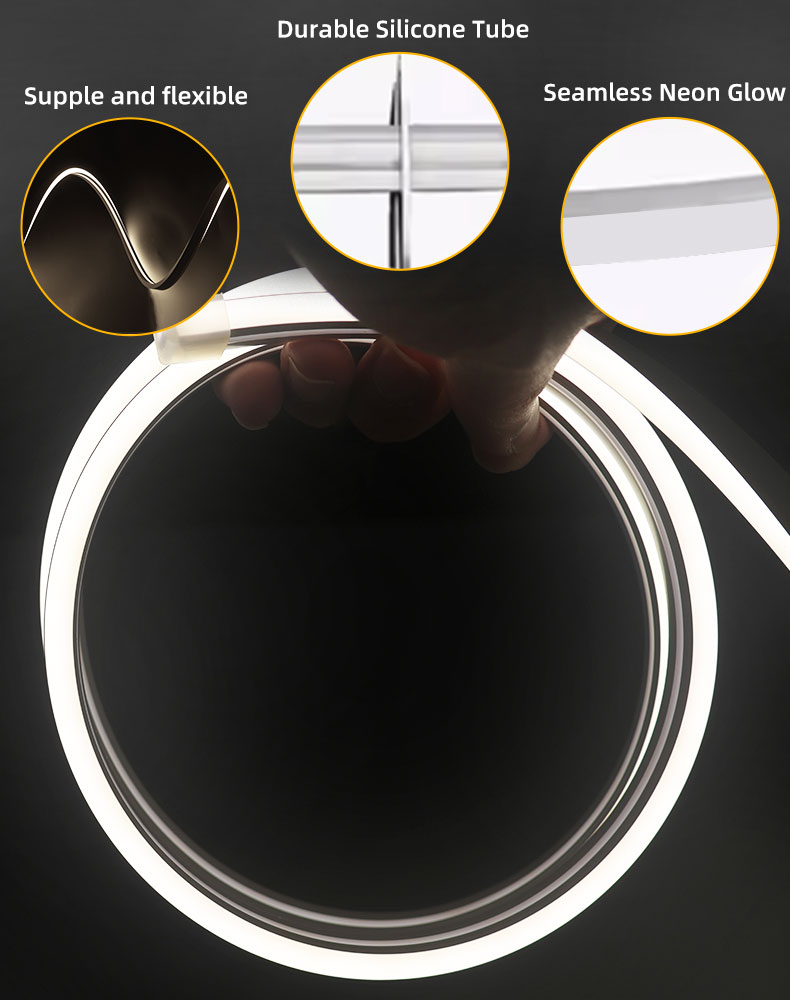
Waterproof RGBW Silicone LED Neon Flex 6×12mm for Architectural Lighting
Wallis waterproof RGBW silicone LED neon flex is a flexible linear lighting solution designed for architectural outlines, commercial signage, retail displays, hospitality interiors, furniture lighting, landscape projects and customized illuminated structures. The current Wallis model is listed with a compact 6 × 12 mm silicone profile and DC12V / DC24V operating options.
The diffused silicone housing helps convert individual LED points into a continuous neon-style line of light while protecting the internal LED strip from dust and moisture. Depending on the selected PCB, LED density, diffuser structure and viewing distance, the product can provide a smoother direct-view lighting effect than a conventional exposed LED strip.
For B2B lighting distributors, sign manufacturers, architectural lighting contractors, display companies and OEM lighting brands, Wallis supports customized lengths, colors, LED density, connectors, cable outlets, branding and packaging. Exact cutting interval, bending direction, minimum bending radius, maximum powered run, white-light CCT, controller type and waterproof termination should be confirmed according to the selected configuration.
RGBW Silicone LED Neon Flex Specifications
| Specification | Current Wallis Information | Project Confirmation |
| Product Type | Flexible Silicone LED Neon Light | Confirm RGB, RGBW, RGBWW or single-color PCB configuration |
| Current Model | LED Neon - 6×12 | Current page also contains a 12×12mm variant reference; confirm exact profile before quotation |
| Profile Size | 6 × 12 mm in the current specification table | Confirm width × height and light-emitting direction |
| Housing | Silicone | Request applicable UV, yellowing, flame or environmental test data when required |
| Input Voltage | DC12V / DC24V | Match power supply, controller and maximum run length |
| LED Density | 60 / 120 / 144 LEDs per meter | Confirm available density for the selected RGB/RGBW PCB |
| Color Options | Current page references single color, RGB, RGBW and RGBWW configurations | Confirm RGBW white-channel CCT and LED configuration |
| Listed IP Rating | IP65 / IP67 in the current specification table | Confirm exact tested assembly including cable outlet, connector and end caps |
| IP68 Option | Mentioned in existing marketing copy but not confirmed in the current specification table | Require project-specific IP68 test documentation before submerged use |
| Listed Lengths | 1 m / 5 m / 10 m | Reel length is not necessarily the same as maximum electrically powered run |
| Cutting Length | Depends on LED / PCB configuration | Confirm exact minimum cut interval before project layout |
| Listed Power | 10W / 12W / 14W | Current page does not clearly state whether these figures are W/m; confirm exact wattage per meter |
| Listed Luminous Efficiency | 100 lm/W | Confirm LED version, active color channel, CCT and photometric test conditions |
| Bending Direction | Flexible rectangular silicone neon profile | Confirm top-bend, side-bend or other construction and minimum bending radius |
| Controller | Required for RGB / RGBW color control | Confirm controller type, current capacity, dimming method and project-control interface |
| Certifications | Current page lists CE / RoHS / CCC | Request certification or declaration applicable to the exact ordered model |
| OEM Options | Length, LED density, colors, connectors, logo and packaging | Confirm tooling, MOQ and sample requirements for custom versions |
Specification note: The current Wallis page contains several configuration differences between the product title, model selector, introduction and specification table. For engineering projects, use the approved datasheet and sample corresponding to the exact SKU rather than combining specifications from different RGB, RGBW, IP or profile versions.

Flexible Silicone LED Neon Flex

Marked Cutting Position
What Is RGBW Silicone LED Neon Flex?
RGBW LED neon flex combines a flexible LED circuit with an optical silicone housing. RGB channels generate colored light, while the additional white LED channel provides a dedicated white-light output instead of creating white only by mixing red, green and blue.
Continuous Neon-Style Light
The diffusing silicone jacket spreads the LED output across the visible surface, helping create a continuous illuminated line suitable for direct-view architectural, signage and decorative applications. Actual dot visibility depends on LED spacing, profile geometry, diffuser transmission and viewing distance.
RGB Colors Plus a Dedicated White Channel
RGBW is useful when a project needs both dynamic color scenes and practical white illumination. The white channel can be selected in different color temperatures on suitable versions, but the exact CCT should be defined before production.
Low-Voltage Linear Lighting
The current Wallis configuration supports DC12V and DC24V. The final installation requires a compatible constant-voltage power supply and, for RGB or RGBW operation, an appropriate controller sized for the electrical load.
RGB vs RGBW vs Single-Color LED Neon Flex
| Light Type | Main Function | Typical Project |
| Single Color | Fixed white or fixed decorative color | Building outlines, signs, furniture and static decorative lighting |
| RGB | Red, green and blue color mixing | Decorative color-changing signs, bars, entertainment and façade effects |
| RGBW | RGB color effects plus dedicated white channel | Architectural, hospitality, retail and signage projects requiring both color and usable white light |
| RGBWW / Other Multi-Channel | Additional white-light configuration depending on PCB design | Project-specific lighting requiring expanded white-light control; availability should be confirmed |

Cuttable LED Neon Structure

Multiple Color Lighting Effects
IP65 vs IP67 vs IP68 LED Neon Flex
Waterproof performance should be specified for the complete finished assembly, not only the silicone extrusion. Cable exits, cut ends, connectors, end caps and field-installed joints can determine the actual protection level.
IP65 for Protected Outdoor or Damp Applications
IP65 versions are suitable for projects requiring protection against dust and water jets when the complete product is installed according to the applicable specification. They should not be treated as submersible lighting.
IP67 for Outdoor and Wet-Location Projects
The current Wallis specification lists IP67 as an available version. IP67 can support demanding outdoor and wet-location installations when the complete neon flex assembly and terminations maintain the specified seal.
Do Not Treat Standard IP67 Neon as Permanent Underwater Lighting
Swimming pools, fountains and continuously submerged installations require a product specifically designed and documented for the intended underwater conditions. If an IP68 version is required, confirm the exact construction, immersion conditions, connector system and applicable test report before installation.
Power Supplies and Controllers Need Their Own Environmental Protection
An IP67 neon flex does not make the complete lighting system IP67 automatically. Drivers, controllers, junctions and electrical connections should be located or protected according to the project environment and applicable electrical requirements.
Top Bend, Side Bend & Minimum Bending Radius
Flexible neon profiles are engineered to bend in specific directions. One of the most important details missing from a generic neon-flex specification is whether the selected model is top-bending, side-bending or capable of multi-directional bending.
Top-Bending Neon Flex
Top-bending profiles typically curve in the plane suited to vertical outlines, lettering or architectural contours. The exact bending direction depends on the cross-section and light-emitting surface.
Side-Bending Neon Flex
Side-bending versions curve in the alternate plane and can be more suitable for certain signs, logos and horizontal architectural shapes.
Minimum Bending Radius Must Be Respected
Bending below the specified minimum radius can damage the PCB, distort the silicone extrusion or create uneven light output. Wallis should confirm the minimum radius for the exact 6 × 12 mm configuration before the customer finalizes a sign or architectural layout.
Avoid Twisting the Neon Body
Flexible does not mean unrestricted twisting. Installation should follow the approved bending axis and avoid concentrated mechanical stress around connectors, solder joints and cable exits.
Cutting, Connecting & Waterproof End Sealing
Cut Only at Marked Positions
The Wallis LED neon flex is designed to be cut at marked PCB locations. The exact interval depends on the internal LED and circuit configuration and should be confirmed before the customer calculates project quantities.
Re-Seal Every Field Cut
Once an outdoor neon flex is cut, its original sealing system is interrupted. The cut end must be terminated using the approved end cap, adhesive, molded connector or other specified sealing method if the installation is expected to retain an IP-rated enclosure.
Cable Outlet Direction Matters
Straight, side or bottom cable exits can affect installation clearance and sign-box design. Specify the required power-entry direction before customized lengths are assembled.
Pre-Assembled Custom Lengths Reduce Field Work
For commercial outdoor projects, factory-cut lengths with pre-installed leads and sealed ends can reduce the number of field joints and simplify installation quality control.
Power Supply, Voltage Drop & Maximum Run Length
12V vs 24V
Both DC12V and DC24V are currently listed. For the same power level, a 24V system operates at lower current than a 12V system, which can be useful when designing longer architectural runs. The actual allowable run length still depends on PCB resistance, wattage, wire size and voltage-drop limits.
Reel Length Is Not Maximum Run Length
A product supplied in 5 m or 10 m reels cannot automatically be powered end-to-end without checking voltage drop. Wallis should provide the recommended maximum single-feed run for the selected wattage and PCB.
Power Injection for Long Runs
Long installations may require power feeds from both ends or intermediate power injection to reduce brightness and color differences caused by voltage drop.
Size the Power Supply with Engineering Margin
Calculate the total wattage from the confirmed watts per meter and installed length, then select a suitable power supply according to the manufacturer's loading recommendation and installation environment.
RGBW Controllers & Lighting Control
RGBW Requires a Compatible Multi-Channel Controller
An RGBW neon flex needs a controller compatible with the exact strip wiring and electrical load to adjust colors, white output, brightness and dynamic scenes.
Controller Current Capacity
The controller must be sized according to total strip power and channel current. Larger installations may require amplifiers, multiple controllers or separate power zones.
DMX or Building-Control Integration
If the project requires DMX, DALI, 0–10V, smart-home or another lighting-control interface, state the requirement during quotation. Compatibility depends on the selected external controller or decoder and should not be assumed from the LED neon flex alone.
Define White-Light CCT
RGBW buyers should specify the required white-channel color temperature, such as warm, neutral or cool white, rather than simply requesting “RGBW.”

Mounting Accessories & Installation
Mounting Clips
Individual mounting clips can support short curves and localized fixing points. Clip spacing should be sufficient to prevent sagging without compressing or damaging the silicone body.
Aluminum Mounting Channel
Straight aluminum channels provide continuous mechanical support for linear architectural installations and can help maintain a clean, straight light line.
Flexible Channel for Curves
Flexible or bendable mounting profiles can be used for approved curved layouts where a standard rigid channel cannot follow the design.
Plan Cable Access Before Installation
Power-feed direction, controller location, driver access and serviceability should be incorporated into the lighting detail before the neon is cut or permanently installed.
Applications of Waterproof RGBW Silicone LED Neon Flex
Architectural Facade Lighting
Flexible neon can outline building edges, entrances, rooflines and façade details while providing a continuous visible light line.
Commercial Signage
Sign makers can use suitable bend profiles to create illuminated letters, logos, borders and branded display elements for retail and advertising projects.
Hospitality and Entertainment Lighting
RGBW color control supports bars, hotels, restaurants, clubs, stages and entertainment interiors that require both dynamic scenes and white accent lighting.
Retail & Exhibition Displays
Neon flex can be integrated into display fixtures, counters, exhibition structures and brand installations where the light source remains directly visible.
Furniture & Cabinet Lighting
Compact profiles can be incorporated into furniture, shelving and cabinetry when the bending direction, heat management and installation dimensions are suitable.
Landscape and Outdoor Accent Lighting
Properly sealed outdoor versions can be used for landscape borders, garden structures and exterior decorative installations subject to the applicable IP rating and electrical installation requirements.

Multiple Lighting Applications

Custom Curves and Shapes
How to Choose RGBW Silicone LED Neon Flex for a Project
1. Confirm Profile Size
Specify whether the project requires the current 6 × 12 mm version or another profile. Provide the available installation channel or recess dimensions where space is limited.
2. Select Top Bend or Side Bend
Provide the intended curve direction and drawing so Wallis can confirm whether the selected neon profile bends correctly for the design.
3. Choose 12V or 24V
Select voltage according to run length, project power architecture and available drivers. For longer commercial systems, voltage-drop calculations should be completed before installation.
4. Define RGBW White CCT
State whether the project requires warm white, neutral white or cool white from the dedicated W channel and request a sample where color appearance is important.
5. Confirm LED Density and Output
Select the available LED density based on desired brightness, dot-free appearance, power consumption and application distance. Confirm lumens per meter rather than relying only on luminous efficacy.
6. Confirm Minimum Cut Length
Sign letters and small decorative elements may require short cut intervals. Obtain the exact cut length before finalizing artwork or fabrication drawings.
7. Calculate Maximum Powered Run
Provide the longest continuous run and planned feed points so voltage drop, wire size and power injection can be reviewed.
8. Define the Required IP Rating
Specify indoor, protected outdoor, wet-location or submerged conditions. Do not select IP67 and IP68 only as marketing labels; the complete installed assembly must match the intended environment.
9. Select Controller & Dimming Method
Identify whether the project requires a simple RF controller, centralized lighting control, DMX integration or another interface so the correct control components can be specified.
10. Confirm Cable, Connector & Mounting Accessories
Specify cable outlet direction, lead-wire length, connector requirement, end caps, mounting clips and aluminum channel before customized pieces are produced.
Quality Control for Waterproof Silicone LED Neon Flex
Commercial LED neon projects require electrical, optical and mechanical inspection rather than appearance checks alone. QC requirements should be established for the exact ordered configuration.
| QC Item | What to Check |
| Profile Dimensions | Width, height and overall extrusion consistency |
| Electrical Input | Voltage, current and watts per meter against the approved specification |
| Color Output | RGB channels, white-channel CCT and color consistency between sections |
| Luminous Output | Lumens per meter or project-specific photometric requirement where specified |
| Light Uniformity | Hot spots, dark sections, color variation and visible LED points |
| Cut Interval | Correct PCB cutting marks and functional segments |
| Bending | Approved bending direction, minimum radius and electrical continuity after bending |
| Waterproof Sealing | Cable entries, connectors, end caps and complete assembly according to ordered IP grade |
| Silicone Surface | Cracks, contamination, deformation, bubbles and surface defects |
| Accessories | Correct power leads, end caps, connectors, clips and channels |
| Packaging | Reel protection, bend radius during packing, labeling and customized accessories |
Test Complete Custom Assemblies
A customized neon flex with pre-installed cables and end caps should be evaluated as an assembly. Testing only an uncut factory reel does not verify the waterproof integrity of customized terminations.
Approve Color Before Bulk Production
Architectural projects using multiple reels should approve RGB performance and the dedicated white-channel CCT because visible color differences can be obvious when products are installed side by side.
OEM & Custom Silicone LED Neon Flex Service
Customized Lengths
Pre-cut project lengths can be discussed according to the PCB cutting interval and final installation drawing.
Customized Color Configuration
Single-color, RGB and RGBW configurations can be reviewed according to current production availability and project requirements.
Customized LED Density
The current page lists 60, 120 and 144 LEDs per meter. Availability should be matched to the selected voltage, color configuration and profile.
Customized Leads & Connectors
Cable length, cable outlet, connectors and termination structure can be discussed for OEM projects to reduce field assembly.
OEM Branding & Packaging
Current Wallis information supports logo branding and customized packaging. Final logo position, label content, reel packaging and accessory kit should be confirmed against the approved sample.
Samples for Project Testing
The current Wallis FAQ states that low-quantity samples are available and that a single piece can be considered for sample testing. This is useful for checking installation dimensions, brightness, CCT, controller compatibility and bending before volume purchasing.
Why Choose Wallis for RGBW Silicone LED Neon Flex?
Compact 6 × 12 mm Current Model
The current model specification lists a compact 6 × 12 mm silicone profile for applications requiring a relatively slim neon-style light line.
12V and 24V Options
Multiple voltage options allow lighting contractors and OEM buyers to coordinate the neon flex with different power architectures.
IP65 and IP67 Current Configurations
Current published specifications list IP65 and IP67 variants for indoor, outdoor and wet-location projects according to the selected construction.
Cuttable Project Lengths
Marked PCB cutting points support customized installation lengths, subject to the minimum cutting interval of the selected circuit.
OEM Support
Wallis supports lighting distributors, advertising companies, interior designers, architectural contractors, furniture manufacturers and retail brands requiring customized lighting products.
Wallis Project & Customer Operations
Wallis supports customized lighting and display projects for B2B customers. For repeat LED neon orders, buyers should retain an approved specification covering profile size, PCB version, voltage, watts per meter, LED density, white-light CCT, cutting interval, IP construction, cable outlet and packaging.

FAQ About Waterproof RGBW Silicone LED Neon Flex
What is RGBW LED neon flex?
RGBW LED neon flex is a flexible diffused linear light containing red, green and blue color channels plus a dedicated white-light channel. It can provide decorative color effects and practical white illumination using a compatible RGBW controller.
What size is the Wallis silicone LED neon light?
The current model and specification table list 6 × 12 mm. The product page also contains a 12 × 12 mm variant reference, so the exact ordered profile should be confirmed before production.
Is the Wallis LED neon flex 12V or 24V?
The current specification lists both DC12V and DC24V. Select the voltage according to the required run length, power supply, controller and project electrical design.
Is RGBW better than RGB?
RGBW is preferable when a project needs both color-changing effects and a dedicated white-light channel. RGB can be sufficient when only decorative colors are required.
What white color temperature is available with RGBW?
The current Wallis page does not publish a fixed RGBW white-channel CCT. Specify the required warm, neutral or cool white temperature when requesting a quotation.
Is this LED neon flex waterproof?
The current specification table lists IP65 and IP67 variants. The actual protection rating applies to the specified complete product configuration and depends on the quality of end caps, cable exits and connectors.
Is IP67 LED neon flex suitable for swimming pools?
Standard IP67 neon flex should not automatically be specified for permanent underwater use. Swimming-pool or submerged applications require a version specifically designed, tested and documented for the intended immersion conditions.
Does Wallis offer IP68 silicone neon flex?
IP68 is mentioned in existing Wallis marketing text, but the current specification table lists only IP65 and IP67. Buyers requiring IP68 should request confirmation and applicable waterproof test documentation for the exact configuration.
Can the silicone LED neon flex be cut?
Yes. The current product has PCB cutting marks and should be cut only at the specified locations. The exact cutting interval depends on the selected PCB and LED configuration.
How do I keep the neon waterproof after cutting?
A cut outdoor neon section must be re-terminated using the approved end-cap and sealing system. Cutting without proper resealing can compromise the original waterproof protection.
What is the minimum cutting length?
The current page only states that cutting length is based on the LEDs. Request the exact minimum cut interval for the selected 12V/24V RGB or RGBW PCB before designing letters or short segments.
What is the maximum continuous run?
The current page lists 1 m, 5 m and 10 m product lengths but does not publish the maximum single-feed run. Maximum run should be confirmed using watts per meter, PCB resistance, voltage and acceptable voltage drop.
Is 24V better than 12V for long LED neon runs?
A 24V system normally operates at lower current than a 12V system at the same power, which can help with longer installations. The actual maximum run still depends on the specific PCB and power design.
How many LEDs per meter are available?
The current Wallis specification lists 60, 120 and 144 LEDs per meter. Confirm which density is available for the exact RGBW model and profile.
What is the power consumption?
The existing table lists 10W, 12W and 14W but does not explicitly state whether these values are per meter. For B2B projects, request the confirmed W/m specification for the selected LED density and color configuration.
Is the luminous efficiency really 100 lm/W?
The current Wallis table lists 100 lm/W. RGBW output varies according to the active color channels, white CCT, LED version and test conditions, so buyers needing photometric performance should request lumens per meter and the applicable test data.
Is the neon completely dot-free?
The silicone diffuser is designed to create a smooth neon-style line of light, but visible dot performance depends on LED pitch, diffuser geometry, brightness and viewing distance. Approve a sample for close-view applications.
Can the LED neon bend in any direction?
Not necessarily. LED neon profiles have specific bending directions and minimum bending radii. Confirm whether the selected Wallis model is top-bend, side-bend or another configuration before installation.
Does RGBW LED neon require a controller?
Yes. RGBW color control requires a compatible controller. The controller must match the strip voltage, wiring configuration, total wattage and required lighting-control method.
Can RGBW neon flex work with DMX?
DMX integration can be evaluated using a compatible external controller or decoder. It should not be assumed that the basic neon strip contains built-in DMX control.
Can Wallis customize cable outlets and connectors?
The current product information states that connector options can be customized. Provide cable length, cable-exit direction and installation requirements during quotation.
Can Wallis provide custom lengths?
Yes. Custom lengths can be produced according to the permitted PCB cutting interval and project specification.
Can I add my logo and custom packaging?
Yes. Current Wallis information states that OEM logo branding and customized packaging can be supported, subject to sample approval and production requirements.
Are CE, RoHS and CCC certificates available?
The current Wallis specification table lists CE, RoHS and CCC. For compliance-sensitive projects, request documents that apply specifically to the exact model, voltage, PCB and configuration being purchased.
Can I order a sample?
Yes. The current Wallis FAQ states that samples can be provided and that one piece can be acceptable for sample testing.
What is the current sample lead time?
The current Wallis FAQ lists approximately 3–5 days for samples. Actual timing should be reconfirmed for customized profiles, leads, connectors or packaging.
What is the current mass-production lead time?
The current page lists approximately 1–2 weeks depending on quantity and customization. Final lead time should be confirmed after the product specification and sample are approved.
What information should I provide for a quotation?
Provide profile size, RGB/RGBW requirement, white-light CCT, 12V or 24V, LED density, required length, longest continuous run, bending direction, IP rating, cut-length requirement, cable outlet, connector, controller type, mounting accessories, quantity, certifications and delivery destination.
Request RGBW Silicone LED Neon Flex Samples & Factory Pricing
Looking for a reliable RGBW silicone LED neon flex manufacturer for signage, architectural outlines, retail displays or outdoor lighting projects? Send Wallis your profile size, voltage, RGBW white CCT, required lengths, bending direction, IP rating, control system, connectors and quantity for technical review, sample testing and B2B factory pricing.