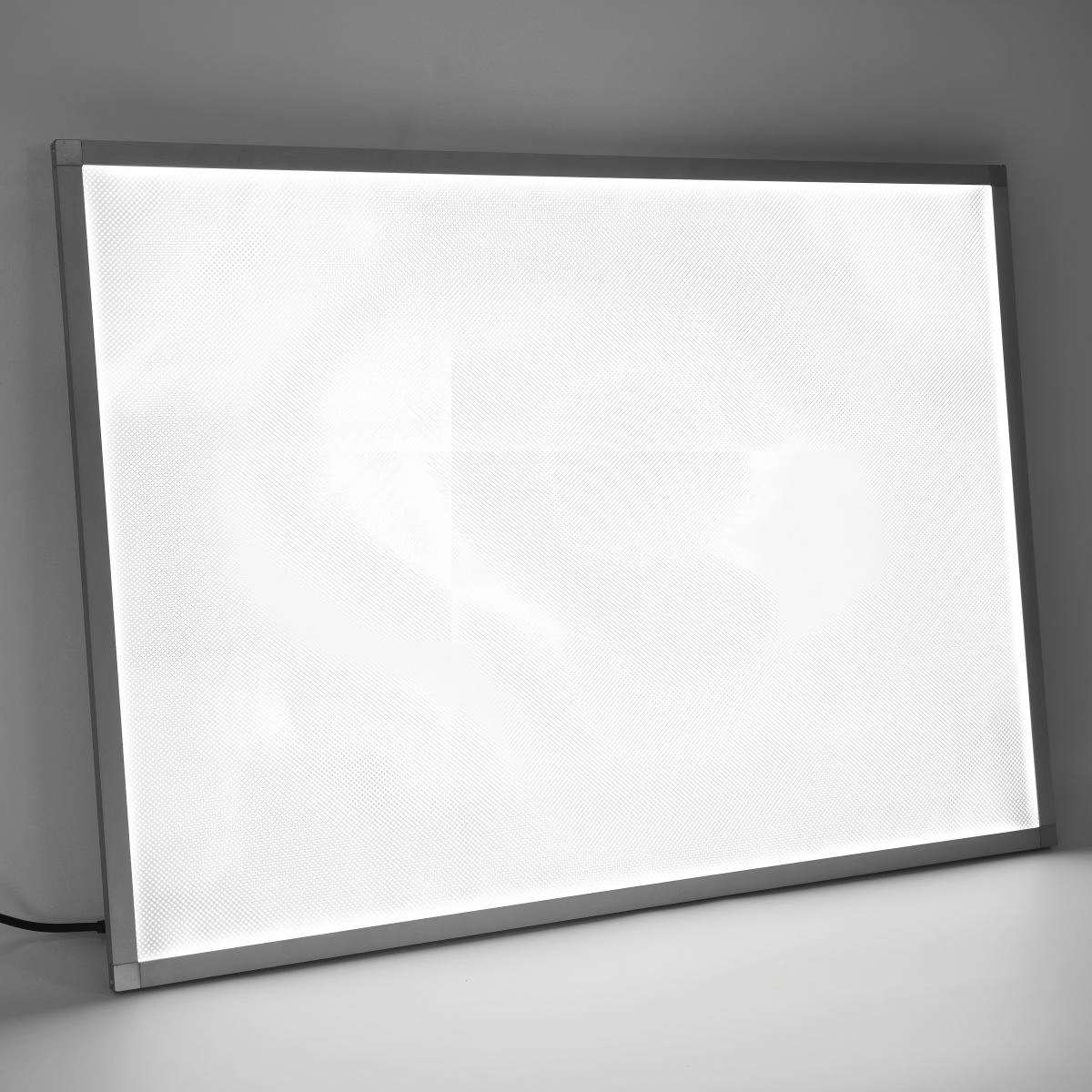
Custom Aluminum Frame LED Backlight Panel with PMMA Light Guide Plate
Wallis aluminum frame LED backlight panel is a slim, high-uniformity lighting solution designed for advertising light boxes, menu boards, retail displays, logo panels, exhibition displays, illuminated graphics and customized commercial backlighting projects.
The panel combines an aluminum frame, optical PMMA light guide plate, precision laser dot pattern and edge-mounted LED lighting to distribute light across the panel surface. Standard A0–A4 and B1–B3 formats are available, while custom dimensions can be produced according to project drawings.
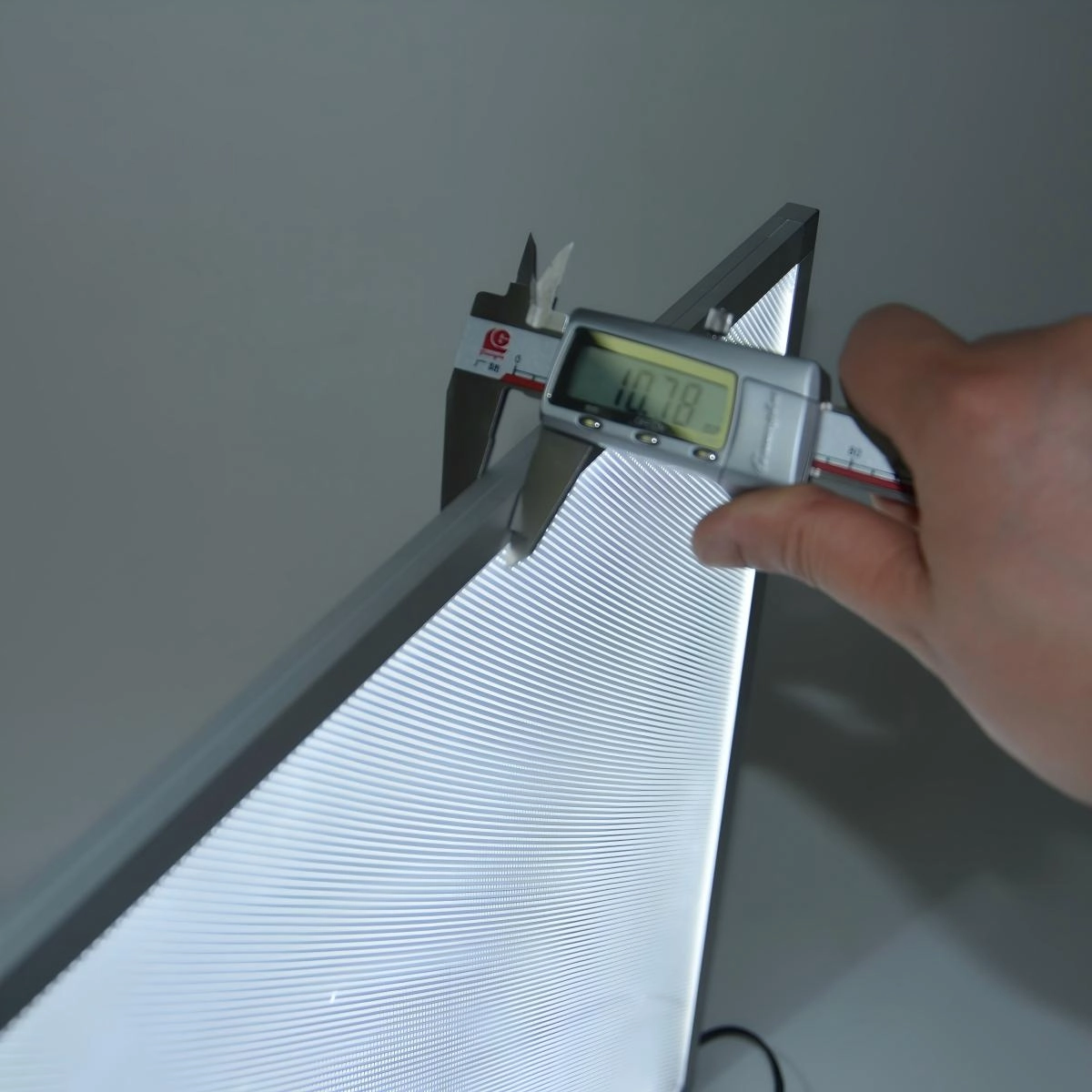
Standard panel thickness options include 7 mm, 8 mm, 9 mm and 10 mm. Available lighting options include 3000K warm white, 6000K cool white and RGB. For larger panels, LEDs can be arranged along both long sides to improve brightness distribution and uniformity.
For B2B projects, Wallis supports laser dot design, CNC processing, LED matching, custom frame dimensions, panel assembly, wiring and export packaging according to JPG, PDF, DXF or DWG drawings.
Aluminum Frame LED Backlight Panel at a Glance
| Product Type | Aluminum Frame LED Backlight / Light Guide Panel |
| Light Guide Material | Optical PMMA Acrylic |
| Optical Technology | Precision Laser Dot Light Extraction Pattern |
| Standard Sizes | A0 / A1 / A2 / A3 / A4 / B1 / B2 / B3 |
| Custom Size | Supported according to project drawings |
| Panel Thickness | 7 / 8 / 9 / 10 mm |
| LED Position | Both long sides for listed standard configurations |
| Light Color | 3000K / 6000K / RGB |
| Frame | Aluminum Frame |
| Custom Processing | Laser Dotting / CNC Cutting / Drilling / Shaping / LED Matching |
| Drawing Formats | JPG / PDF / DXF / DWG |
| Typical Applications | Light Boxes, Menu Boards, Retail Displays, Signage, Logo Panels and Exhibition Displays |
Note: Final voltage, LED power, luminance, CRI, electrical connection, dimming method, frame profile and installation structure should be confirmed according to the selected panel size and project specification.

How Does an LED Backlight Panel Work?
An LED backlight panel uses LEDs positioned along the edge of a transparent light guide plate. Light enters the PMMA panel from the sides and is redirected toward the illuminated surface by a carefully designed optical dot pattern.
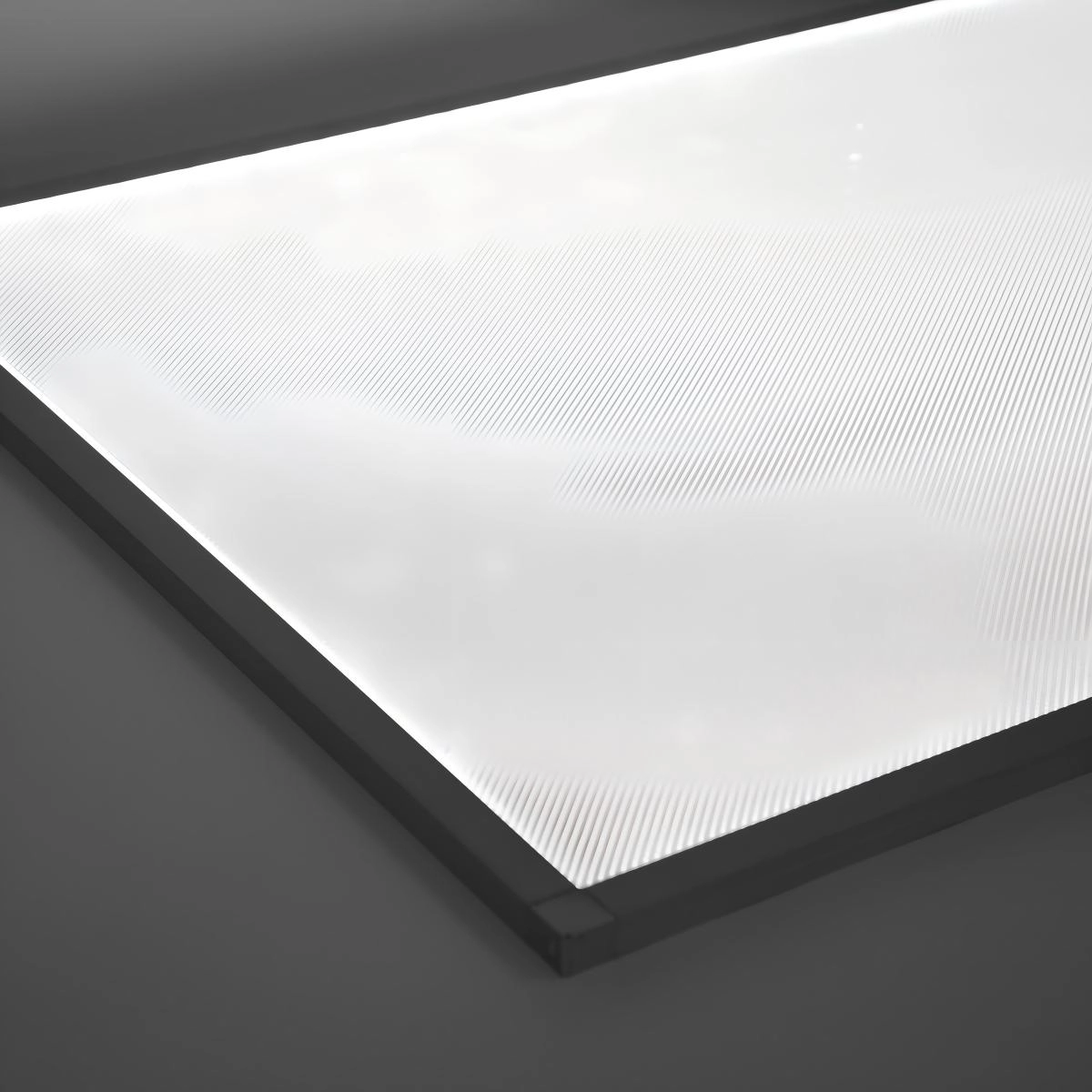
The density and distribution of laser dots can be adjusted according to panel size, LED position and target brightness. This helps compensate for the gradual reduction of light intensity as light travels away from the LED source and supports more uniform illumination across the panel.
PMMA Light Guide Plate
Optical PMMA is used as the light guide medium because of its high optical clarity and suitability for precision laser-dot processing. The LGP transfers LED light from the panel edges across the illuminated area.
Precision Laser Dot Pattern
The laser-dot pattern controls where light exits the acrylic. Correct dot density and spacing help reduce bright edges, dark centers and uneven illumination in custom-size panels.
Edge-Mounted LEDs
LED strips are mounted along selected panel edges. In the listed standard Wallis configurations, LEDs are installed along both long sides to support more balanced illumination, particularly on larger rectangular panels.
Why Choose an Aluminum Frame LED Backlight Panel?
Improved Heat Dissipation
Aluminum conducts heat away from the LED mounting area and helps maintain a more stable operating environment. Effective thermal management is important for commercial displays that operate for extended periods.
Stronger Mechanical Structure
The frame supports the panel edges and helps reduce bending, edge damage and deformation during assembly, transportation and installation. This is particularly useful for larger custom panels and export projects.
Easier Mounting and Integration
An aluminum frame provides a defined mechanical structure that can be integrated into light boxes, wall displays, menu boards, retail fixtures or other commercial assemblies. Final brackets and mounting details can be designed according to the installation method.
Professional Finished Appearance
Aluminum profiles provide a clean and durable edge finish, making framed panels suitable for exposed retail, hospitality, office, showroom and exhibition applications.
Better Protection During Transport
The rigid perimeter structure provides additional protection for the LGP and panel edges during handling and international shipping compared with an unsupported bare light guide plate.

LED Backlight Panel Structure and Optical Design
Standard Aluminum Frame LED Backlight Panel Sizes
| Item | Frame Size | Dimensions | Thickness | LED Sides | Light Color |
| LED Lighting Panel | A0 | 1189 × 841 mm | 7 / 8 / 9 / 10 mm | Both Long Sides | 3000K / 6000K / RGB |
| A1 | 841 × 594 mm | Both Long Sides | 3000K / 6000K / RGB |
| A2 | 594 × 420 mm | Both Long Sides | 3000K / 6000K / RGB |
| A3 | 420 × 297 mm | Both Long Sides | 3000K / 6000K / RGB |
| A4 | 297 × 210 mm | Both Long Sides | 3000K / 6000K / RGB |
| B1 | 1000 × 707 mm | Both Long Sides | 3000K / 6000K / RGB |
| B2 | 707 × 500 mm | Both Long Sides | 3000K / 6000K / RGB |
| B3 | 500 × 350 mm | Both Long Sides | 3000K / 6000K / RGB |
Custom Size LED Backlight Panels for OEM Projects
Standard paper sizes are convenient for posters and signage, but many retail fixtures, menu boards and branded displays require non-standard dimensions. Wallis can process custom light guide panels according to the finished visible area, frame size and installation structure.
Custom Rectangular Panels
Custom-width and custom-length panels can be manufactured according to furniture, signage, menu-board or retail-fixture dimensions rather than requiring the buyer to redesign the project around standard A or B sizes.
CNC-Cut Custom Shapes
CNC processing can be used for compatible custom shapes, holes and edge features. Buyers should provide accurate drawings showing the illuminated area, outside dimensions and cable or mounting locations.
Customized Laser Dot Distribution
The optical dot pattern can be adjusted according to panel geometry, LED location and lighting target. Customized dot density helps improve uniformity on unusual aspect ratios and non-standard sizes.
Applications of Aluminum Frame LED Backlight Panels

Commercial Signage Application

Retail Display Application
Advertising Light Boxes
Edge-lit LGP panels provide a thin illumination source behind advertising graphics and can be integrated into wall-mounted light boxes, poster frames and commercial sign cabinets.
Menu Boards
Restaurants, cafés and food-service brands can use custom backlight panels behind menu graphics where thin construction and consistent illumination are important.
Retail and POS Displays
LED light guide panels can be integrated into product displays, shelf systems, promotional fixtures and point-of-sale installations to create illuminated branding and merchandising elements.
Logo and Brand Panels
Custom CNC shapes and optical designs can support illuminated logos, corporate signage and branded architectural features.
Exhibition and Trade Show Displays
Slim backlighting can be integrated into exhibition walls, counters, product displays and temporary branded structures where space efficiency and visual impact are important.
Interior and Decorative Backlighting
Custom light panels can also be used behind translucent decorative materials, furniture features and interior surfaces where uniform planar illumination is required.
Edge-Lit LGP Panel vs Direct Backlight Panel
| Comparison | Edge-Lit LGP Panel | Direct Backlight Panel |
| LED Position | Along panel edges | Behind illuminated surface |
| Light Distribution | PMMA LGP distributes light across panel | LEDs illuminate surface directly |
| Panel Depth | Suitable for slim lighting structures | Usually requires more LED-to-diffuser distance |
| Optical Design | Laser dot pattern is critical | LED spacing and diffuser distance are critical |
| Typical Use | Slim signs, displays, menu boards and integrated panels | Deeper light boxes and large direct-backlit displays |
How to Improve LED Backlight Panel Uniformity
Uniformity depends on the complete optical design rather than LED brightness alone. The relationship between LED location, PMMA thickness, laser-dot density, reflector, diffuser and panel dimensions should be considered together.
Optimize laser-dot density according to distance from the LED source.
Match LED brightness and spacing to panel size.
Use appropriate LED entry sides for the panel aspect ratio.
Maintain accurate alignment between LEDs and PMMA edges.
Use suitable reflector and diffusion materials where required.
Control PMMA edge quality after CNC processing.
Prototype unusual sizes before mass production where practical.
How to Choose an Aluminum Frame LED Backlight Panel
1. Confirm the Finished Panel Size
Provide the overall frame size and required illuminated area. For projects installed inside another housing, also provide available installation space and tolerance requirements.
2. Select Panel Thickness
Standard listed options include 7 mm, 8 mm, 9 mm and 10 mm. Selection depends on panel size, mechanical structure and optical requirements.
3. Confirm the Required Brightness
Tell Wallis how the panel will be used and whether the target is advertising backlighting, decorative illumination, menu-board lighting or another application. If a specific luminance or illuminance target is required, include it in the technical inquiry.
4. Choose Light Color
Current standard options include 3000K warm white, 6000K cool white and RGB. White light is commonly selected for graphic presentation, while RGB can be used for decorative or dynamic visual effects.
5. Confirm LED Entry Sides
The listed standard configurations use LEDs on both long sides. Custom designs may require different LED placement depending on size, aspect ratio and target brightness. The optical pattern should be designed around the final LED arrangement.
6. Confirm Cable and Power Locations
Cable exits and power connections should be positioned according to the final installation. Mark the required wire direction, connector location and available installation space on the drawing.
7. Confirm Installation Method
Tell Wallis whether the panel will be wall-mounted, integrated into furniture, installed inside a light box or used as part of another OEM assembly so the frame and mechanical details can be evaluated accordingly.
Custom Processing and OEM Services
Wallis provides project-based processing for customized LED light guide panel assemblies. Services can be coordinated according to the buyer's final drawing and assembly requirements.
Custom PMMA light guide panel dimensions
Laser dot pattern design
CNC cutting and shaping
Hole drilling and custom openings
LED strip matching
Custom aluminum frame dimensions
3000K / 6000K / RGB lighting options
Wiring and cable-position customization
Pre-assembled panel supply
Sample testing
Export packaging
OEM / ODM project support

Information Needed for an Accurate Quote
Providing complete project information helps shorten the optical-design and quotation process.
Overall panel size
Visible lighting area
Required thickness
Required quantity
3000K, 6000K or RGB requirement
Required luminance or brightness target, if specified
LED entry sides
Installation method
Cable exit position
Power supply or controller requirement
CNC holes or special shapes
Frame color or profile requirement
Packaging requirement
JPG, PDF, DXF or DWG project drawing
Frequently Asked Questions About LED Backlight Panels
What is an LED light guide panel?
An LED light guide panel uses edge-mounted LEDs and an optical light guide plate to distribute light across a flat surface. Laser dots or other optical patterns extract the light from the PMMA and create more uniform planar illumination.
Can Wallis make custom-size LED backlight panels?
Yes. Standard A0–A4 and B1–B3 formats are listed, and non-standard sizes can be produced according to the buyer's drawing and optical requirements.
What thicknesses are available?
The current standard specification lists 7 mm, 8 mm, 9 mm and 10 mm options. The appropriate thickness depends on panel dimensions, structure and optical design.
What light colors are available?
Current standard options include 3000K warm white, 6000K cool white and RGB. Additional lighting requirements should be discussed during project evaluation.
Why are LEDs installed on both long sides?
Feeding light from both long sides can improve brightness distribution across larger rectangular panels. Final LED positioning should be designed according to panel dimensions, LED output and the laser-dot pattern.
How do laser dots improve light uniformity?
Laser dots redirect light out of the PMMA surface. Dot density can be varied across the panel to compensate for changes in light intensity and reduce visible bright or dark areas.
Can the panel be CNC cut into custom shapes?
Yes. Wallis can CNC cut, trim, drill and process compatible custom shapes according to supplied drawings. The optical design should be developed around the final finished geometry.
What drawing formats can I provide?
The current Wallis product information lists JPG, PDF, DXF and DWG files for custom project evaluation and processing.
Can Wallis customize the laser dot pattern?
Yes. Laser dot parameters can be adjusted according to panel size, LED location, brightness target and final application to improve illumination uniformity.
Can the LED backlight panel be dimmed?
Dimming depends on the selected LED strip, driver and controller. If dimming is required, specify the control method and electrical system when requesting a quotation so compatible components can be evaluated.
Can RGB lighting be controlled separately?
RGB panels require a compatible RGB controller and power system. Tell Wallis how the panel will be controlled so the LED strip, wiring and controller can be matched correctly.
Can LED backlight panels be used outdoors?
The standard product is primarily intended for indoor applications. Outdoor projects require a suitable sealed structure and materials selected for UV, moisture and environmental exposure. Provide the actual outdoor conditions before ordering.
Can the panel backlight fabric or printed graphics?
Yes. LED light guide panels are commonly used behind compatible advertising graphics, translucent films and display materials. The final brightness depends on graphic transmission and panel output.
Is an aluminum frame better than a frameless LED panel?
An aluminum frame provides additional mechanical support, edge protection, heat dissipation and mounting structure. A frameless panel may be preferred where a completely borderless appearance is more important. The better option depends on the final application.
Can Wallis provide a complete pre-assembled panel?
Yes. Wallis can provide pre-assembled LED backlight panels including the PMMA light guide plate, LED strips, aluminum frame, wiring and project-specific packaging according to the confirmed order specification.
Can I order a sample before mass production?
Sample testing is available for custom projects. A prototype allows the buyer to evaluate dimensions, uniformity, lighting color, frame structure and installation details before larger production.
What information should I provide for a quotation?
Provide the panel dimensions, illuminated area, thickness, quantity, light color, required brightness, LED sides, installation method, cable position and project drawings. If electrical specifications or dimming requirements are already defined, include them as well.
Request a Quote for Custom Aluminum Frame LED Backlight Panels
Looking for a custom LED backlight panel manufacturer for advertising displays, menu boards, retail fixtures, logo panels or OEM lighting projects? Wallis provides PMMA light guide panel processing, laser-dot optical design, aluminum frame assembly and custom LED matching for B2B applications.
Send your size, drawing, thickness, light color, brightness requirement and order quantity to receive a suitable panel recommendation and quotation.