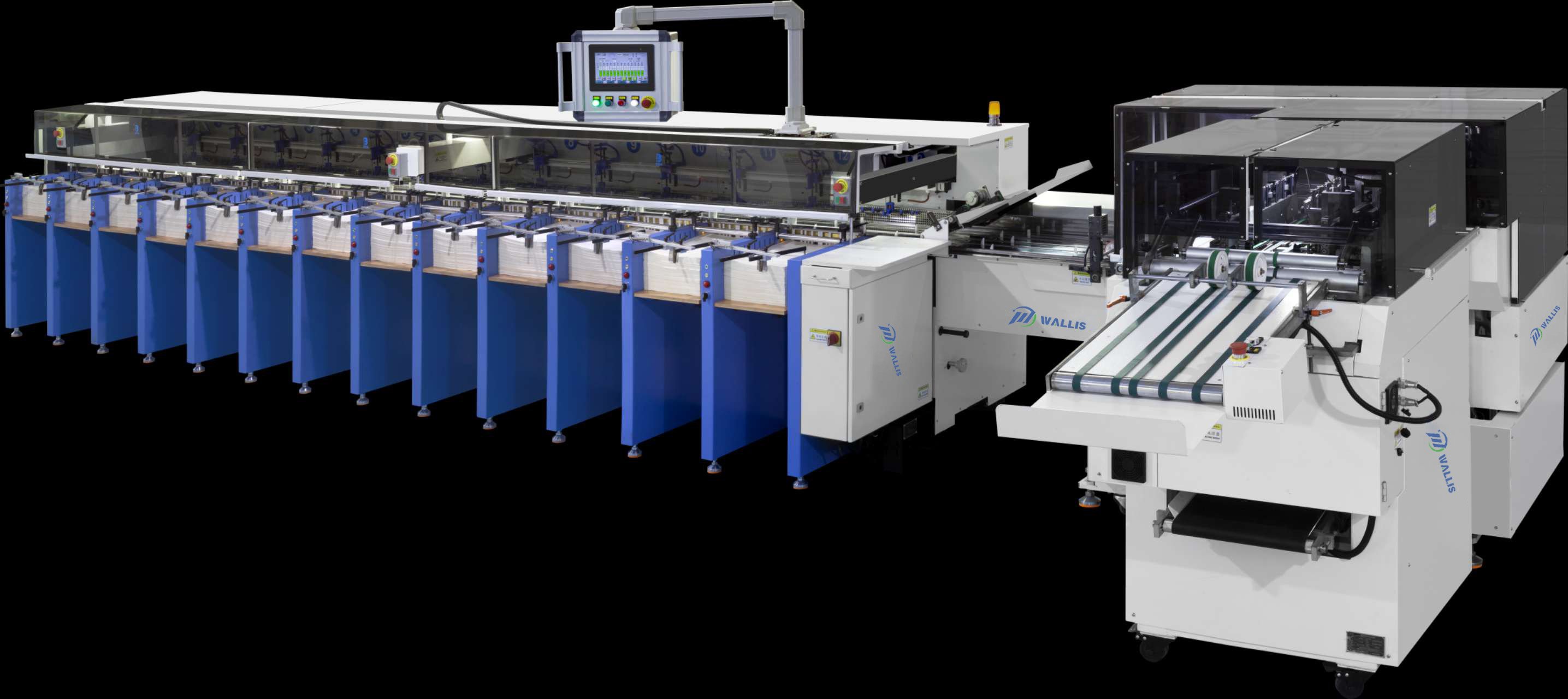
High-Speed Automatic Horizontal Collator Machine for Industrial Sheet Gathering
Wallis supplies a high-speed automatic horizontal collator machine for industrial sheet gathering, sequence matching and multi-station material assembly. The system is designed for printing companies, bookbinding plants, packaging manufacturers, card-material processors and production-line integrators that need repeatable collating accuracy with less manual sorting.
Depending on the approved configuration, the machine can collate paper sheets, folded signatures, cardboard inserts, PVC film, PET film and other flat materials at approximately 2,600–5,000 sets per hour. Independent station control, missing-sheet compensation, double-sheet detection and optional visual inspection help improve sequence accuracy during continuous B2B production.
![High-speed automatic horizontal collator machine for industrial sheet gathering]()
| Typical Output | 2,600–5,000 sets/hour | Station Options | Multiple configurations by sheet format |
| Feeding Structure | Horizontal belt-transfer system | Detection | Missing-sheet and double-sheet control |
| Suitable Buyers | Commercial printers, publishers, packaging plants, card-material factories, system integrators and industrial distributors |
Request Machine Configuration & B2B Quote
What Is an Automatic Horizontal Collator Machine?
An automatic horizontal collator machine feeds flat materials from multiple stations and gathers one item from each selected station into a complete set in a predetermined sequence. The horizontal transport path gives operators a clear view of the feeding process and supports flexible station combinations for products with different page counts or component structures.
This type of industrial collating equipment is suitable when manual gathering creates excessive labor cost, unstable sequence accuracy or limited production capacity. It can be used as a stand-alone collator or integrated with optional downstream equipment for folding, wire stitching, trimming, stacking, inspection or packaging.
Automatically gathers sheets or flat components in the required order.
Allows independent station activation for different product recipes.
Uses sensors and alarms to identify feeding abnormalities.
Supports stand-alone production or customized line integration.
Reduces repetitive manual sorting in medium- and high-volume plants.

Technical Specifications
The following values describe the available reference configurations. Final sheet range, station quantity, speed, voltage and inline finishing modules should be confirmed against the customer’s material samples and approved technical proposal.
| Configuration Item | Sheet or Process Range | Available Stations / Notes |
| Folio Sheet Configuration | Maximum 900 × 600mm; minimum 210 × 50mm | 5, 10 or 15 stations |
| Quarto Sheet Configuration | Maximum 600 × 480mm; minimum 210 × 50mm | 10, 15 or 20 stations |
| Octavo Sheet Configuration | Maximum 480 × 320mm; minimum 210 × 50mm | 8, 13, 15, 16 or 26 stations |
| Collating Speed | Approximately 2,600–5,000 sets/hour; actual output depends on material, size, station count and line configuration |
| Maximum Loading Height | Folio configuration: up to 1,100mm | Quarto / octavo: up to 600mm |
| Standard Power Supply | 380V; voltage, phase and frequency must be confirmed for the destination market |
| Typical Finished Formats | 170 × 220mm, A4, 240 × 320mm and customized sizes |
| Optional Folding | Single-knife folding module, subject to approved line configuration |
| Optional Wire Stitching | Standard 2 stitching heads; optional 1–4 heads |
| Optional Trimming | Reference trimming range 1–10mm; common setup 3mm |
Key Features for B2B Production
Independent Station Control
Each feeding station can be enabled or disabled according to the required set structure. This makes the machine suitable for factories producing multiple SKUs with different sheet counts or component sequences.
Missing-Sheet Compensation and Double-Sheet Detection
Sensor-based monitoring helps detect missing feeds and double feeds. Depending on the selected control package, the system can issue an alarm, compensate for an empty feed or reject an incorrect set before it reaches the next process.
Horizontal Belt Transfer
The horizontal transfer structure supports smooth material movement and gives operators direct access to feeding stations. Correct belt, guide and suction settings should be validated for each paper, film or mixed-material job.
Alarm and Fault Indication
Station indicators and audible alarms help operators locate feeding faults quickly, reducing troubleshooting time and supporting stable shift production.
Flexible Industrial Integration
The collator can be engineered as a stand-alone gathering machine or connected to compatible folding, stitching, trimming, stacking, palletizing, inspection and packaging modules.
How the Horizontal Collating Process Works
1. Material Loading and Station Setup
Operators load the required paper sheets, folded signatures, plastic films or inserts into the assigned stations. Guides, feeding pressure and sensor settings are adjusted according to material thickness, stiffness, surface friction and size.
2. Automatic Feeding and Sequence Gathering
The selected stations feed materials onto the horizontal conveyor in a preset order. The machine gathers the components into complete sets while monitoring the feeding status at each active station.
3. Error Detection and Set Verification
Missing-sheet and double-sheet controls help identify incomplete or incorrect sets. Optional cameras or code-reading systems can be discussed when printed-content verification or SKU-level traceability is required.
4. Delivery to the Next Process
Completed sets are delivered for manual collection or transferred to optional folding, stitching, trimming, stacking, inspection or packaging equipment.

Compatible Materials and Recommended Validation
| Material Type | Typical B2B Application | Items to Confirm Before Ordering |
| Unfolded Paper Sheets | Manuals, brochures, calendars, workbooks and printed sets | Size, gsm, coating, static level and curl |
| Folded Signatures | Book blocks, magazines and booklet preparation | Fold format, closed size, thickness and feeding orientation |
| Cardboard and Inserts | Packaging kits, instruction cards and promotional packs | Caliper, rigidity, surface treatment and dimensional tolerance |
| PVC / PET Film | Card-material matching, film sequencing and plastic-sheet assembly | Thickness, static, surface friction, protective film and stiffness |
| Mixed Materials | Multi-component packs and custom industrial kits | Sample testing is required to confirm a stable shared speed |
Main Components and Reference Brands
The machine uses an industrial control platform, servo drive, sensors, vacuum components and pneumatic controls selected for continuous production. The following brands describe the reference configuration; final component brands and origins are subject to the approved project bill of materials and availability.
| Component | Reference Brand / Origin |
| Industrial Integrated Touch Screen | Zmotion, China |
| Servo Motor | LEAD-MOTION, reference configuration |
| AC Motor with Brake | JSCC, Taiwan |
| Photoelectric Sensor | SICK, Germany |
| Additional Sensor | Biduk, China |
| Ultrasonic Detection System | Swiss reference system |
| Encoder | Omron, Japan |
| Vacuum Pump | BECKER, Germany |
| Solenoid Valve | AIRTAC, Taiwan |
The integrated frame is machined for rigidity and alignment accuracy. During project confirmation, Wallis can provide the proposed configuration, utility requirements, machine dimensions, spare-parts list and acceptance criteria for review.

Quality Control and Error-Prevention Options
Missing-sheet monitoring: identifies stations that fail to release the required material.
Double-sheet monitoring: helps prevent two sheets from entering the same set position.
Station alarm indicators: support faster fault location and operator response.
Optional visual verification: can be discussed for checking printed content, codes or station correctness.
Sample-based acceptance testing: validates feeding stability using the buyer’s actual production materials.
Optional Inline Systems
Optional modules can be configured according to the finished product and available factory layout. Not every module is included in the base collator machine, so buyers should define the required process boundary during the quotation stage.
Folding equipment for booklet or signature processing
Wire-stitching or nailing modules
Trimming equipment for finished booklet edges
Stacking or palletizing systems
Visual inspection, barcode or printed-content verification
Packaging and downstream conveyor connections
Manual feeding station for special components or exception handling
Machine Structure and Station Options

Automatic Feeding Stations

Optional Manual Station

Rigid Industrial Base
Applications for Industrial Buyers
Commercial Printing and Publishing
Gather manuals, workbooks, brochures, calendars, magazines, book signatures and other printed sets before binding, stitching, trimming or packing.
Packaging and Product-Kit Assembly
Collate instruction sheets, warranty cards, labels, inserts, promotional cards and other flat components into complete packaging kits.
Pharmaceutical and Regulated Packaging
Assemble medicine leaflets, instructions and related package inserts where reliable sequence control is important. Validation requirements should be specified by the buyer.
PVC, PET and Card-Material Processing
Match plastic films, printed sheets, overlays and related flat materials for card-production or lamination workflows after successful material testing.
Retail, E-Commerce and Promotional Sets
Prepare multi-sheet promotional packs, product documentation, vouchers, cards and branded inserts for retail or e-commerce fulfillment.
How to Configure the Right Collator Machine
For an accurate proposal, B2B buyers should provide actual production information rather than selecting only by maximum speed. The stable production rate depends on material behavior, station count, sheet format, finished-set thickness and downstream processes.
Provide the material type, dimensions, thickness or gsm, coating and surface condition.
Confirm the number of components or pages in each finished set.
State the required output per hour and daily production schedule.
Identify mixed materials, folded sheets, static-prone films or difficult components.
List required error detection, code verification and traceability functions.
Define whether folding, stitching, trimming, stacking or packaging is required inline.
Provide factory voltage, frequency, available air supply and installation space.
Send representative samples for feeding and acceptance testing where possible.
Why Choose Wallis for a B2B Collating Project?
Application-based configuration: machine layout is matched to the customer’s actual sheet and finished-product requirements.
Sample testing support: difficult paper, film and mixed-material projects can be evaluated before final configuration approval.
Flexible station quantities: multiple machine formats are available for different sheet sizes and set structures.
Optional production-line integration: folding, stitching, trimming, inspection, stacking and packaging modules can be discussed.
Export project support: technical documents, packing, shipment coordination and remote commissioning guidance can be included according to the contract.
Frequently Asked Questions
What is the production speed of the automatic horizontal collator machine?
The reference range is approximately 2,600–5,000 sets per hour. Actual stable output depends on sheet size, material properties, station count, set thickness, error-detection settings and connected downstream equipment.
How many feeding stations are available?
Available station quantities depend on the selected folio, quarto or octavo machine format. Reference configurations include 5–15 stations for folio, 10–20 for quarto and 8–26 for octavo applications.
Can each station be controlled independently?
Yes. Independent station control allows operators to activate only the stations required for a particular product, supporting different page counts and collating sequences.
Can the machine collate PVC film and PET film?
PVC and PET films may be processed when their thickness, stiffness, static level, surface friction and protective-film condition are compatible with the feeding system. Representative samples should be tested before the final machine configuration is approved.
Does the collator detect missing or double sheets?
The reference system includes missing-sheet and double-sheet monitoring. The exact alarm, compensation, stop or rejection logic should be confirmed in the approved control specification.
Can folded signatures and different paper thicknesses be collated together?
The machine can be configured for folded signatures and mixed paper types, but stable feeding must be validated using the buyer’s actual materials. The common operating speed may be limited by the most difficult component.
Are folding, stitching and trimming included in the base machine?
These are optional inline processes and are not automatically included in every base collator configuration. The quotation should state clearly which modules, conveyors and controls are included.
Can a camera or barcode verification system be added?
Optional visual inspection or code-reading functions can be discussed for printed-content verification, station checking or traceability. Buyers should provide sample artwork, code position and acceptance logic.
What information is needed for a quotation?
Please provide material samples or specifications, minimum and maximum sizes, thickness or gsm, components per set, target output, station quantity, detection requirements, downstream processes, voltage and factory layout.
Can Wallis arrange a sample test before production?
Sample testing can be discussed for B2B projects, especially when the application includes coated paper, folded signatures, plastic films, mixed materials or strict sequence-verification requirements.
Request a Collator Machine Proposal
Contact Wallis with your sheet samples, material specifications, required number of stations, target output and downstream process. Our team will review the application and prepare a suitable machine configuration for your production project.
Contact Us for Samples, Configuration & Factory Quote